
Curved Treadmill Sprint (AssaultRunner)
Category: 🟦 Cardio / Plyometrics / HIIT-Tabata
Difficulty: ★★★★☆ (advanced)
Equipment: Self-powered curved treadmill (AssaultRunner)
Goal
- Develop speed and metabolic power through a natural stride pattern (self-propelled, no motor assistance).
- Focus on step frequency, heel recovery toward the glutes, and backward drive from the glutes/hamstrings.
- Improve VO₂max, the anaerobic threshold, and running economy through short explosive cycles.
Muscles Worked
- Main muscles: glutes, hamstrings, quadriceps, calves.
- Synergists: hip flexors, full posterior chain.
- Stabilizers: rib-cage bracing, spinal erectors, shoulder girdle.
Variations
- Regression: fast run-up + active walk, without sprinting, to learn the stride pattern.
- Speed variation: very short sprints, ultra-short strides, maximum cadence.
- Power variation: 10–12-second sprints, longer recovery to produce more force.
- Technical drill: 15–20 seconds of heel recovery toward the glutes to automate the leg cycle.
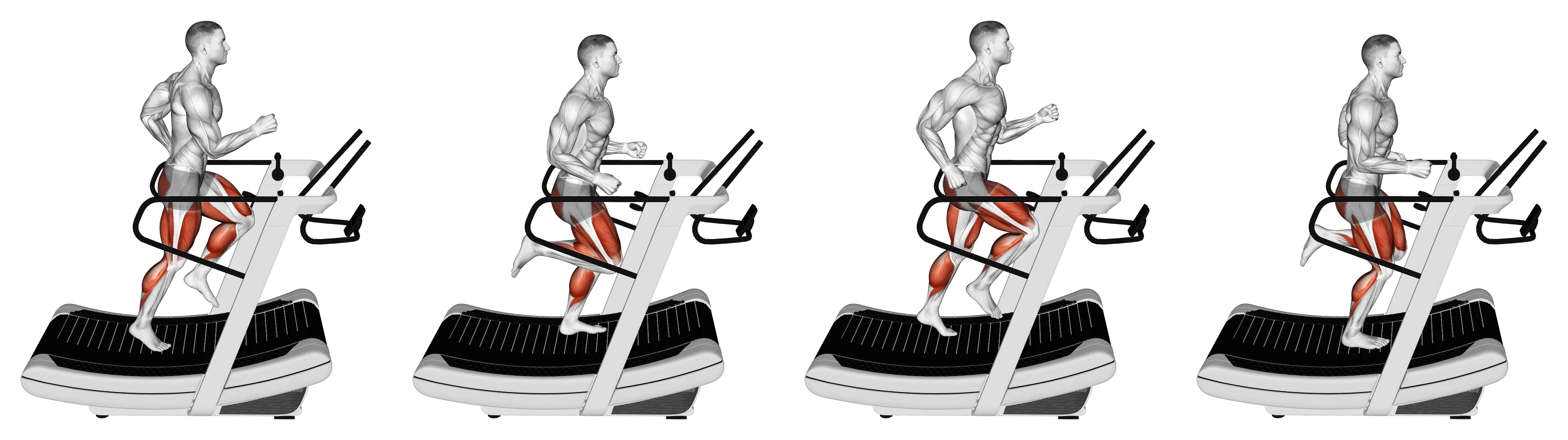
Short stride, foot under the hips, active arms: the foundation of a clean sprint on a curved treadmill.
Technique — Step by Step
- Starting position:
Place your feet on the belt, hip-width apart, knees soft, pelvis neutral. Brace the trunk, keep the shoulders low, and look straight ahead. The arms are bent at around 90°, ready to drive the stride. Breathe in calmly before accelerating. - Driving phase (acceleration):
Gradually increase your cadence until you reach sprint speed. Strike with the midfoot under the center of mass, using short strides and active heel recovery toward the glutes. Push hard backward and downward, with strong arm action driving the rhythm. Exhale through the effort using a 2–2 or 3–2 breathing pattern. - Recovery phase:
Reduce your cadence over a few steps until you return to a slow run or active walk. Keep the chest tall and breathe deeply to recover without collapsing onto the machine. - Target rhythm / range of motion:
Fast strides, no long steps. The foot lands under the hips, impact stays controlled, and the running cycle remains short. Keep the technique clean from the first sprint to the last.
| ❌ Common Mistakes | ✅ Best Practices |
|---|---|
|
|
Method 1%
| Standard HIIT Cardio Peak 1 Block | Explosiveness (RSA)Very short sprints | Tabata 8× 20/10 | |
|---|---|---|---|
| Block | HIIT (Cardio Peak 1) | HIIT (Cardio Peak 1) | Phase 6 – Tabata |
| Work | 30–45 s “hard” | 6–12 s sprints | 20 s max |
| Rest | 30–60 s “easy” | 10–20 s walk | 10 s |
| Rounds | 8–12 | 8–12 sprints | 8 |
| Key cue | Stride quality, stable cadence. | Maximum power, clean technique. | Very dense format, reserved for trained participants. |
Traditional Sessions
| Power (short sprints) | Endurance (cardio block) | Posture / Economy (technical work) | |
|---|---|---|---|
| Sets | 6–8 sprints | 4–6 blocks | 3 blocks |
| Work | 10–15 s | 20–30 s | 30–45 s |
| Rest | 45–60 s | 30–45 s | 30 s |
| Focus | cadence | breathing | technique |
Method 1% Integration
Phase 3 – HIIT (Cardio Peak 1)
Integration Logic
- Place it in the HIIT-Tabata block, after a lower-body strength block or a full-body block.
- Goal: conditioning + transfer from squat/hinge patterns into the running stride.
- Use short sprints to preserve technique: foot under the hips, high cadence, short cycles.
- Adjust density: if technique starts to break down, reduce sprint duration instead of forcing the effort.
Recommended Frequency
- 1 to 2 times per week, depending on lower-body workload and recovery.
- 6-week cycle: progressively add 1 sprint or 2 seconds of work per block.
Coach’s Note
Produce maximum effort from the very first sprint, then learn to reproduce that power under metabolic fatigue.
Oxygen-Driven HIIT – VO₂max
- long blocks (30 s → 4 min)
- submaximal intensity repeated across intervals
- progressive rise in VO₂
- heart-rate limited → cardio-focused
➝ Primarily stimulates the maximal aerobic system.
Metabolic Intermittent HIIT
- repeated short formats (30/30, 40/20 over 8–12 min)
- incomplete recovery, with lactate building block after block
- high cardiovascular load + moderate glycolytic stress
➝ Improves lactate tolerance, active recovery, and mechanical economy.
RSA – Repeated Sprint Ability
- ultra-short max sprints (6–12 s)
- very short rest (10–20 s)
- goal = reproduce maximum power despite fatigue
- adaptation = anaerobic system as the engine, aerobic system as support
➝ Stimulates glycolysis, buffer systems, and lactate clearance.
In RSA, the energy for the first few seconds comes from the muscle’s immediate energy reserves, then the anaerobic pathway takes over.
The aerobic system quickly acts as a support system: it helps you recover between sprints and recycle lactate, allowing you to complete 8 to 12 high-intensity repetitions.
Goal: improve lactate tolerance, the speed of recovery between explosive efforts, and the ability to maintain speed despite metabolic fatigue → a typical adaptation for combat sports.
In this context, aiming for a 9–10/10 perceived effort makes sense, with heart rate progressively rising toward 90–95% of HRmax, despite the very short work duration.
On a curved treadmill, speed comes from technique: foot under the center of mass, high cadence, short cycle.
The goal is to stay explosive when the mechanics become costly.
On a curved treadmill, speed comes from technique. Clean up the stride, and the speed will follow.
Golden rule: foot under the hips, cadence > stride length, controlled breathing.