
Smith Machine Hip Thrust
Category : 🟨 Lower Body – Glutes / Hip Extension
Difficulty : ★★★☆☆ (intermediate to advanced)
Equipment : Smith machine + flat bench + bar pad
Goal
- Develop glute strength and hypertrophy with a horizontal push pattern.
- Reinforce the posterior chain for better transfer to squats, sprints and jumps.
- Improve pelvic stability and hip drive under load while protecting the lower back.
Target Muscles
- Main: Gluteus maximus.
- Synergists: Hamstrings, quadriceps.
- Stabilizers: Lumbar erectors, deep core, upper-back stabilizers.
Variations
- Bodyweight or dumbbell hip thrust as a regression.
- Banded hip thrust (elastic around knees or bar) for constant lateral tension.
- 2–3 s isometric hold at the top to emphasize peak contraction.
- Single-leg hip thrust for unilateral glute strength and hip stability.
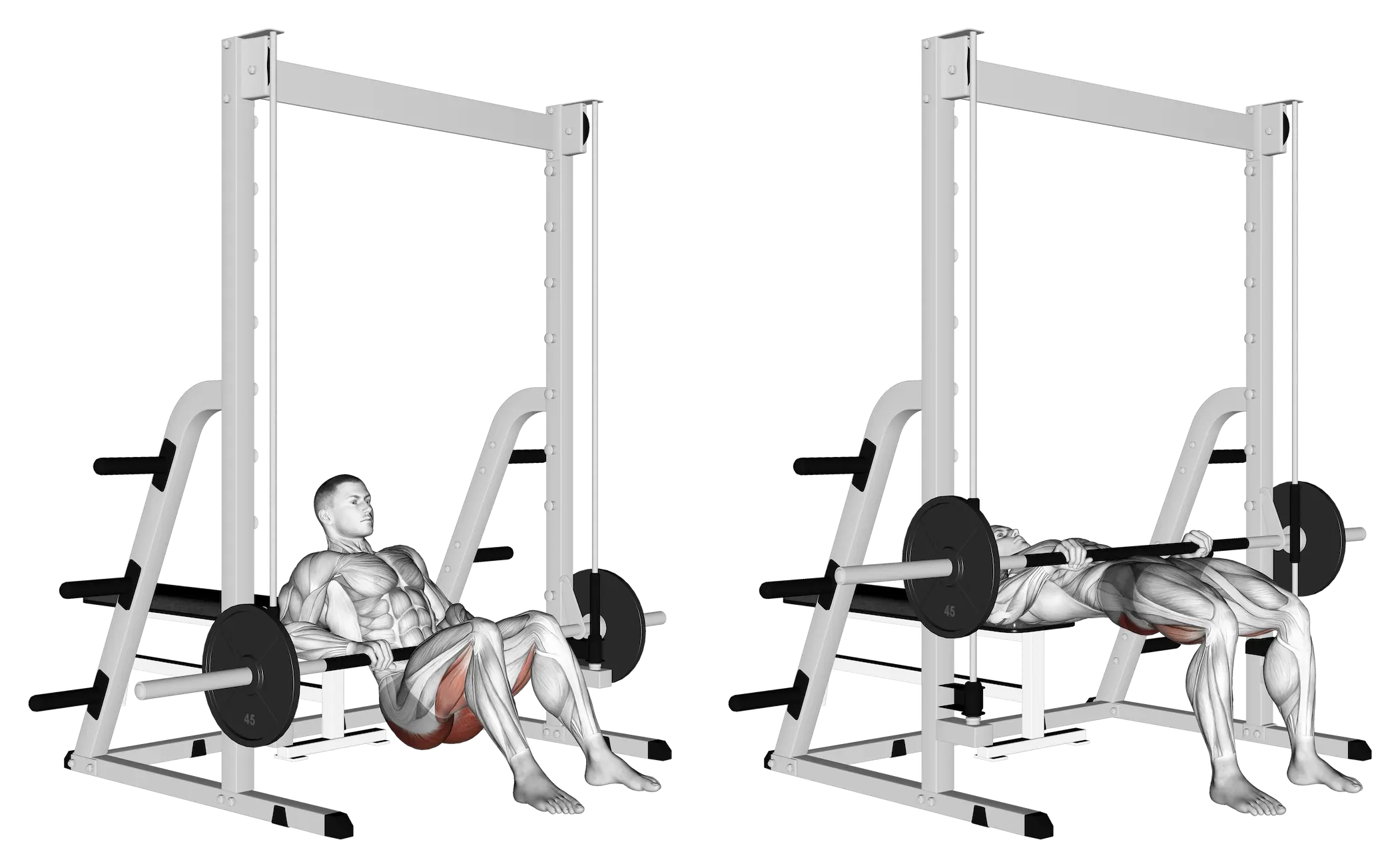
Strong glutes, neutral spine, full lockout — every rep, every set.
Technique — Step by Step
- Starting position:
Place the upper back on a stable bench, shoulder blades close to the edge. Feet flat on the floor, slightly wider than hip-width, toes turned out a few degrees. The Smith bar rests across the hips with a thick pad. Brace the core, keep ribs down and take a breath in. - Concentric (up):
Drive hard through the heels and extend the hips until knees, hips and shoulders form a straight line. Squeeze the glutes as hard as possible at the top for 1–2 seconds without over-arching the lower back. - Eccentric (down):
Inhale and lower the hips in a controlled way until the glutes are just above the floor. Do not relax fully and do not let the bar bounce on the stops. - Tempo / Range target:
2 – 1 – 2 (up – hold – down). Aim for full range with a neutral spine, stable pelvis and shins vertical at the top.
| ❌ Common Mistakes | ✅ Best Practices |
|---|---|
|
|
Training Formats
| Strength (control) (TUT 20–35 s) | Hypertrophy (TUT 40–60 s) | Endurance (TUT 30–40 s) | |
|---|---|---|---|
| Sets | 4 | 4 | 3 |
| Reps | 6 – 8 | 10 – 12 | 15 – 20 |
| Tempo | 2 – 0 – 2 | 2 – 1 – 2 | 1 – 0 – 1 |
| Rest | 90 s | 60 s | 45 s |
1% Method
| PLC Power – Length – Contraction | |
|---|---|
| Goal | Densify the end of the glute block with a calibrated, high-tension set. |
| Structure | 1 “key” set guided by the widget (tempo, range, RPE). |
| Load | From the widget — heavy but technically clean, aiming for RPE 8–9. |
| Intra-set rest | Continuous tempo, with optional micro-pauses at the bottom if form degrades. |
| Frequency | 1–2×/week on the main hip thrust session. |
| Key cue | Drive through the heels, full hip lockout, neutral spine maintained on every rep. |
1% Method Integration
Phase 4 – Muscle Block
Integration Logic
- Use as a key glute strength exercise early in the lower-body session after warm-up and activation.
- Combine with a leg curl or hip abduction machine in super set for full posterior-chain recruitment.
- On strength-focused cycles, place the PLC set at the end of the hip thrust block to concentrate density without extra volume.
Recommended Frequency
- Program the Smith Machine Hip Thrust 1–2×/week depending on total lower-body workload and recovery.
- Aim for 3–6 hard sets per week on this pattern (excluding warm-up sets) for most intermediate clients.
Heels down, hips through, squeeze the glutes — every rep earns its lockout.