
Jump Squat
Category: 🟧 Cardio / Plyometrics – Lower body – Explosiveness
Difficulty: ★★★☆☆ (intermediate)
Equipment: bodyweight only
Goal
- Build leg power and explosiveness (quads and glutes).
- Create an intense cardio spike in HIIT or as a Tabata finisher, with VO₂ max improvement.
- Improve coordination, proprioception and the ability to repeat controlled jumps.
Muscles worked
- Main: quadriceps, gluteus maximus, gluteus medius.
- Synergists: hamstrings, calves (soleus, gastrocnemius).
- Stabilizers: abs, spinal erectors, lumbopelvic stabilizers.
Variations
- Basic version: bodyweight squat without jump, controlled descent, dynamic stand-up without leaving the floor.
- Mini-jump: squat with a small, low-amplitude jump, ideal to learn landing and core bracing.
- Split jump squat: 1 rep = one squat + one jump + a short standing pause before the next rep to keep technique clean.
- Weighted version: jump squat with a weight vest or light load held close to the chest (for experienced lifters only).
- Box jump squat: jump onto a stable, low box, focusing on soft landings.
- Tabata version: jump squat used in a 20/10 × 8 format at the end of the session as an explosive finisher.
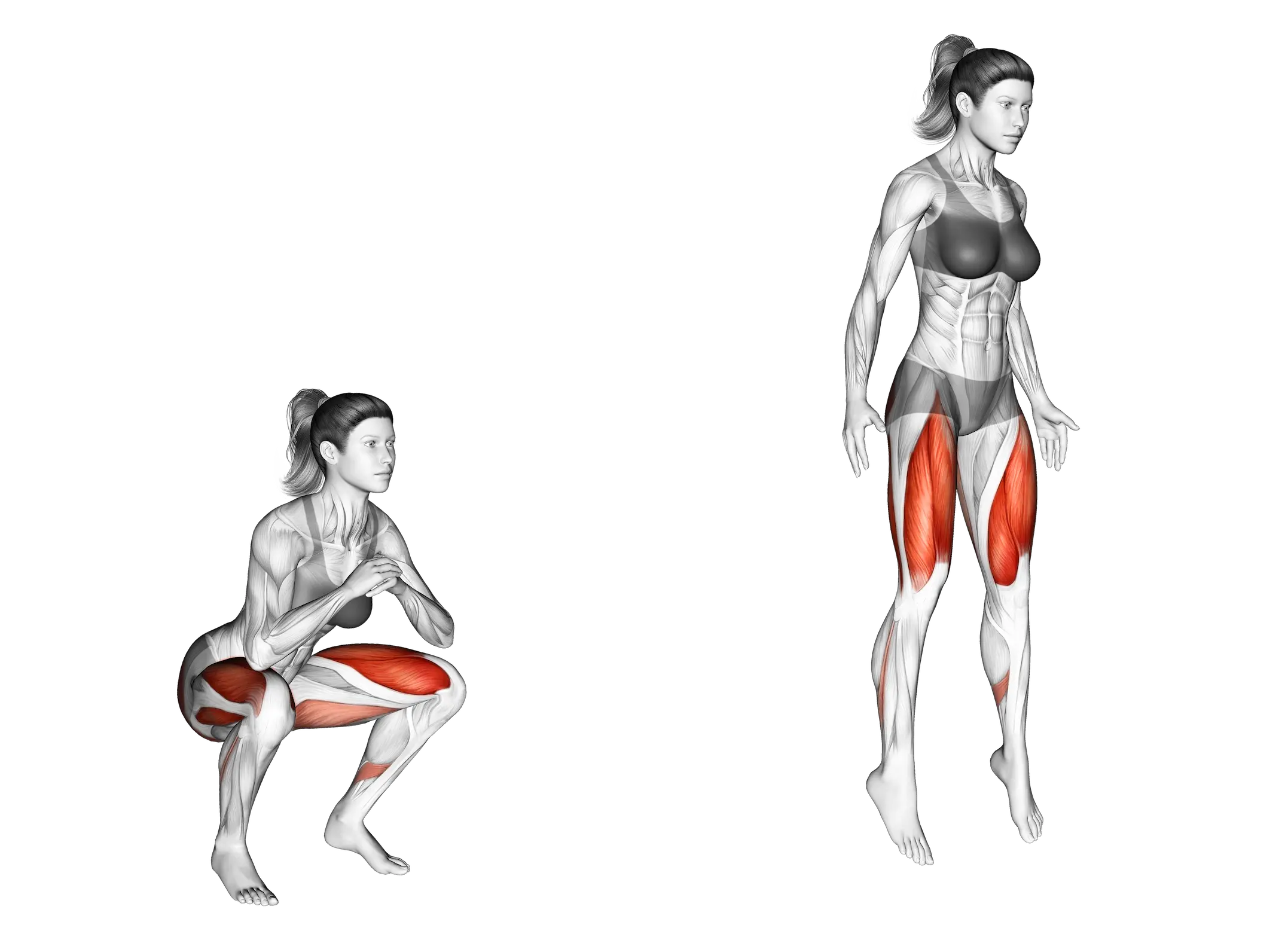
Jump squats are a lower-body power booster: a few well-placed blocks are enough to turn a leg session into a real performance peak.
Technique — Step by step
- Starting position:
Stand tall with your feet shoulder-width apart or slightly wider, toes slightly turned out. Brace your core, keep your chest up, shoulders stacked over hips and eyes looking forward. - Squat descent:
Push your hips back as if you’re sitting down, then bend your knees. Keep your heels on the floor, knees tracking in line with the feet (not caving in). Go down to a comfortable depth (hips roughly at knee height) while keeping a long spine and your weight spread across the whole foot. - Explosive phase:
From the bottom position, drive hard into the floor by extending your hips, knees and ankles quickly. Use your arms to help the jump, as if you wanted to “leave the floor”. The goal is a controlled vertical jump, not maximum height at any cost. - Landing and rhythm:
Land on the mid-forefoot then place your heels down, with knees slightly bent to absorb the impact. Knees stay aligned, chest doesn’t collapse forward. In HIIT, keep a smooth rhythm: breathe in on the way down, breathe out on the jump.
| ❌ Common mistakes | ✅ Best practices |
|---|---|
|
|
Typical formats
| HIIT (Cardio Peak block) | Tabata (Explosive finisher) | |
|---|---|---|
| Work time | 20–40 s | 20 s |
| Rest | 20–40 s | 10 s |
| Number of rounds | 6–10 rounds depending on level | 8 rounds |
| Target intensity | RPE 7–9, able to keep powerful, controlled jumps | RPE 8–9, clean landings all the way to the last round |
1% Method
| HIIT Cardio Peak 1 | Final Tabata Cardio Peak 2 | |
|---|---|---|
| Goal | Create a controlled cardio peak with a lower-body plyometric movement. | Short but very intense finisher to end the leg session on a strong endorphin high. |
| Structure | Block of 20–40 s work / 20–40 s rest. | Fixed 20 s work / 10 s rest × 8 rounds. |
| Placement | Phase 3 – Cardio Peak 1, after warm-up and neuromuscular pre-activation. | Phase 6 – Cardio Peak 2, at the end of a leg or full-body session. |
| Load | Bodyweight, range adapted to hip mobility and landing quality. | Bodyweight, reduce range of motion if technique starts to break down. |
| Frequency | 1–2×/week in explosive lower-body or full-body sessions. | 1×/week max at the end of a leg or cardio block. |
| Main cue | Go for power on the jump, but knees aligned and quiet landing come first. | Stay explosive but clean until the last round, even if you have to jump a bit lower. |
“1% Method” integration
HIIT – Cardio Peak 1 (5 min)
Tabata – Cardio Peak 2 (4 min)
Phase 2 – Neuro-connection (3–4 min)
Goal: prepare the neuromuscular system for the full jump squat by securing squat path and landing.
Level 1 – Controlled squat (no jump)
- “Drop into a controlled full squat, stand back up dynamically without leaving the floor.”
- “Keep knees in line with toes, heels on the floor, long braced torso.”
- “Look for a smooth path: hips go back first, then knees bend with no jerky shifts.”
Level 2 – Squat + mini-jump
- “Add a small, low-amplitude jump as you come out of the squat, like a controlled rebound.”
- “Land softly with slightly bent knees, then shake the tension out for a few seconds before the next rep.”
Level 3 – Linked jumps with short pause
- “Chain 2 to 3 jump squats in a row with a short standing pause between mini-sets to keep technique clean.”
- “Focus on quiet landings and stable knees, even as the pace picks up.”
Level 4 – Full range and arm swing
- “Finish each rep with a clear vertical jump, arms driving overhead to support the impulse.”
- “This block is still neural prep: you’re chasing movement precision, not max breathlessness yet.”
Goal: hit the HIIT block with an automatic squat pattern, stable knees and controlled landings.
Phase 3 – Cardio Peak 1 – HIIT (5 min)
Goal: create a controlled cardio peak with powerful but technically clean jump squats.
Coaching cues to go further:
- “Control the bottom, explode at the top: take time to set your squat, then drive hard on the jump.”
- “Keep a steady pace for the whole interval rather than going all out for the first 10 seconds.”
- “On every landing, think ‘knees out’ and ‘quiet landing’. If you’re slamming into the floor, lower the jump height a bit.”
- “If technique starts to break, switch back for a while to the mini-jump version while keeping the HIIT tempo.”
- “Aim for RPE 7–9: very out of breath, but still able to keep clean jumps every round.”
Phase 6 – Final Tabata (4 min – 20/10 × 8)
Goal: explosive finisher to end the leg session on a peak of cardio and endorphins.
Advanced cues:
- “On every 20-second block, aim for the same rep count from start to finish: consistency beats a one-off record.”
- “When fatigue kicks in, lower the jump height before you sacrifice knee-to-foot alignment.”
- “Use your arms to keep rhythm and coordination, without pulling your chest forward.”
- “Keep your breathing rhythmic: inhale on the way down, exhale on the jump, no breath-holding.”
Recommended frequency
- Use 1 to 2 times per week as an intense cardio block (HIIT or Tabata) to limit total plyometric load.
- Avoid programming heavy or very deep jump squats the day before or after other highly explosive sessions (jumps, sprints, heavy plyometrics).
- Jump squats combine well with blocks of controlled strength work (squats, hip thrusts, leg press) and core training to balance stress on knees and lower back.
Placed at the right moment, jump squats turn a simple lower-body block into power, cardio and mental toughness work all at once.