
Smith Machine Incline Bench Press
Category : 🟧 Push – Diagonal / Upper chest
Difficulty : ★★☆☆☆ (intermediate)
Equipment : Smith machine + incline bench (30–45°)
Goal
- Shift the focus toward the upper chest while keeping the bar path guided and safe.
- Develop pressing strength and hypertrophy for the pectorals, anterior delts and triceps.
- Allow lifters to push volume with less balance demand than a free barbell incline press.
Target Muscles
- Main: Upper fibers of the pectoralis major (clavicular portion).
- Synergists: Anterior deltoids, triceps brachii.
- Stabilizers: Trapezius, scapular stabilizers, core and glutes maintaining bench contact.
Variations
- Slight incline (~30°) for more chest and less shoulder involvement.
- Higher incline (~45°) to recruit more anterior deltoid (use lighter load).
- Close-grip to emphasize triceps contribution.
- 1–2 s pause on the chest line to improve control and starting strength.
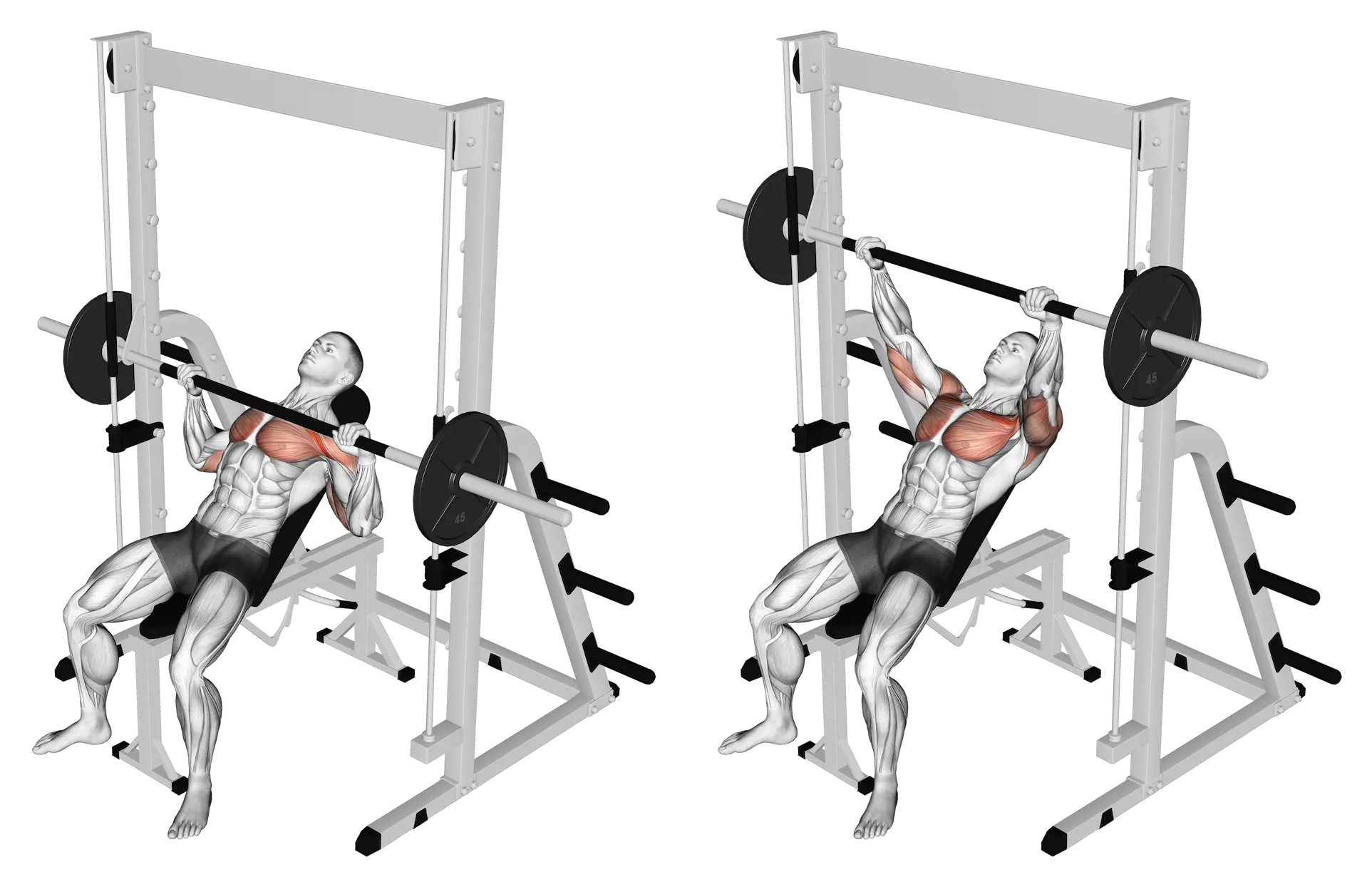
Set the bench, lock the shoulders, drive the bar straight up through the upper chest.
Technique — Step by Step
- Starting position:
Set the bench at 30–45° under the Smith bar. Lie back with eyes roughly under the bar. Feet flat, glutes and upper back anchored to the bench. Grip the bar slightly wider than shoulder width, wrists stacked above elbows. Retract and depress the shoulder blades before unhooking the bar. - Eccentric (down):
Inhale and lower the bar in a controlled path toward the upper chest/clavicle line. Keep elbows at roughly 30–45° from the torso, forearms vertical. Stop just above chest contact, no bounce. - Concentric (up):
Drive the bar straight up along the rails while pushing the feet into the floor. Exhale and actively squeeze the chest at the top, without forcefully locking the elbows. - Tempo / Range target:
2–3 s down, brief control at the bottom, then a smooth but powerful 1–2 s press. Maintain a natural arch, glutes in contact with the bench and tension in the chest at all times.
| ❌ Common Mistakes | ✅ Best Practices |
|---|---|
|
|
Training Formats
| Strength (TUT 15–25 s) | Hypertrophy (TUT 35–60 s) | Strength endurance (TUT 30–40 s) | |
|---|---|---|---|
| Sets | 4 | 4 | 3 |
| Reps | 5–7 | 8–12 | 15–20 |
| Tempo | 2–0–1 | 2–1–2 | 1–0–1 |
| Rest | 90 s | 60 s | 45 s |
1% Method
| PLC Power – Length – Contraction | |
|---|---|
| Goal | Densify the main upper-chest block with a calibrated, high-quality top set. |
| Structure | 1 key PLC set after your last work set, using the widget to fix tempo and range. |
| Load | Load from the widget (tempo/range) aiming for RPE 8–9 with clean technique. |
| Intra-set rest | Continuous tension; only strategic micro-pauses at lockout if form starts to drift. |
| Frequency | 1×/week on this exercise or rotated with another main chest press. |
| Key cue | Same bar path every rep, stable scapulae, full-body tension from feet to upper back. |
1% Method Integration
Phase 4 – Muscle Block
Integration Logic
- Use as a main or secondary upper-body push block after warm-up or after flat bench work.
- Pair in agonist/antagonist supersets with a horizontal or vertical row, or with an incline fly variation.
- Integrate PLC once per week on this lift to drive progression in load and tempo while protecting technique.
Recommended Frequency
- Program the Smith Machine Incline Bench Press 1–2×/week depending on total chest and shoulder workload.
- Aim for 3–6 hard sets per week on this pattern for most intermediate clients, balancing with horizontal press and pulling work.
Coach’s Note
On the incline bench, a slightly deeper range of motion than the flat bench is not only normal — it’s often what allows the upper chest to actually work.
The angle of the bench puts the shoulder in a position where going below 90° of elbow flexion is usually safe, as long as the upper arm doesn’t drift behind the line of the torso.
The most common mistake is benching like on a flat bench: elbows flared out and the bar drifting toward the head. That instantly shifts the load to the front delt and puts the shoulder in a vulnerable position.
Stick to the key principles:
- bring the bar toward the upper-chest line,
- keep the elbows around 45° from the torso,
- use a full but comfortable depth,
- stop the rep if the humeral head starts to glide forward.
When executed properly, the incline press becomes a top-tier builder for the upper chest and a great way to reinforce scapular stability.
Rushed, uncontrolled reps turn it into a half–shoulder press that punishes the shoulders instead of building the pecs.
Bench angle right, shoulders locked, bar path fixed — every rep builds the upper chest, not just the ego.