
Alternating Jumping Lunges
Category: 🟨 Lower body – Lunges / Plyometrics
Difficulty: ★★★☆☆ (intermediate to advanced)
Equipment: Bodyweight only, training shoes, stable surface
Goal
- Develop lower-body power and explosiveness (quads, glutes, hamstrings).
- Quickly raise heart rate in a HIIT or Tabata block.
- Improve coordination, balance and joint control in dynamic movement.
Target muscles
- Primary: Quadriceps, glutes, hamstrings.
- Synergists: Calves, hip flexors.
- Stabilizers: Abs, lower back, gluteus medius, shoulder girdle.
Variations
- Basic version: alternating lunges without the jump for beginners or as part of a warm-up.
- “Power” version: slightly increase jump height while keeping a controlled landing.
- Regressed version: one hand on a support (wall, bar) to secure balance.
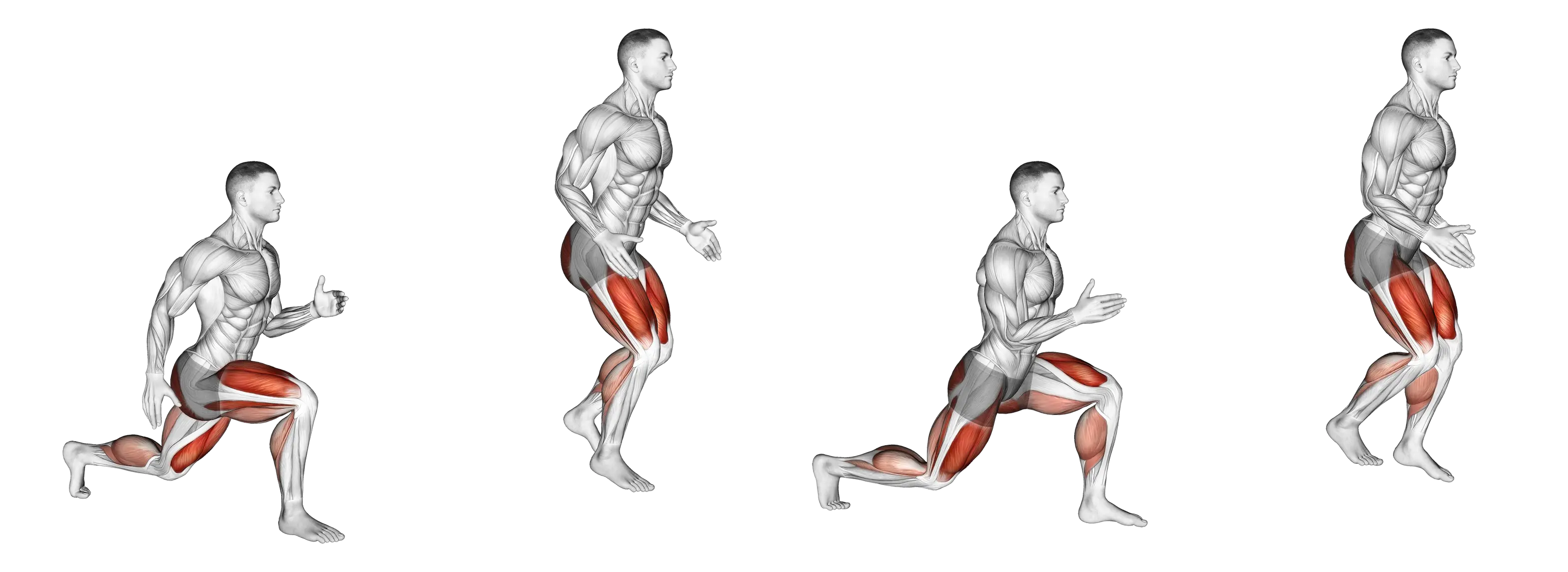
Jumping Lunges are a HIIT classic: an explosive move that burns your legs, spikes your heart rate and builds motor control with every landing.
Technique — Step by step
- Start position:
Set up in a long lunge, one foot in front, one behind, front knee bent around 90°, back knee pointing toward the floor without touching it.
Keep your core braced, torso slightly leaning forward but without rounding your back. Look about 2 m in front of you to help balance. Hands can stay close to the hips or move naturally like in running. - Jump phase (transition):
From the bottom position, push explosively through the floor with your front leg as if you want to grow tall toward the ceiling.
Use the airtime to switch leg positions: back leg comes forward, front leg goes back. Keep the core stable, avoid “diving” your chest forward. - Controlled landing:
Land by absorbing the impact with a bend at the knees and hips, aiming for a roughly 90° angle at the front knee again.
The front knee stays above the mid-foot, not far past the toes. Keep your shoulders stacked over your hips and the back foot on the ball of the foot to keep mobility. - Target rhythm / range:
Prioritize a quiet, controlled landing before chasing jump height. Start with a moderate range of motion, then build it up as you control the path better.
In HIIT: aim for 30–45 s of continuous work with clean technique before increasing duration or height.
| ❌ Common mistakes | ✅ Best practices |
|---|---|
|
|
Typical formats
| Short HIIT (Cardio Peak block) | Tabata (Explosive finisher) | |
|---|---|---|
| Work time | 30 – 45 s | 20 s |
| Rest | 20 – 45 s | 10 s |
| Number of cycles | 6 – 10 cycles depending on level | 8 cycles |
| Target intensity | RPE 7 – 9, technique always under control | RPE 8 – 9, keep landings clean all the way through |
1% Method
| Short HIIT Cardio Peak 1 | Final Tabata Cardio Peak 2 | |
|---|---|---|
| Goal | Create a controlled cardio peak with explosive leg work | Short but very intense finisher to boost endorphins |
| Structure | 30–45 s work / 20–45 s rest block | Fixed 20 s work / 10 s rest × 8 cycles |
| Placement | Phase 3 – Cardio Peak 1, after warm-up and pre-activation | Phase 6 – Cardio Peak 2, at the end of the session |
| Load | Bodyweight, range adjusted to joint control | Bodyweight, reduce range if technique breaks down |
| Frequency | 1–2×/week in lower body / full-body sessions | 1×/week max at the end of leg or full-body blocks |
| Key cue | Landing quality first, intensity second | Stay explosive but clean up to the last cycle |
1% Method Integration
HIIT – Cardio Peak 1 (5 min)
Tabata – Cardio Peak 1 (4 min)
Phase 2 – Neuro-Connection (3–4 min)
Goal: activate the neuromuscular system and build the movement progressively.
Level 1 – Controlled setup (no impact)
- “Step back into a lunge, come up, switch legs. Stay on the floor.”
- “Imagine you’re going down in a vertical elevator — your knee doesn’t drive forward or diagonally.”
- “Keep your chest up, eyes fixed about 2 meters in front of you.”
Level 2 – Smooth rhythm and coordination
- “Slightly pick up the pace without losing form.”
- “Let your arms move like in running to help you stabilize.”
Level 3 – Small prep bounce
- “Add a small neutral jump, just enough to shift your weight from one leg to the other.”
- “Stay light on your feet: silent landing.”
Level 4 – Build-up to cardio peak (pre-Jumping Lunges)
- “Use your arms to create a vertical drive.”
- “No need for max power here: this is neural prep, not the ‘real effort’ yet.”
Goal: Dial in technique before the HIIT block, without excessive fatigue.
Phase 3 – Cardio Peak 1 – HIIT (5 min)
Goal: create a controlled cardio peak with a clean explosive movement.
Coaching cues to push further:
- “Land light, fly strong: soft landing, sharp take-off.”
- “Keep a consistent jump height: no random jumps.”
- “Use your arms: drive down / lift up to generate power.”
- “If form breaks down: reduce height, not quality.”
- “Aim for RPE 7–9 depending on the cycle: explosive but clean.”
Phase 6 – Final Tabata (4 min – 20/10 × 8)
Goal: short, dense, explosive finisher, still under control.
Advanced cues:
- “Give your best for 20 seconds, but keep landings clean up to the last cycle.”
- “Slightly shorten the range if fatigue makes you lose balance.”
- “Keep arm drive to hold the rhythm.”
- “Stay explosive but efficient: every rep should look like the first one.”
Recommended frequency
- Use 1–2 times per week depending on the total plyometric volume in the cycle.
- Do not place it before heavy or slow lifts (squats, hip thrust, RDL) if you want to keep a strong neuromuscular contrast.
- Alternate blocks: one session in short HIIT format (Phase 3), another in Tabata format (Phase 6) to vary stress without overloading the joints.
This exercise pairs perfectly with upper-body push / pull movements to keep overall balance in your program.