
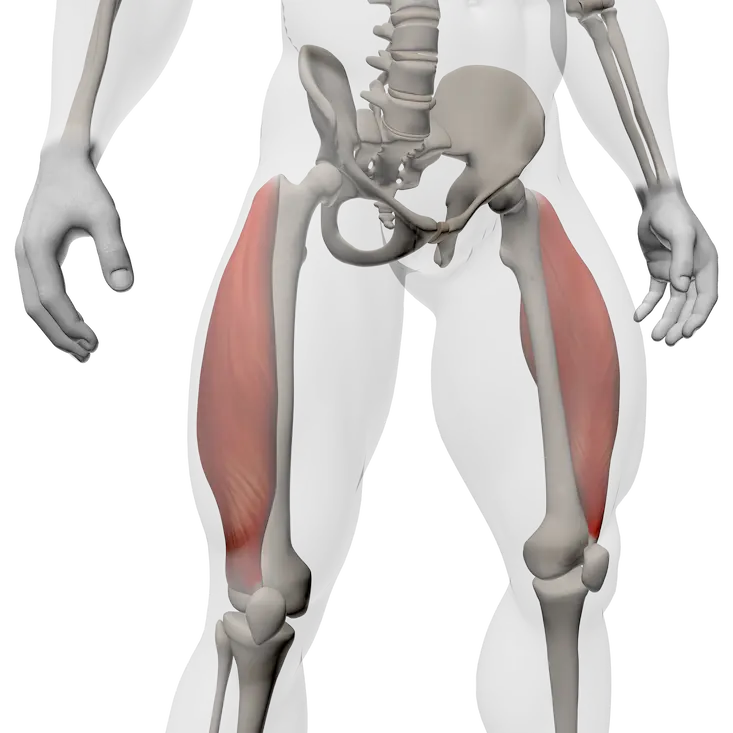
Vastus Lateralis
Scientific name:
Vastus lateralis
Location:
Muscle located on the outer side of the front thigh, forming part of the quadriceps group.
Overall role:
Provides powerful and stable knee extension, with a major role in lateral patellar stability.
Sports where this muscle is a key :
- Running / sprinting
- Team sports (football, rugby, handball)
- Jumping sports (basketball, athletics)
- Cycling
- Combat sports
Origin
- Lateral surface of the greater trochanter of the femur
- Linea aspera of the femur (outer edge)
Insertion
- Lateral border of the patella via the quadriceps tendon
- Tibial tuberosity through the patellar ligament
Innervation
- Femoral nerve (roots L2–L4)
(nerve responsible for knee extension and anterior thigh control)
Key points to remember
- Mono-articular muscle (acts only on the knee)
- Largest and most powerful of the vasti
- Direct influence on lateral patellar tracking
- Highly loaded during push-off, braking, and landing phases
Main actions
- Knee extension
Synergists (muscles working with it)
- Vastus medialis
- Vastus intermedius
- Rectus femoris
- Gluteus maximus (push-off chain)
Antagonists (muscles with opposite action)
- Hamstrings (knee flexion)
Postural / stabilizing role
- Lateral knee stabilization
- Helps maintain proper hip–knee–ankle alignment during weight-bearing tasks
The vastus lateralis is a force-producing and control muscle.
It plays a key role during propulsion, deceleration, and landing.
Practical coaching interpretations:
- Weak → lateral knee instability
- Over-dominant → lateral pull on the patella
- Reduced range of motion → compensation by vastus medialis or rectus femoris
Activation test (bodyweight / light load)
- Goal: assess vastus lateralis activation without hip compensation.
- Setup:
- Partial squat, feet hip-width apart.
- Slight external foot rotation.
- What to observe:
- Tension felt on the outer thigh.
- Knees remain stable, no inward collapse.
- Interpretation:
- ➡️ Knee drifting inward → insufficient activation.
- ➡️ Central thigh sensation only → under-recruitment of vastus lateralis.
Weakness test (light to moderate load)
- Goal: identify loss of control during knee extension.
- Setup:
- Leg press or single-leg squat.
- Moderate load, slow tempo (≈ 3–1–2).
- What to observe:
- Stable knee alignment.
- Controlled descent and push-off.
- Interpretation:
- ➡️ Lateral instability → vastus lateralis weakness.
- ➡️ Speed increase at lockout → control deficit.
Dominance / compensation test
- Goal: detect excessive vastus lateralis dominance.
- Setup:
- Bilateral squat, then single-leg squat.
- What to observe:
- Patellar tracking during movement.
- Interpretation:
- ➡️ Visible lateral patellar pull → vastus lateralis dominance.
- ➡️ Anterior knee pain → imbalance between vastus lateralis and vastus medialis.
- Simple correction:
- Reduce range of motion.
- Emphasize slow tempo.
- Prioritize controlled unilateral work.
Activation / isolation
- Partial-range leg extension
- Low squat isometric holds
Functional / multi-joint
- Controlled squats
- Forward lunges
- Step-ups
Useful variations
- Slow unilateral work
- Targeted partial ranges
Typical imbalances
- Vastus lateralis dominance over vastus medialis
- Poor lateral knee control
Related risks / pain
- Anterior or lateral knee pain
- Patellar discomfort during effort
Warning signs
- Tightness on the outer side of the knee
- Instability during landings
- Pain when descending stairs
- Heavy loading without knee alignment control
- Deep squats with unstable knees
- Prioritizing load over stability
- Compensation through the hip or ankle
- Fully aligned with the FR version
- Clear functional complement to rectus femoris
- Coaching-oriented, non-academic
- Ready for EN / NL / TH ecosystem consistency
Vaste latéral
Nom scientifique :
Vastus lateralis
Localisation simple :
Muscle situé sur le côté externe de l’avant de la cuisse, faisant partie du quadriceps.
Rôle global :
Assure une extension puissante et stable du genou, avec un rôle majeur dans la stabilité latérale de la rotule.
Sports où ce muscle est déterminant :
- Course à pied / sprint
- Sports collectifs (football, rugby, handball)
- Sports de saut (basket, athlétisme)
- Cyclisme
- Sports de combat
Origine
- Face latérale du grand trochanter du fémur
- Ligne âpre du fémur (bord externe)
Insertion
- Bord latéral de la rotule via le tendon quadricipital
- Tubérosité tibiale par le ligament patellaire
Innervation
- Nerf fémoral (racines L2–L4)
(nerf responsable de l’extension du genou et du contrôle antérieur de la cuisse)
Particularités à retenir
- Muscle mono-articulaire (agit uniquement sur le genou)
- Plus grand et plus puissant des vastes
- Influence directe le tracking rotulien latéral
- Très sollicité en charge et en réception
Actions principales
- Extension du genou
Synergies (muscles qui travaillent ensemble)
- Vaste médial
- Vaste intermédiaire
- Rectus femoris
- Grand fessier (chaîne de poussée)
Antagonistes (muscles opposés)
- Ischio-jambiers (flexion du genou)
Rôle postural / stabilisation
- Stabilisation latérale du genou
- Contribution à l’alignement hanche–genou–cheville en appui
Le vaste latéral est un muscle de force et de contrôle.
Il intervient fortement lors des phases de poussée, de freinage et de réception.
Formulations pratiques type coaching :
- Faible → instabilité latérale du genou
- Trop dominant → traction latérale sur la rotule
- Amplitude réduite → compensation par le vaste médial ou le rectus femoris
Test d’activation (poids du corps / charge légère)
- Objectif : vérifier l’activation du vaste latéral sans compensation de hanche.
- Mise en place :
- Squat partiel, pieds largeur bassin.
- Légère rotation externe des pieds.
- À observer :
- Tension ressentie sur le côté externe de la cuisse.
- Genoux stables, sans effondrement.
- Interprétation :
- ➡️ Genou qui part vers l’intérieur → activation insuffisante.
- ➡️ Sensation uniquement centrale → vaste latéral sous-recruté.
Test de faiblesse (charge légère à modérée)
- Objectif : détecter une perte de contrôle en extension.
- Mise en place :
- Leg press ou squat unilatéral.
- Charge modérée, tempo lent (≈ 3–1–2).
- À observer :
- Axe genou stable.
- Descente contrôlée.
- Interprétation :
- ➡️ Instabilité latérale → faiblesse du vaste latéral.
- ➡️ Accélération en fin de poussée → déficit de contrôle.
Test de dominance / compensation
- Objectif : identifier une dominance excessive du vaste latéral.
- Mise en place :
- Squat bilatéral puis unilatéral.
- À observer :
- Trajectoire de la rotule.
- Interprétation :
- ➡️ Traction latérale visible → vaste latéral trop dominant.
- ➡️ Douleur antérieure → déséquilibre vaste latéral / vaste médial.
- Correction simple :
- Réduire l’amplitude.
- Accentuer le tempo lent.
- Travailler l’unilatéral contrôlé.
Activation / isolation
- Leg extension angle partiel
- Squat isométrique bas
Fonctionnels / multi-articulaires
- Squat contrôlé
- Fente avant
- Step-up
Variations utiles
- Travail unilatéral lent
- Amplitudes partielles ciblées
Déséquilibres typiques
- Dominance du vaste latéral sur le vaste médial
- Manque de contrôle latéral du genou
Risques / douleurs associées
- Douleurs antérieures ou latérales du genou
- Inconfort rotulien à l’effort
Symptômes / signes à surveiller
- Sensation de tiraillement sur le côté du genou
- Instabilité lors des réceptions
- Douleur lors des descentes d’escaliers
- Charges lourdes sans contrôle de l’axe du genou
- Squats profonds avec genoux instables
- Recherche de charge avant la stabilité
- Compensations par la hanche ou la cheville
- Flexions–extensions de genou contrôlées en charge légère
- Mobilité de cheville pour améliorer l’alignement
- Marche consciente avec attention sur l’axe jambe–genou–hanche