
Straight-Arm Dumbbell Fly (Flat Bench)
Category : 🟧 Push – Chest Isolation
Difficulty : ★★☆☆☆ (intermediate)
Equipment : Flat bench + 2 light dumbbells
Goal
- Purely isolate the pectorals with a long lever, keeping tension in the stretched position.
- Develop motor control and shoulder stability under a slow, controlled stretch.
- Use as a finisher or control drill after heavier press work.
Target Muscles
- Main: Pectoralis major (mainly sternal portion).
- Synergists: Anterior deltoids, biceps (stabilisation role).
- Stabilizers: Deep shoulder stabilisers, scapular muscles, trunk bracing.
Variations
- Regression: Bent-elbow dumbbell fly (shorter lever, more shoulder-friendly).
- Cable version: Straight-arm fly on cable crossover (more constant tension).
- Incline option: Straight-arm fly on an incline bench to emphasise upper chest.
- Continuous mode: Do not let the dumbbells relax at the top; keep light tension throughout the range.
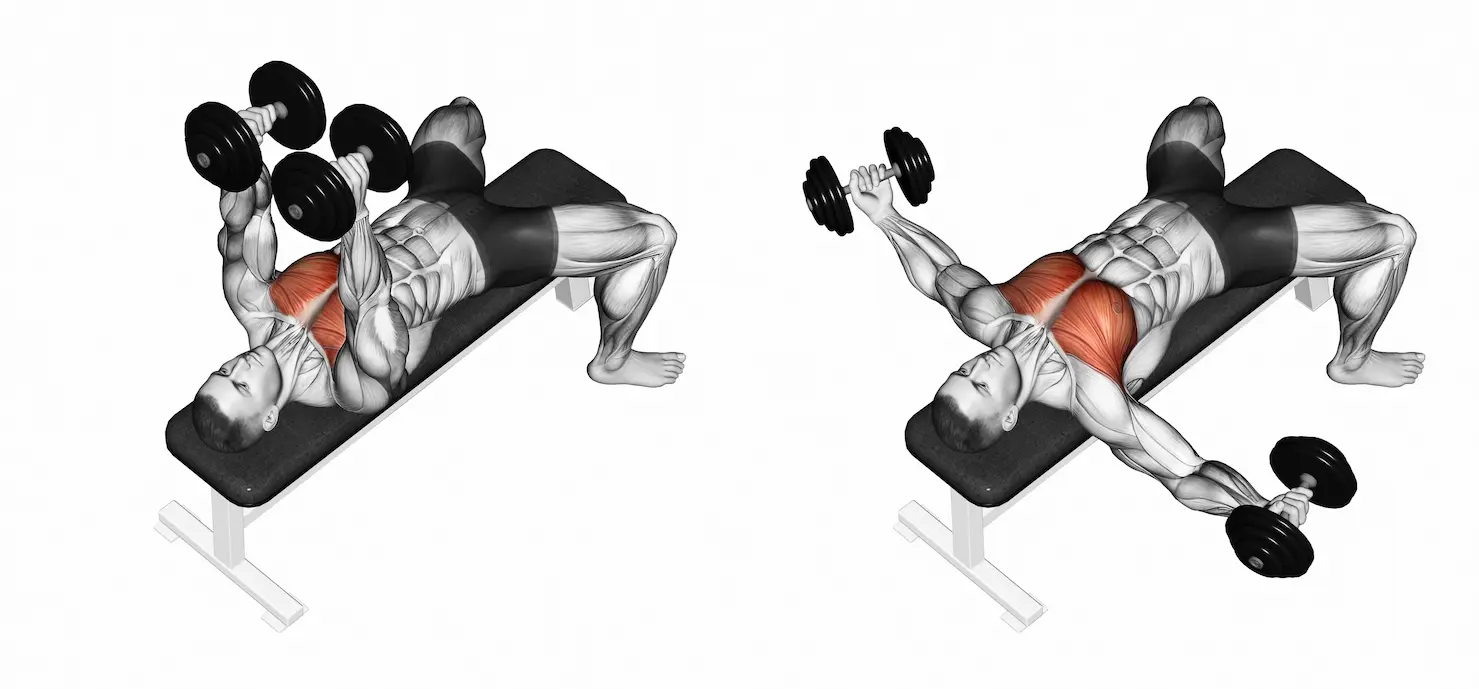
Long lever, light load, slow stretch — chest working, shoulders protected.
Technique — Step by Step
- Starting position:
Lie on a flat bench, feet planted and low back supported. Hold one dumbbell in each hand, arms almost straight above the chest, palms facing each other. Keep a soft bend in the elbows (~5–10°), shoulders down and scapulae set on the bench. - Eccentric (down):
Inhale and lower the dumbbells in a wide arc, opening the chest until they reach about shoulder height. Do not let the hands drop below bench level. Control the descent over 3–4 seconds, feeling a stretch across the chest, not a pinch in the front of the shoulder. - Concentric (up):
Exhale and bring the arms back above the chest over 1–2 seconds, keeping the same elbow angle. Imagine crushing a big ball over your chest. Do not slam the dumbbells together; keep the line smooth. - Tempo / Range target:
Use a tempo of 3 – 1 – 2 (down – short pause – up) for hypertrophy, with a moderate range: stop when the stretch is strong but still comfortable, always staying slightly above bench level.
| ❌ Common Mistakes | ✅ Best Practices |
|---|---|
|
|
Training Formats
| Hypertrophy (slow stretch focus) | Mobility / Control (very light, technical) | |
|---|---|---|
| Sets | 3 – 4 | 2 |
| Reps | 12 – 15 | 15 – 20 |
| Tempo | 3 – 1 – 2 | 4 – 0 – 2 |
| Rest | 45 s | 30 s |
1% Method
| Set of 100 Density / Pump Finisher | |
|---|---|
| Goal | Local chest endurance and massive pump at the end of the session. |
| Structure | 100 total reps in mini-blocks (e.g., 10×10 or 5×20) with strict tempo. |
| Load | Very light load, technique and range of motion never compromised. |
| Intra-set rest | 10–20 s between mini-blocks while keeping shoulders relaxed. |
| Frequency | Max. 1×/week per chest session, at the very end of the push block. |
| Key cue | Stay above bench line, soft elbows, feel the stretch and squeeze—not joint pain. |
1% Method Integration
Phase 4 – Muscle Block
Integration Logic
- After main press work: place the straight-arm fly after heavy or moderate bench press for targeted chest fatigue with lighter joint stress.
- Control block: use the “Mobility / Control” format on lighter days to reinforce shoulder stability and scapular control.
- Set of 100 finisher: reserve this for well-trained clients who tolerate volume, always with very light dumbbells.
- Agonist / antagonist balance: pair the fly block with horizontal rowing in the same cycle to keep shoulders healthy.
Recommended Frequency
- Use the straight-arm dumbbell fly 1–2×/week depending on total chest volume and shoulder tolerance.
- Limit the Set of 100 version to once per week per chest programme to avoid excessive tendon stress.
Coach’s Note
The dumbbell fly with straight arms is not a strength movement — it’s a long-lever stretch-tension exercise.
That’s exactly why it works… and exactly why it becomes risky when athletes go too heavy.
The limiting factor is never the pec itself. It’s the front of the shoulder: long head of the biceps, anterior capsule, and sometimes the supraspinatus.
Even with good form, a heavy load places more stress on the shoulder than on the chest.
✔ Keep the load light — always. This exercise only works when every centimeter is under control.
✔ Use a moderate range of motion. Stopping at bench level protects the rotator cuff.
✔ Maintain a soft bend in the elbows. Never lock out the arms; the slight flexion absorbs the stress.
✔ The goal isn’t to lift heavier or drop deeper, but to feel the pecs stretch without pulling on the front of the shoulder.
For “100-rep” protocols, the aim is blood flow, control, and clean mechanics, not performance.
If you lose the arc, shake, or start compensating, the load is already too heavy.
Stay above bench level, breathe into the stretch, and let the chest — not the ego — lead the load.