
Box Jump (Plyometric Box Jump)
Category : 🟧 Cardio / Plyometrics – Lower body – Coordination
Difficulty : ★★★☆☆ (intermediate)
Equipment : Stable plyometric box or step, sports shoes, non-slippery surface
Goal
- Develop explosive leg power and triple extension (hips, knees, ankles).
- Improve neuromuscular reactivity and coordination in vertical jump patterns.
- Challenge the cardiovascular system in HIIT, Tabata or explosive conditioning circuits.
Muscles worked
- Main movers: Quadriceps, gluteus maximus and medius, calves (gastrocnemius, soleus).
- Synergists: Hamstrings, adductors, hip flexors.
- Stabilisers: Deep core (transverse abdominis), spinal erectors, shoulder stabilisers for arm swing and balance.
Variations
- Easier – step-up on box : step one foot at a time onto the box, stand tall, then step down without jumping.
- Easier – low box : use a low step (around knee height or lower) to reduce impact and fear of the jump.
- Easier – technique sets : 3–4 sets of 8–10 controlled reps with focus on quiet landings and posture.
- Harder – higher box or light load : slightly increase box height or use light external load (e.g. weight vest) while keeping clean technique.
- Harder – rebound version : step down quickly and immediately preload into the next jump (advanced athletes only).
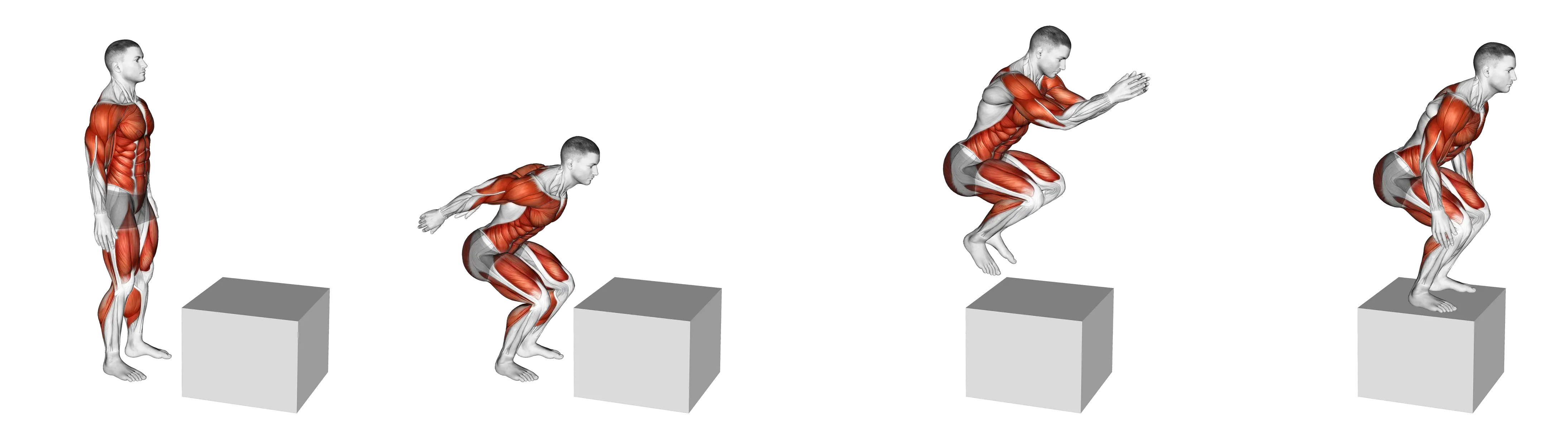
Box jumps are a key plyometric drill to build vertical power, sharp reactivity and cardio in the same explosive sequence.
Technique — Step by step
- Start position
Stand facing a stable box, feet shoulder-width apart. The box height should feel challenging but safe (around knee height for most athletes). Brace the core, keep the chest lifted and look at the front edge or top of the box. - Preload and arm swing
Hinge slightly at the hips and bend the knees, sending the hips back like in a half squat. Swing the arms behind you to preload the movement, keeping the heels in contact with the floor and the spine long. - Take-off and flight
Drive the arms forwards and up while you push hard through the floor, extending hips, knees and ankles in one explosive motion. Jump just high enough to land safely on the box – no need to search for maximum height every rep. - Landing on the box
Land softly on the balls of the feet then allow the heels to load, knees bent and tracking in line with the toes. The trunk stays slightly forward but strong, without collapsing. Stand up fully on the box to lock the rep. - Return and rhythm
Step down one foot at a time to the floor instead of jumping off. Reset your stance, breathe, then preload for the next repetition. Keep a consistent rhythm across the set, stopping if you lose confidence, posture or landing control.
| ❌ Common mistakes | ✅ Good practice |
|---|---|
|
|
Typical formats
| HIIT block (Cardio Peak) | Tabata (Explosive finisher) | |
|---|---|---|
| Work duration | 8 – 12 reps or 15 – 30 s | 20 s |
| Rest | 30 – 60 s | 10 s |
| Number of cycles | 4 – 6 sets depending on level | 8 rounds |
| Target intensity | RPE 7 – 9, powerful jumps with clean landings every time | RPE 8 – 9, explosive but technically solid until the last round |
1% Method
| HIIT format Cardio Peak 1 | Final Tabata Cardio Peak 2 | |
|---|---|---|
| Goal | Create a controlled cardio peak with explosive vertical jumps. | Short, very intense finisher to boost endorphins at the end of the workout. |
| Structure | 8–12 reps or 15–30 s of work / 30–60 s of rest. | Fixed 20 s work / 10 s rest × 8 rounds. |
| Placement | Phase 3 – Cardio Peak 1, after warm-up and pre-activation. | Phase 6 – Cardio Peak 2, as a final explosive block. |
| Load | Body weight, box height matched to clean, safe landings. | Body weight, option to lower box or volume if technique drops. |
| Frequency | 1–2×/week in full-body or power-oriented sessions. | Up to 1×/week as a high-impact finisher. |
| Key coaching cue | Explode up, land soft, always own the landing. | Stay explosive but technically clean until the final round. |
1% Method integration
HIIT – Cardio Peak 1 (5 min)
Tabata – Cardio Peak 2 (4 min)
Phase 2 – Neuro-connection (3–4 min)
Goal: prepare the neuromuscular system for safe, explosive vertical jumps with precise landings.
Level 1 – Step-up technique (no jump)
- “Step one foot at a time onto the box, stand tall, then step back down under control.”
- “Feel the whole foot on the box and drive through the heel to extend the hip.”
- “Keep the chest open and the knee tracking in line with the toes.”
Level 2 – Small jumps on the spot
- “Practice small vertical jumps on the floor, focusing on arm swing and soft landings.”
- “Absorb each landing through ankles, knees and hips instead of locking the legs.”
Level 3 – Low box jumps
- “Move to a low box and perform controlled jumps, standing up fully on each rep.”
- “Reset between reps rather than rushing – quality first, speed later.”
Level 4 – Continuous rhythm
- “Link the jumps into a steady rhythm, still stepping down one foot at a time.”
- “This block remains neural prep: focus on confidence, posture and landing mechanics, not on maximum fatigue yet.”
Goal: start the HIIT block with a clean, confident jump pattern where every landing feels safe and controlled.
Phase 3 – Cardio Peak 1 – HIIT (5 min)
Goal: create a controlled cardio peak with repeated explosive box jumps.
Coaching cues to push further
- “Load under control, explode up: smooth half squat, then commit to the jump.”
- “Keep a steady pace for all sets instead of sprinting the first one and fading after.”
- “Think ‘own the landing’ on every rep: quiet feet, knees aligned, trunk strong.”
- “If technique drops, lower the box or reduce volume rather than forcing ugly jumps.”
- “Aim for an RPE of 7–9: breathless but always in control of the jump and landing.”
Phase 6 – Final Tabata (4 min – 20/10 × 8)
Goal: short, dense and explosive finisher to close the session with a strong vertical power stimulus.
Advanced coaching cues
- “Give your best effort on each 20-second block while keeping the same landing quality from start to finish.”
- “As fatigue builds, reduce box height or jump height before letting posture or landing mechanics collapse.”
- “Use a benchmark: count reps and stay within 1–2 reps from round 1 to round 8.”
- “Keep a rhythmic breathing pattern: exhale on take-off, inhale as you reset between jumps.”
Recommended frequency
- Use box jumps 1–2 times per week in high-intensity power or cardio blocks to limit cumulative plyometric load.
- Avoid stacking other heavy plyometric drills (high box jumps, repeated sprints, depth jumps) the day before or after this exercise.
- Combine this movement with more controlled strength or core work (squats, lunges, planks) to balance joint stress and fatigue.
Used wisely, box jumps are one of the most efficient tools to build leg power, reactivity and mental focus in a very short time.