
Why do some meals keep clients fuller than others at the same calories?
The ISE™ gives you a clear reference point to read satiety per calorie, refine your client nutrition plans, and improve the quality of your decisions when building a diet strategy.
Goal: understand better, explain better, prescribe better.Why talk about “satiety per calorie”?
You build a nutrition plan with kilocalories, but your client mainly feels volume, texture, density, and how effectively the meal reduces hunger.
That is why two 800 kcal meals can produce very different satiety responses.
Fat
1 g of fat provides a lot of energy.
1 g = 9 kcalWater
1 g of water provides no calories, but still takes up volume.
1 g = 0 kcalCoach reading
The more water and fiber a food provides, the more it can add volume without pushing calories too high.
What the ISE™ actually measures
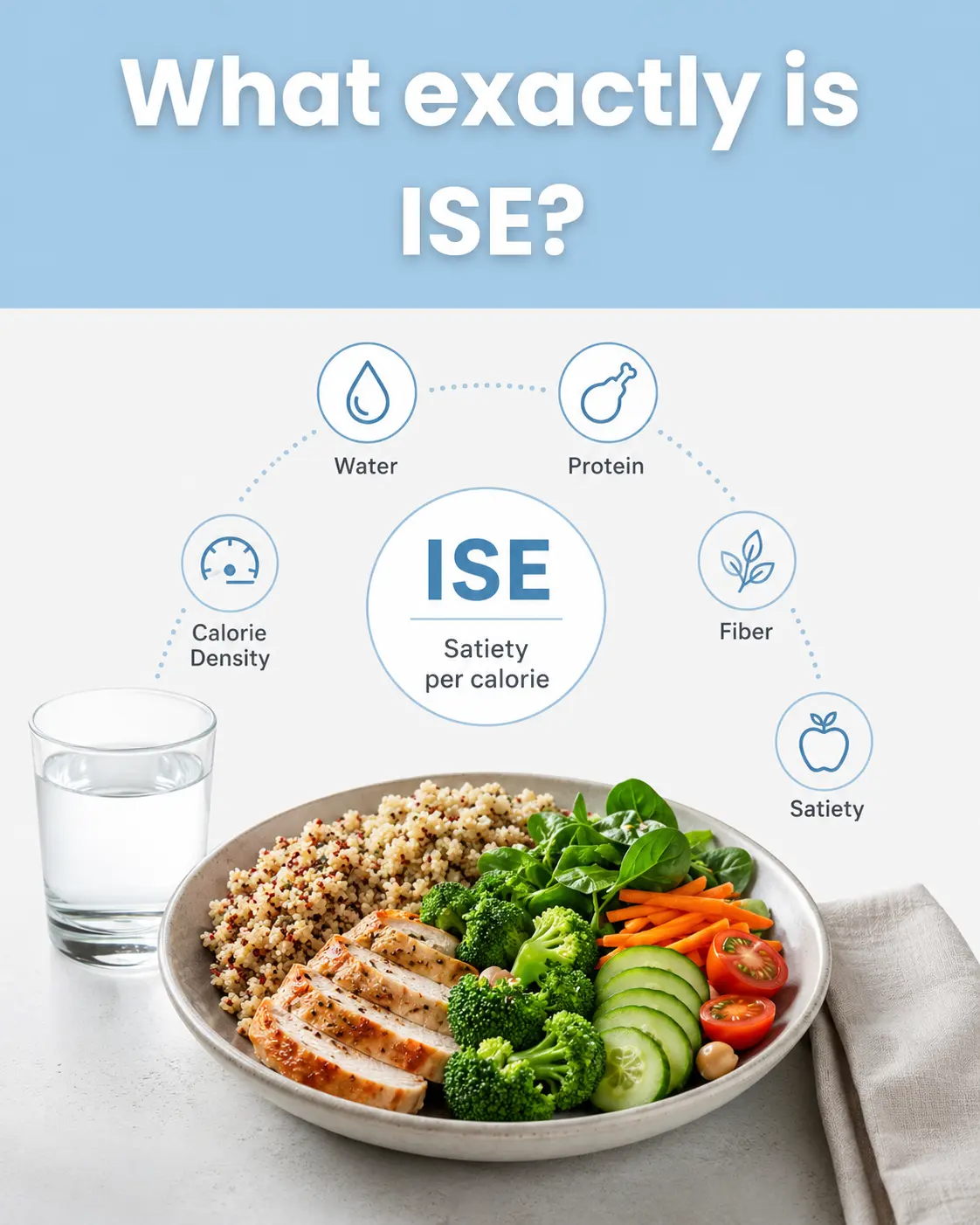
The principle
The purpose of the ISE is to estimate how much satiety a food or meal provides per unit of energy.
The index adds the elements that fill the stomach or contribute to satiety signals:
- Water — mechanical filling: coefficient 1
- Protein — hormonal signal: coefficient 2
- Fiber — volume and slower gastric emptying: coefficient 4
The result is then divided by kcal to obtain a yield, then multiplied by 100 to make the values easier to read.
Fat and sugar do not appear in the numerator: they carry a high calorie load but add little volume. Their effect therefore lowers the ratio automatically.
The hydro-caloric ratio — RHC
The RHC complements the ISE by giving a simple reading of the relative hydration of a food or meal: how much water it provides for each calorie.

≥ 5 g/kcal
Ultra-hydrating

2 – 4.9 g/kcal
Hydrating

1 – 1.9 g/kcal
Standard

< 1 g/kcal
Dense / dry
Case study: watermelon alone vs complete meal
A deliberately simple example: watermelon provides a lot of water for few calories. Adding a lamb chop strongly increases calories, without adding the same amount of water or fiber.
| Watermelon 500 g | Lamb chop 250 g | Total meal | |
|---|---|---|---|
| Water (g) | 455 | 145 | 600 |
| Protein (g) | 3.5 | 64.3 | 67.8 |
| Fiber (g) | 2.5 | 0 | 2.5 |
| kcal | 195 | 600 | 795 |
| Index | Formula | Watermelon alone | Complete meal |
|---|---|---|---|
| RHC | Water ÷ kcal | 455 / 195 = 2.33 | 600 / 795 = 0.76 |
| ISE | (Water + 2P + 4F) ÷ kcal × 100 | (455 + 7 + 10) / 195 × 100 ≈ 242 | (600 + 136 + 10) / 795 × 100 ≈ 94 |
| Watermelon alone | Watermelon + lamb chop | |
|---|---|---|
| Hydration | Hydrating — RHC 2.33 | Dense / dry — RHC 0.76 |
| Satiety | Very filling — ISE 242 | Moderately filling — ISE 94 |
How to explain it to a client
Picture a warm bowl of vegetable soup: light, full of water and fiber, and able to take up a lot of space in the stomach for very few calories.
Now add a slice of high-fat cheese or a piece of buttered bread: the total volume changes very little, but the energy density rises sharply.
This is exactly what the ISE shows: when you introduce a highly energy-dense food into a hydrated, fiber-rich meal, calories rise faster than the satiety potential per calorie.
In other words, the ISE works like a “price per kilo” applied to satiety. If you combine a food that is very expensive in calories with a food that is cheap in volume, the overall average drops.
Practical applications in your nutrition plans
Balance a meal that is too dense or too dry
- Reduce the portion of the dense food when the calorie load becomes too high.
- Add vegetables, fruit, or whole grains to increase water and fiber.
- Keep useful protein, but improve the meal’s filling volume.
Useful coach wording
“Your plate contains enough protein, but it lacks water and fiber for each 100 kcal. Let’s add 200 g of steamed vegetables: same protein base, better RHC, higher ISE.”
Limits of the index
What the ISE does not replace
- Micronutrient density: vitamins, minerals, and overall food quality.
- Sensory satiety: texture, aromas, food enjoyment, and chewing time.
How to use it correctly
The ISE is not an absolute judgment on a food. It is a reading tool that helps you improve your decisions when building or adjusting a client nutrition plan.
Mini-quiz — self-assessment
Why are fats not included in the ISE numerator?
They provide a lot of kcal but little volume. Their effect therefore appears in the denominator and lowers the ratio.
Will a 100% fruit smoothie have the same ISE as whole fruit?
No. Fiber is less intact, chewing is reduced, and the satiety potential can drop.
How can you increase the ISE of a pasta dish without pushing calories too high?
Add zucchini or spinach, choose a higher-fiber base, and limit oil or very energy-dense foods.
Key takeaways
-
ISE and RHC are ratios.
When you add a dense food that is low in water or fiber, both values drop. -
Protein matters, but water and fiber strongly structure filling volume.
That is what helps you build more effective meals for your clients.
Use the ISE™ to build better nutrition plans
The ISE™ helps you read meal satiety more clearly, explain your choices with more confidence, and build more coherent nutrition plans for your clients.
With DietHelper™ Offline, you can integrate this logic directly into your planning workflow.