
Cable Hip Extension (Kickback)
Category : 🟨 Lower Body – Glutes / Hamstrings
Difficulty : ★★☆☆☆ (intermediate)
Equipment : Low pulley + ankle strap (unilateral)
Goal
- Isolate the gluteus maximus with continuous tension throughout the range of motion.
- Improve glute shape and tone while reinforcing pelvic and trunk stability.
- Develop unilateral control and correct side-to-side imbalance in hip extension strength.
Target Muscles
- Main: Gluteus maximus.
- Synergists: Hamstrings, gluteus medius.
- Stabilizers: Lumbar erectors, deep core, stance-leg hip and ankle stabilizers.
Variations
- Regression: Floor hip extension or banded kickback.
- Cross-cable: Stand slightly across from the pulley for a different line of pull.
- Small 1–2 s isometric hold at full extension to emphasise the squeeze.
- Continuous mode: keep the weight stack from resting to maintain tension on the glutes.
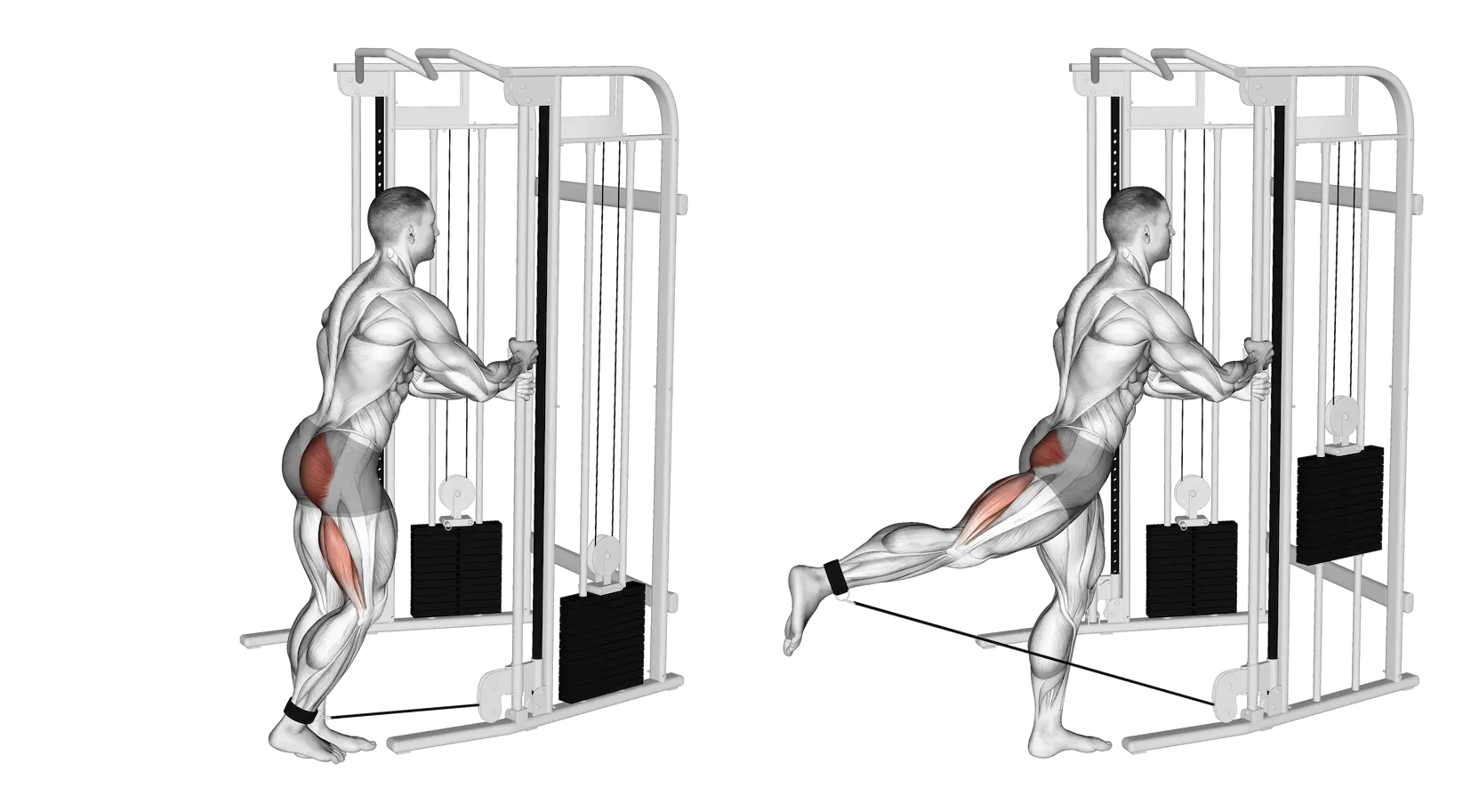
Fixed trunk, heel drive, hard glute squeeze: every rep is a clean hip extension, not a back bend.
Technique — Step by Step
- Starting position:
Attach the ankle strap to the working leg and clip it to the low pulley. Stand facing the machine, lightly holding the frame or handle for balance. Stance leg slightly bent, neutral spine, core braced. Take a small step forward so the cable is slightly tensioned. - Concentric (up):
Exhale and drive the heel back and slightly up, extending the hip while keeping the knee softly bent. Focus on squeezing the glute, not arching the lower back. Pause 1–2 s at peak contraction. - Eccentric (down):
Inhale and return slowly to the starting position, keeping the trunk still. Stop just before the stack touches to maintain continuous tension. - Tempo / Range target:
2 – 0 – 2 or 2 – 1 – 2 depending on the format. Full, controlled hip extension and flexion with no torso swing and no lumbar arching. - Quick cues:
“Ribs down, core tight – heel back – squeeze the glute – control the way down.”
| ❌ Common Mistakes | ✅ Best Practices |
|---|---|
|
|
Training Formats
| Strength – Control (TUT ~30–40 s) | Hypertrophy (TUT ~40–60 s) | Endurance – Tone (TUT ~20–30 s) | |
|---|---|---|---|
| Sets | 3 | 4 | 3 |
| Reps (per leg) | 8 – 10 | 12 – 15 | 18 – 20 |
| Tempo | 2 – 0 – 2 | 2 – 1 – 2 | 1 – 0 – 1 |
| Rest | ~75 s | ~60 s | ~45 s |
1% Method
| PLC Power – Length – Contraction | Set of 100 Density / Pump Finisher | |
|---|---|---|
| Goal | Densify the end of the glute block with a calibrated key set. | Local endurance and pump in the glutes. |
| Structure | 1 “key” set programmed with the PLC widget (tempo & range). | 100 reps split into mini-blocks (e.g. 10×10 / 5×20 per leg). |
| Load | Load from the widget, aiming for RPE 8–9 with clean technique. | Light → moderate to keep strict control and avoid lumbar stress. |
| Intra-set rest | Continuous tempo or short targeted micro-pauses if needed. | 10–20 s between mini-blocks. |
| Frequency | 1–2×/week on your main glute isolation exercise. | ≤ 1×/week at the end of a lower-body session. |
| Key cue | Ribs down, core tight, heel drive, hard squeeze at full extension. | Stop early if form breaks; protect the lower back, keep breathing. |
1% Method Integration
Phase 4 – Muscle Block
Integration Logic
- Place it as a targeted glute isolation block after a main strength lift (e.g. squats, deadlifts, leg press).
- Super set ideas: pair with a quad-dominant movement (Bulgarian split squat, leg press) or with a hinge (Romanian deadlift) for full lower-body balance.
- Use PLC on heavier days to calibrate load and tempo, and a Set of 100 as an occasional metabolic finisher.
Recommended Frequency
- Include cable hip extension in 1–2 lower-body sessions per week, depending on total glute volume and recovery.
- Alternate the focus across cycles: Strength – Control → Hypertrophy → Endurance / Pump to keep progressing without overloading the lumbar spine.
Brace hard, drive through the heel, squeeze the glute — the back only follows, it never leads.