
Seated Dumbbell Shoulder Press (Seated Military Press)
Category : 🟧 Push – Shoulders / Triceps
Difficulty : ★★☆☆☆ (intermediate)
Equipment : Pair of dumbbells + bench with back support
Goal
- Develop strength and muscle mass in the shoulders, especially the anterior and middle deltoids.
- Strengthen the triceps to support all overhead pressing patterns.
- Improve upper-body posture and scapular stability with controlled seated work.
Target Muscles
- Main: Anterior deltoid, middle deltoid, triceps brachii.
- Synergists: Upper trapezius, upper chest (clavicular head), serratus anterior.
- Stabilisers: Deep core, lumbar extensors, rotator cuff, middle and lower trapezius, scapular stabilisers.
Variations
- Easier – partial range : lighter dumbbells and shorter range in the bottom half to reduce shoulder stress.
- Easier – alternating press : press one arm at a time to focus on control and shoulder stability.
- Easier – neutral grip : palms facing each other to place the shoulder in a more joint-friendly position.
- Harder – standing press : perform the movement standing to demand more core and whole-body stability.
- Harder – slow tempo or pause : use a 3–1–3 tempo or add a 2-second hold at the top to increase time under tension.
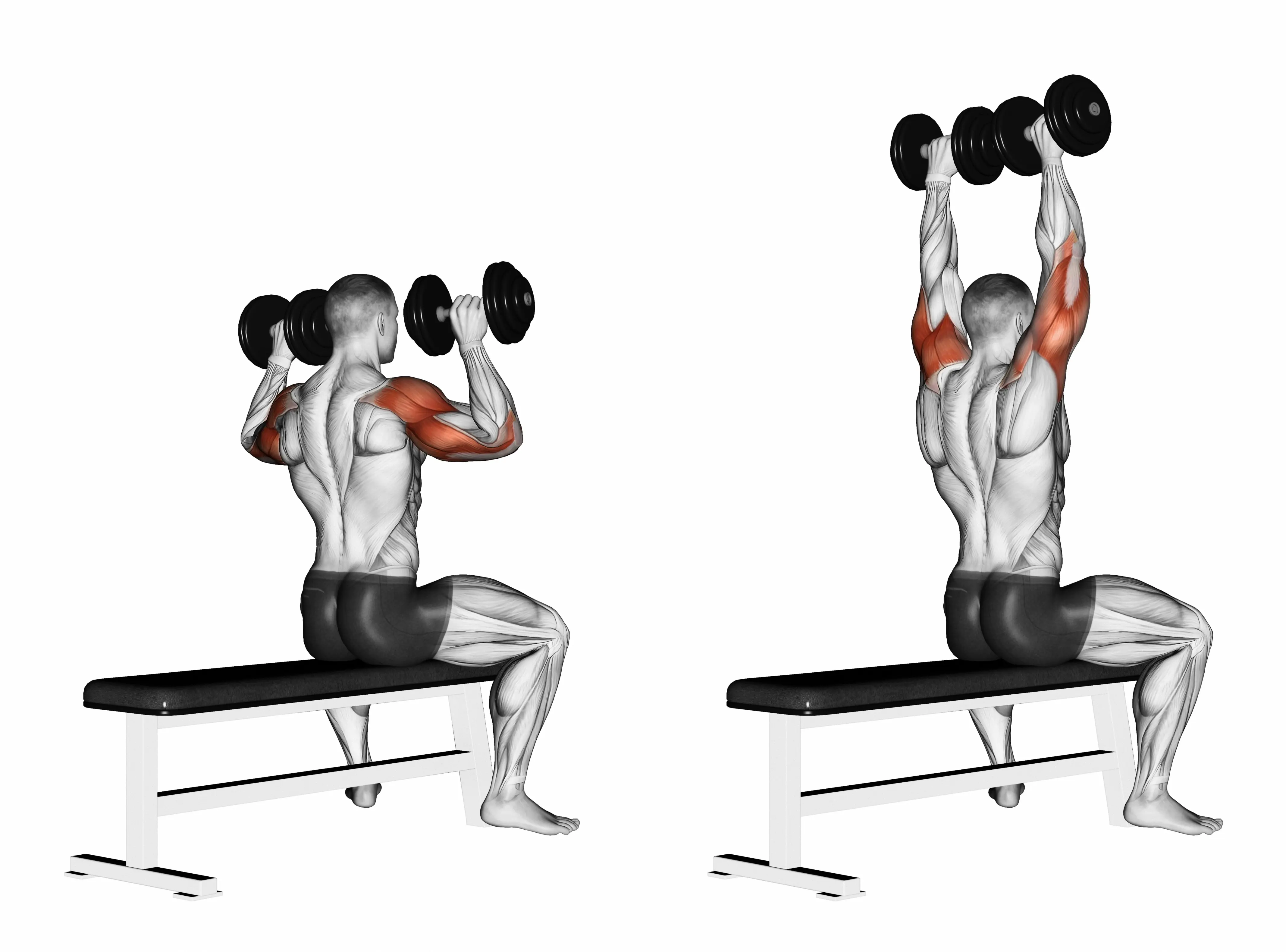
Stable seat, ribs down, smooth press: the classic formula for stronger, healthier shoulders.
Technique — Step by Step
- Starting position:
Sit on a straight or slightly inclined bench with feet flat on the floor. Hold a dumbbell in each hand at shoulder height, palms facing forward or slightly in. Brace the core, keep the ribcage stacked over the pelvis and maintain a neutral spine. - Concentric (up):
From this stable position, press the dumbbells vertically above the head. Keep the elbows under the wrists and avoid pushing the weights behind the head. Stop just before full lockout to keep constant tension on shoulders and triceps. - Eccentric (down):
Inhale and slowly lower the dumbbells back to ear level, elbows remaining slightly in front of the torso. Maintain scapular tension (shoulder blades gently drawn back and down) and do not let the lower back arch off the bench. - Tempo / range target:
Aim for a 2 – 0 – 2 tempo (up – down) or 2 – 1 – 2 with a short hold at the top. Use a full but comfortable range without bouncing or losing shoulder control.
| ❌ Common Mistakes | ✅ Best Practices |
|---|---|
|
|
Training Formats
| Hypertrophy (TUT 30–50 s) | Strength (main block) (TUT 20–40 s) | Endurance / finisher (TUT 40–60 s) | |
|---|---|---|---|
| Sets | 3 – 4 | 4 – 5 | 2 – 3 |
| Reps | 8 – 12 | 5 – 8 | 12 – 15 |
| Tempo | 2 – 0 – 2 | 2 – 0 – 2 | 2 – 1 – 3 |
| Rest | 60 – 90 s | 90 – 150 s | 45 – 60 s |
1% Method
| PLC Power – Length – Contraction | Set of 100 Density/Pump Finisher | |
|---|---|---|
| Goal | Calibrate load, tempo and range to match the athlete’s shoulder control. | Create strong local fatigue and pump at the end of the session. |
| Structure | 1 key set per widget with precise tempo and load adjustments. | 100 controlled reps split into mini-blocks (e.g. 10×10 / 5×20). |
| Load | Moderate to heavy dumbbells; technical reps only (RPE 8–9). | Light to moderate load, strict form maintained from rep 1 to 100. |
| Intra-set rest | Continuous tempo or short targeted micro-pauses if needed. | 10–20 s between mini-blocks to keep quality. |
| Frequency | 1–2×/week on the main shoulder press exercise. | ≤ 1×/week at the end of an upper-body session. |
| Key cue | Ribs down, elbows slightly forward, smooth vertical path. | Break early, keep shoulders safe, breathe rhythmically. |
1% Method Integration
Phase 4 – Muscle Block (7 to 10 min)
Integration Logic
- Main upper-body push block: use the seated dumbbell shoulder press as the key shoulder movement of the session.
- Agonist/antagonist balance: pair with horizontal or vertical pulling work (rows, pulldowns) to stabilise the shoulder girdle.
- Set of 100: optional metabolic finisher with lighter loads to increase shoulder endurance without joint impact.
- PLC: ideal for fine-tuning load and tempo when you want technical, heavy sets without compensation.
Recommended Frequency
- Program the seated dumbbell shoulder press 1–2 times per week in upper-body or push-dominant sessions.
- Avoid stacking multiple heavy overhead presses in the same workout; combine with pulling and core work for balance.
- Rotate between PLC, standard hypertrophy work and Set of 100 over the training cycle to keep progressing without overloading the joints.
Well-executed seated presses build powerful shoulders, strong triceps and a confident, upright posture that carries over to every push movement.