
Burpee (classic version)
Category: 🟧 Cardio / Plyometrics – Full body – Explosiveness
Difficulty: ★★★★☆ (intermediate to advanced)
Equipment: Bodyweight only, training shoes, stable surface
Goal
- Build full-body power and explosiveness (legs, core, upper body).
- Create an intense cardio spike in HIIT blocks or as a Tabata finisher.
- Improve overall coordination, your ability to string transitions together, and boost VO₂ max.
Muscles worked
- Primary: Quadriceps, gluteus maximus and medius, pectorals.
- Synergists: Hamstrings, calves, triceps, deltoids.
- Stabilizers: Abs, lower back, deep core stabilizers, shoulder girdle.
Variations
- Basic version: burpee without push-up, controlled return to plank and moderate jump.
- Low-impact version: no jump, step back to plank one foot at a time, ideal for beginners or to protect the joints.
- “Walk” version: squat down, hands to the floor, walk the feet back and forward without impact, steady pace.
- Advanced version: add a full push-up from the plank position before bringing the feet back in.
- Explosive version: powerful vertical jump with arms reaching overhead on every rep.
- Very intense version: vertical jump with high knees or jump onto a stable box (reserved for experienced lifters).
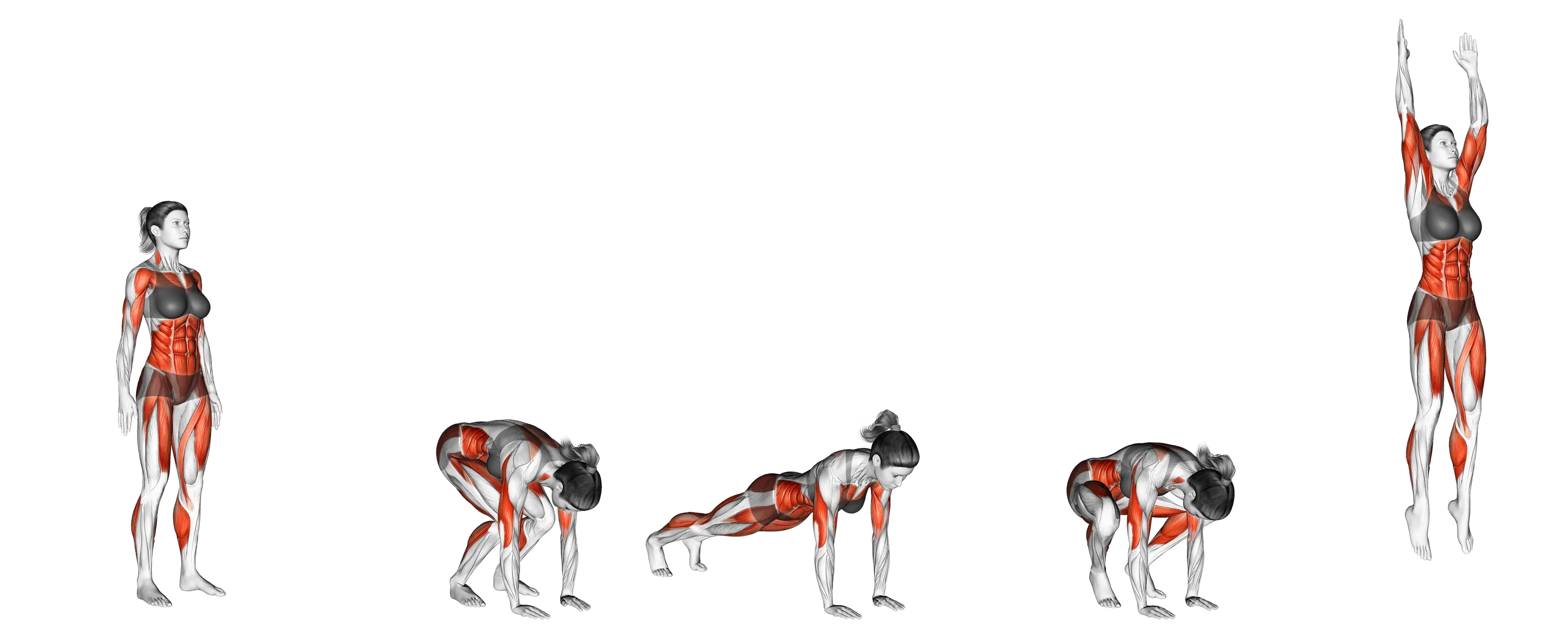
The burpee is a classic HIIT block move: an explosive combo that spikes your heart rate fast while hitting your whole body.
Technique — Step by step
- Starting position:
Stand tall with your feet hip-width apart, toes slightly turned out. Brace your core, keep your chest up and shoulders relaxed, eyes looking a few meters in front of you. - Squat down and hands to the floor:
Bend your hips and knees to sit into a real squat before placing your hands on the floor. Heels stay on the ground as long as possible. Avoid “falling” straight onto your hands with straight legs, which overloads the wrists. - Transition to plank and push-up option:
Jump or step your feet back into a strong braced plank: shoulders, hips and ankles in one line. Keep your abs tight, don’t let the hips sag or pike. If you add the push-up, lower your chest toward the floor with elbows close to your body, then press back up under control. - Return, jump and rhythm:
Bring your feet back under your hips, passing again through a squat position. Drive hard through the floor into a vertical jump, lifting your arms overhead. Aim for a soft, quiet landing with slightly bent knees. In HIIT, keep a smooth pace for 20–40 s while syncing your breathing: inhale at the bottom, exhale on the explosive phase.
| ❌ Common mistakes | ✅ Best practices |
|---|---|
|
|
Typical formats
| HIIT (Cardio Peak block) | Tabata (Explosive finisher) | |
|---|---|---|
| Work duration | 20 – 40 s | 20 s |
| Rest | 20 – 40 s | 10 s |
| Number of cycles | 6 – 10 cycles depending on level | 8 cycles |
| Target intensity | RPE 7 – 9, technique stays solid even under fatigue | RPE 8 – 9, strong core and jump quality until the last round |
1% Method
| HIIT Cardio Peak 1 | Final Tabata Cardio Peak 2 | |
|---|---|---|
| Goal | Create a controlled cardio peak with a full-body explosive movement | Short but very intense finisher to boost endorphins |
| Structure | 20–40 s work / 20–40 s rest block | Fixed 20 s work / 10 s rest × 8 cycles |
| Placement | Phase 3 – Cardio Peak 1, after warm-up and pre-activation | Phase 6 – Cardio Peak 2, at the end of the session |
| Load | Bodyweight, range adjusted so you keep core control | Bodyweight, range reduced if technique breaks down |
| Frequency | 1–2×/week in full-body / high-intensity cardio sessions | 1×/week max at the end of a full-body or cardio block |
| Key cue | Core quality first, intensity second | Stay explosive but clean until the last cycle |
1% Method integration
HIIT – Cardio Peak 1 (5 min)
Tabata – Cardio Peak 2 (4 min)
Phase 2 – Neuro-connection (3–4 min)
Goal: prepare the neuromuscular system for the full burpee by breaking the movement down.
Level 1 – Squat + hands to the floor (no impact)
- “Drop into a controlled squat, place your hands on the floor, then stand back up without moving your feet.”
- “Think about sharing the load between legs and arms, not crashing onto your wrists.”
- “Long spine, chest open, eyes looking 1–2 meters in front of you.”
Level 2 – Step back to plank (no jump)
- “From your squat, step one foot at a time back into plank, then walk back in to the squat.”
- “Keep your hips in line with your shoulders: no overarched lower back, no hips way up in the air.”
Level 3 – Dynamic plank with small jump
- “Once you’re comfortable, jump both feet back and forward, always with a tight, braced core.”
- “Aim for soft, quiet landings, as if you were protecting your wrists and knees.”
Level 4 – Add the vertical jump
- “Finish every rep with a vertical jump, arms reaching overhead.”
- “This block is still neural prep: smooth and controlled, not max gasping yet.”
Goal: hit the HIIT block with an automatic, clean movement and zero technical fear.
Phase 3 – Cardio Peak 1 – HIIT (5 min)
Goal: create a controlled cardio peak with a full-body explosive combo.
Coaching cues to go further:
- “Control the way down, explode on the way up: clean squat at the bottom, max intent on the jump.”
- “Maintain a steady rhythm for the whole interval instead of starting too fast and crashing.”
- “In plank, think ‘steel core’: nothing sags, everything stays aligned.”
- “If your form breaks down, reduce the jump height or switch back to step-backs, but keep your technique sharp.”
- “Aim for an RPE of 7–9 depending on your level: you’re breathing hard, but still in control of every rep.”
Phase 6 – Final Tabata (4 min – 20/10 × 8)
Goal: short, dense, explosive finisher to end the session on a big endorphin high.
Advanced cues:
- “Give your best in each 20-second block, but with the same clean technique from start to finish.”
- “When fatigue kicks in, shrink your jump height before you compromise your core position.”
- “Use a benchmark: same number of reps on the 1st and last cycle, or very close.”
- “Keep your breathing rhythmic: one breath per rep or every two reps, depending on your comfort.”
Recommended frequency
- Use 1 to 2 times per week max as a high-intensity cardio block (HIIT or Tabata) to limit cumulative plyometric load.
- Avoid scheduling heavy burpee Tabatas the day before or the day after other very explosive sessions (jumps, sprints).
- Burpees pair well with more controlled strength or core blocks to balance the session (squats, deadlifts, planks).
Used sparingly but in the right spot, the burpee is a powerful tool to challenge your cardio system and your mindset at the end of a full-body block.