
Quick Feet Run (Fast Feet Drill)
Category : 🟧 Cardio / Coordination – Speed / Agility
Difficulty : ★★☆☆☆ (beginner to intermediate)
Equipment : Sports shoes, stable non-slippery surface, small training space
Goal
- Develop foot strike frequency and short, explosive ground contacts.
- Improve neuromuscular coordination and agility in place.
- Use as a low-impact cardio and reactivity drill in warm-ups or HIIT circuits.
Muscles worked
- Main movers: Calves (soleus, gastrocnemius), quadriceps, hamstrings.
- Synergists: Glutes, hip flexors, forearm and shoulder muscles driving the arm swing.
- Stabilisers: Deep core (transverse abdominis), lumbar muscles, postural muscles around the pelvis.
Variations
- Easier – controlled fast walk : slow down the rhythm and use the drill as a dynamic warm-up for posture and ankles.
- Harder – sprint on the spot : drive the feet as fast as possible while keeping low knee lift (not a High Knees drill).
- Harder – directional changes : move slightly forward/backward or side-to-side while keeping the same foot speed.
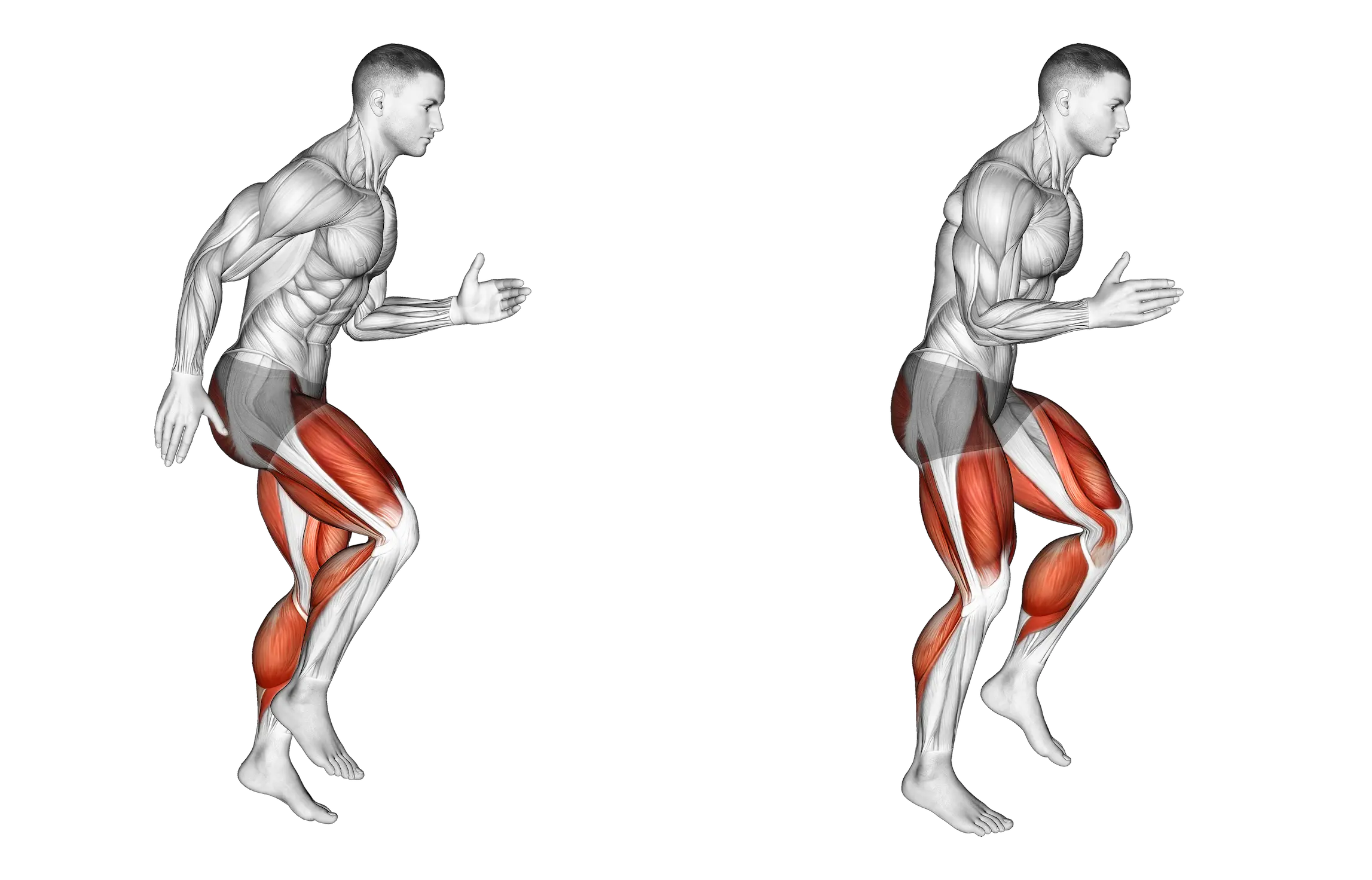
Quick Feet Run is a simple but powerful drill to train speed, reactivity and cardio without heavy impact.
Technique — Step by step
- Start position
Stand tall with a slight forward lean from the hips, feet hip-width apart. Bend the elbows to about 90° as if you were about to sprint. Brace the core and keep the gaze fixed on a point in front of you. - Foot action and posture
Start making very small, fast steps on the spot, lifting the feet just a few centimetres from the floor. Push off and land on the balls of the feet, keeping the knees soft and under the hips, not driving them up like in a High Knees drill. - Arm drive and control
Let the arms swing naturally in opposition to the legs, close to the body. Shoulders stay low and relaxed, hands open or gently closed. Avoid big, exaggerated arm movements that disturb posture. - Rhythm and breathing
Find a quick but sustainable rhythm and keep it for the full set. Breathe continuously — short exhales as the feet strike the floor, inhales as you maintain the rhythm. Stop or regress if the heels start slamming down or if posture collapses.
| ❌ Common mistakes | ✅ Good practice |
|---|---|
|
|
Typical formats
| HIIT block (Speed & agility) | Tabata (Explosive finisher) | |
|---|---|---|
| Work duration | 20 – 40 s | 20 s |
| Rest | 20 – 40 s | 10 s |
| Number of cycles | 3 – 5 rounds depending on level | 8 cycles |
| Target intensity | RPE 6 – 8, fast feet with posture always under control. | RPE 8 – 9, maximum foot speed while keeping light contacts. |
1% Method
| HIIT format Cardio Peak 1 | Final Tabata Cardio Peak 2 | |
|---|---|---|
| Goal | Create a controlled cardio peak with fast, elastic footwork. | Short, very intense finisher to push speed and reactivity at the end of the workout. |
| Structure | 20–40 s work / 20–40 s rest, repeated. | Fixed 20 s work / 10 s rest × 8 rounds. |
| Placement | Phase 3 – Cardio Peak 1, after warm-up and pre-activation. | Phase 6 – Cardio Peak 2, as a final finisher. |
| Load | Body weight only, focus on speed and technique. | Body weight, option to slightly reduce tempo if posture drops. |
| Frequency | 1–2×/week in full-body or cardio-focused sessions. | Up to 1×/week due to density and fatigue. |
| Key coaching cue | Think “whisper-light contacts” and consistent rhythm from start to finish. | Stay explosive but never sacrifice posture or foot placement. |
1% Method integration
HIIT – Cardio Peak 1 (5 min)
Tabata – Cardio Peak 2 (4 min)
Phase 2 – Neuro-connection (3–4 min)
Goal: prepare the ankles, calves and coordination for fast footwork before the HIIT block.
Level 1 – March on the spot (no speed)
- “Start with a low-impact march on the spot, short steps and soft contacts.”
- “Feel the push from the ankles and calves, not from big knee lifts.”
- “Keep shoulders relaxed and eyes fixed on a point in front of you.”
Level 2 – Faster steps, same amplitude
- “Gradually increase the cadence without changing step size or losing posture.”
- “Keep the weight slightly forward over the balls of the feet, heels light.”
Level 3 – Short fast bursts
- “Alternate 5–10 seconds fast feet with 10 seconds walk to test reactivity.”
- “Focus on quiet, quick contacts, not on how high you lift the feet.”
Level 4 – Continuous fast feet (low intensity)
- “Hold a light quick-feet rhythm for 20–30 seconds while keeping breathing relaxed.”
- “This block stays preparatory: technique first, then speed in the HIIT phase.”
Goal: start the HIIT block with an automatic, efficient fast-feet pattern instead of discovering it under fatigue.
Phase 3 – Cardio Peak 1 – HIIT (5 min)
Goal: create a controlled cardio peak with continuous fast feet at a challenging but sustainable pace.
Coaching cues to push further
- “Short contacts, fast cadence: imagine the floor is hot under your feet.”
- “Keep the same step length from the first to the last second of the interval.”
- “Think ‘tall and light’: long spine, relaxed shoulders, quick feet.”
- “If form deteriorates, drop the speed slightly rather than grinding with heavy steps.”
- “Aim for an RPE of 6–8 depending on the athlete: breathless but always able to maintain quality.”
Phase 6 – Final Tabata (4 min – 20/10 × 8)
Goal: use Quick Feet Run as a short, dense and explosive finisher to close the session with a strong cardio stimulus.
Advanced coaching cues
- “On each 20-second round, focus on maximum foot speed with silent landings.”
- “As fatigue builds up, keep amplitude small and protect posture instead of letting the heels crash.”
- “Use a benchmark: try to keep a similar rep count or perceived cadence from round 1 to round 8.”
- “Coordinate breath and rhythm: short, regular exhales help maintain tempo and focus.”
Recommended frequency
- Use Quick Feet Run 1–2 times per week in high-intensity cardio blocks (HIIT or Tabata).
- Avoid stacking several similar high-cadence drills (Jump Rope, sprints) in the same session for beginners.
- Combine this drill with more controlled strength or core work (squats, lunges, planks) to balance the session.
Used smartly in HIIT or Tabata, Quick Feet Run is a simple tool to test speed, reactivity and mental focus with almost no equipment.