
Battling Ropes (rope waves)
Category: 🟧 Cardio / Strength – Shoulders – Muscular endurance
Difficulty: ★★★☆☆ (intermediate)
Equipment: Battling ropes, stable anchor point, non-slip surface
Goal
- Improve overall conditioning, bilateral coordination and upper-body endurance.
- Strengthen the shoulders, arms and upper back while engaging the core and legs for stability.
- Create a strong metabolic stimulus in HIIT or Tabata, ideal as a finisher with no joint impact.
Muscles worked
- Main: Anterior and middle deltoids, trapezius, rhomboids.
- Synergists: Biceps, triceps, forearms, latissimus dorsi.
- Stabilizers: Abs, obliques, lower back, glutes, quads and calves.
Variations
- Basic version: simultaneous waves with both arms, moderate range of motion, athletic stance.
- Low-impact version: 15 s ON / 45 s OFF, higher stance with less knee flexion.
- Endurance version: alternating waves at a steady pace for 30–40 seconds.
- Explosive version: fast alternating “arm sprints” with sharp waves.
- “Slams” version: lift the ropes up, then slam them powerfully into the floor on each rep.
- Tabata version: 20 s of intense waves / 10 s rest × 8 rounds.
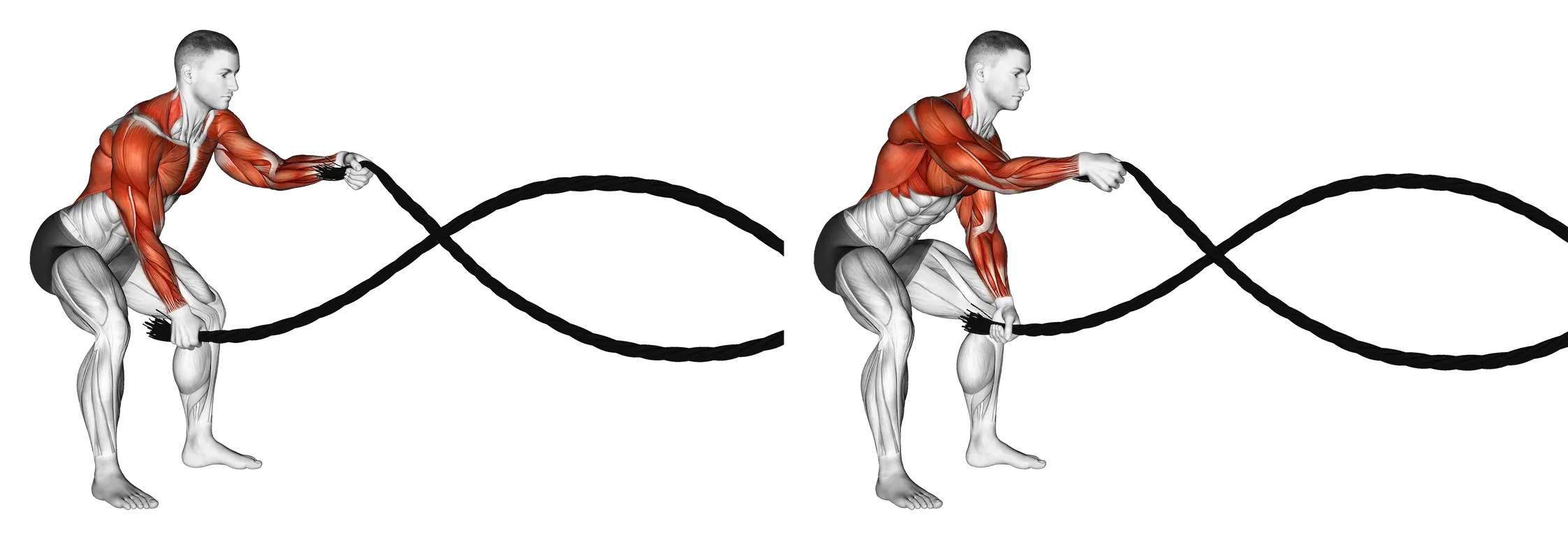
Battling ropes are an excellent HIIT finisher: continuous upper-body work that sends your heart rate sky-high, without joint impact.
Technique — Step by step
- Starting position:
Stand with your feet hip- to shoulder-width apart, knees slightly bent, hips pushed slightly back. Brace your core, keep your chest up, shoulders down and gaze forward. - Grip and tension:
Hold one end of the rope in each hand with a neutral grip. Leave some slack on the floor to create waves. Keep the elbows close to your body and wrists neutral: the movement starts from the shoulders, not from the hands. - Alternating waves:
Lift and lower your arms alternately in a rhythmic pattern to create clean waves in the ropes. Your core stays fixed and braced; the legs absorb the movement lightly without bouncing excessively. - Rhythm, range and breathing:
Choose a range of motion you can hold for the entire interval. Aim for a smooth rhythm: inhale for 1–2 waves, exhale for 1–2 waves. If your technique breaks down, reduce the range or speed instead of forcing through with tight traps.
| ❌ Common mistakes | ✅ Best practices |
|---|---|
|
|
Typical formats
| HIIT (Cardio Peak block) | Tabata (Explosive finisher) | |
|---|---|---|
| Work duration | 20–40 s of continuous waves | 20 s very intense |
| Rest | 20–40 s | 10 s |
| Number of rounds | 4–8 rounds depending on level | 8 rounds |
| Target intensity | RPE 7–9, shoulders and core on fire but technique controlled | RPE 8–9, explosive waves without losing posture |
1% Method
| HIIT Cardio Peak 1 | Final Tabata Cardio Peak 2 | |
|---|---|---|
| Goal | Create a controlled cardio peak with continuous upper-body work | Short, explosive finisher to push the shoulders and cardio system to the limit |
| Structure | Blocks of 20–40 s work / 20–40 s rest | Fixed format 20 s work / 10 s rest × 8 rounds |
| Placement | Phase 3 – Cardio Peak 1, after warm-up and pre-activation | Phase 6 – Cardio Peak 2, at the end of the session |
| Load | Rope weight, range of motion adapted to core control | Rope weight, range slightly reduced if technique breaks down |
| Frequency | 1–2×/week in full-body / intense cardio sessions | Max 1×/week at the end of a full-body or upper-body block |
| Key cue | Strong posture, shoulders down, steady waves from start to finish | Stay explosive but clean until the last round |
1% Method integration
HIIT – Cardio Peak 1 (5 min)
Tabata – Cardio Peak 2 (4 min)
Phase 2 – Neuro-connection (3–4 min)
Goal: prepare the neuromuscular system for rope waves by installing a solid posture and fluid pattern.
Level 1 – Athletic stance without movement
- “Stand in an athletic stance: feet grounded, knees slightly bent, core braced, torso slightly leaned forward.”
- “Hold the ropes under light tension without moving them yet, breathing calmly.”
- “Feel the weight of the ropes without letting the shoulders creep up toward the ears.”
Level 2 – Low-amplitude simultaneous waves
- “Start with small simultaneous waves, arms lifting and lowering together.”
- “Your core stays fixed; the shoulders lead the movement while the arms stay relaxed.”
Level 3 – Controlled alternating waves
- “Switch to alternating waves: one arm goes up while the other goes down, at a steady pace.”
- “Focus more on the quality of the waves than on speed.”
Level 4 – Adding speed and duration
- “Gradually increase the cadence in 15–20 second blocks while keeping the technique clean.”
- “This block is still neural preparation: you’re chasing fluidity and control, not exhaustion.”
Goal: start the HIIT block with a stable posture, ready shoulders and automatic waves.
Phase 3 – Cardio Peak 1 – HIIT (5 min)
Goal: create a controlled cardio peak with continuous upper-body waves.
Cues to go further:
- “Keep a steady cadence for the entire interval instead of sprinting then crashing.”
- “Prioritize the quality of the waves in the ropes: smooth, regular, no jerks.”
- “Keep shoulders down and core braced, even when fatigue hits.”
- “If your form breaks, reduce range or speed but keep the wave rhythm going.”
- “Aim for an RPE of 7–9 depending on your level: out of breath but still able to keep clean technique.”
Phase 6 – Final Tabata (4 min – 20/10 × 8)
Goal: explosive finisher to end the workout on a high endorphin peak, with a strong focus on upper body.
Advanced cues:
- “Give your best on each 20-second block with intense but controlled waves.”
- “When fatigue builds up, slightly reduce the range instead of letting your back round.”
- “Use a benchmark: try to keep a similar number of waves per interval from the 1st to the 8th round.”
- “Breathe rhythmically without holding your breath: one breath every 2–3 waves.”
Recommended frequency
- Use 1 to 2 times per week max as an intense cardio block (HIIT or Tabata) to avoid overloading the shoulders and forearms.
- Avoid scheduling heavy battling ropes Tabata the day before or the day after other very explosive upper-body sessions.
- Battling ropes pair well with blocks of controlled strength work (rows, presses, core bracing) to balance the session.
Placed at the end of the workout, battling ropes are a brutal tool to challenge your cardio, upper-body endurance and mental toughness.