Sartorius (sometimes called the tailor muscle)
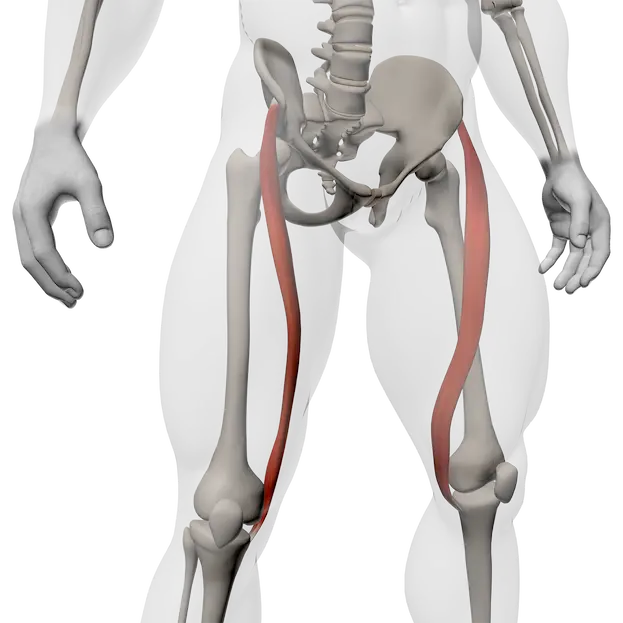
Scientific name:
Sartorius
Location:
Long, thin muscle running across the front of the thigh, from the outer pelvis down to the inner side of the knee.
Overall role:
Coordinates hip and knee positioning to guide leg orientation and improve stability during movement.
Sports where this muscle is a key :
- Combat sports (knee strikes, stance changes)
- Football / soccer
- Basketball / handball
- Racket sports (lunges, quick recovery steps)
- Running, especially during turns and single-leg support
Origin
- Anterior superior iliac spine (ASIS)
(front-upper part of the pelvis)
Insertion
- Medial surface of the tibia, via the pes anserinus
(shared tendon area with two medial hamstrings)
Innervation
- Femoral nerve (mainly L2–L3)
- Controls coordination between hip flexion and knee positioning
Key points to remember
- Bi-articular muscle (acts on both hip and knee)
- Designed more for coordination and guidance than pure strength
- Strongly involved in knee alignment, especially in single-leg tasks
- Often linked to inner knee discomfort when hip–knee control is poor
Main actions
- Hip flexion (lifting the thigh)
- Knee flexion
- External rotation of the hip
- Internal rotation of the tibia when the knee is flexed
(helps orient the leg and foot during stance)
Synergists (muscles working with it)
- Iliopsoas (hip flexion)
- Adductors (medial thigh control)
- Medial hamstrings (semimembranosus, semitendinosus)
- Quadriceps (overall knee stability)
Antagonists (muscles with opposite action)
- Gluteus maximus (hip extension)
- Quadriceps (knee extension)
Postural / stabilizing role
- Helps maintain knee-to-foot alignment in single-leg support
- Contributes to knee stability during walking, lunges, step-downs, and direction changes
Acts like a guiding cable, not a prime mover
Influences how force is transmitted, not how much force is produced
Weak / under-recruited
- Poor knee guidance
- Unstable or imprecise single-leg mechanics
Overactive / too tight
- Diagonal tension across the front of the thigh
- Inner knee discomfort during repeated flexion
Altered range of motion
- Hip rotation without proper knee tracking
- Increased stress on the knee system over time
This muscle cannot be voluntarily isolated: it always works in synergy with other muscles. Tests and exercises therefore assess coordination and motor control, not isolated strength.
Activation test
- Goal
- Check if the sartorius engages to guide the thigh without pelvic distortion
- Setup
- Standing on one leg
- Lift the knee to ~90°
- Slightly open the knee outward without leaning the trunk
- Hold 10–15 seconds, calm breathing
- What to observe
- Stable pelvis
- Diagonal activation in the front of the thigh
- Interpretation
- Pelvic movement → poor control
- Sensation only in the groin/psoas → sartorius under-recruited
Weakness test
- Goal
- Assess knee-foot alignment under simple control demand
- Setup
- Low step-down (10–20 cm)
- Slow tempo (3–1–2)
- What to observe
- Knee tracks over the 2nd–3rd toe
- No uncontrolled hip rotation
- Interpretation
- Knee collapse or drift → deficient hip-knee guidance
Dominance / compensation test
- Goal
- Identify compensations from trunk or hip flexors
- Setup
- Light resistance band around the feet
- Controlled knee lift and descent, 6–8 reps
- What to observe
- Excessive lumbar arching
- Interpretation
- Lumbar dominance → poor sartorius contribution
- Simple correction
- Reduce range
- Slow tempo
- Add 2–3 second holds at the top
Activation / isolation
- Controlled high-knee marches
- Isometric open-knee holds
- Small-range knee lifts with external hip rotation
Functional / multi-joint
- Step-downs with slow control
- Short-stride forward lunges
- Split squats with stable pelvis
Useful variations
- Unilateral focus
- Slow tempo and pauses to reinforce motor control
Typical imbalances
- Overreliance on global hip flexors (psoas dominance)
- Poor medial knee control during single-leg tasks
Related risks / pain
- Inner knee discomfort during repetitive flexion
- Anterior hip discomfort when flexion strategy is poorly controlled
Warning signs
- Diagonal pulling sensation across the thigh
- Instability during stair descent or step-downs
- Excessive lumbar arch during knee lifts
- Using load instead of control
- Allowing pelvic tilt or lumbar arching
- Pushing extreme hip-knee ranges under fatigue
- Ignoring knee-to-foot alignment during lunges and step-downs
- Slow hip circles (small range, stable pelvis)
- Controlled knee lifts with gentle rotation
- Short dynamic lunges with clean alignment