
Rhomboids (Major & Minor)
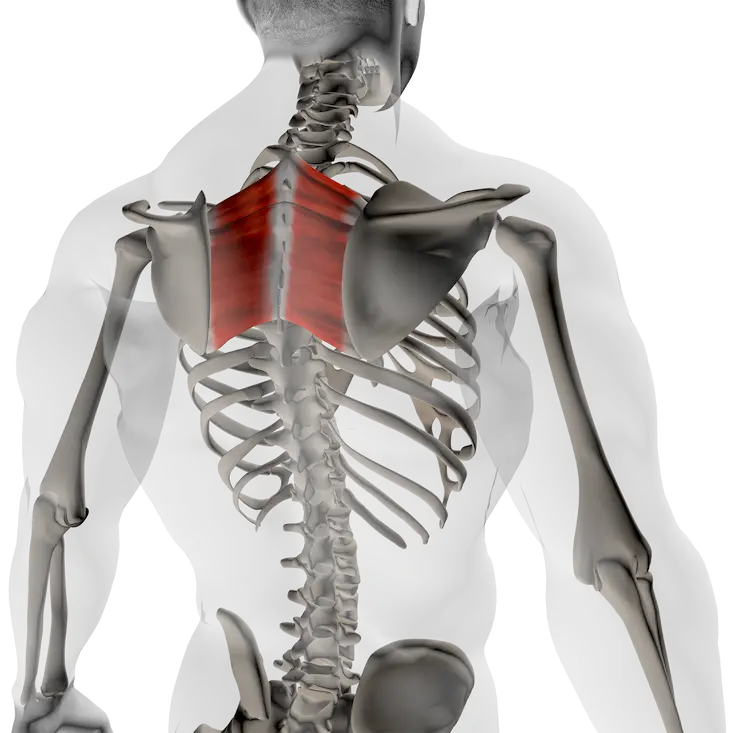
Scientific name:
Rhomboideus major & Rhomboideus minor
Location:
Upper back muscles running between the thoracic spine and the inner border of the shoulder blade (scapula).
Overall role:
Bring the scapula back and keep it stable so the shoulder stays strong and efficient.
Sports where this muscle is a key :
- Climbing
- Rowing
- Swimming (scapular control)
- Combat sports (pulling, clinch, grappling)
- Gymnastics / calisthenics (pull-ups, hanging work)
- Strength training (rows, pull-ups: scapular stability)
Origin
- Spinous processes (bony bumps) of the upper-to-mid thoracic spine (commonly described around T2–T5 for minor and T2–T7 for major, depending on anatomy references).
Insertion
- Medial border of the scapula (inner edge), with minor higher and major more inferior.
Innervation
- Dorsal scapular nerve (often C5, sometimes with C4 contribution)
- A nerve mainly dedicated to muscles that control scapular position.
Key points to remember
- These are “control” muscles: they don’t just move the arm—they position the scapula so the shoulder can work cleanly.
- They often share the workload with the middle/lower trapezius: similar area, complementary roles.
- Their efficiency depends a lot on thoracic mobility (a stiff upper back limits scapular freedom).
Main actions
- Scapular retraction (pull the shoulder blade toward the spine)
- Downward rotation of the scapula (helps orient the scapula “down”)
- Scapular stabilization against the ribcage (a “set/anchored” shoulder blade)
Synergists (muscles working with it)
- Middle and lower trapezius
- Latissimus dorsi (coordination during pulling patterns)
- Rotator cuff (shoulder stability)
- Spinal erectors (thoracic posture support)
Antagonists (muscles with opposite action)
- Serratus anterior (in protraction and upward-rotation patterns)
- Pectoralis minor (tends to pull the scapula forward and down)
- Pectorals (can promote forward-shoulder posture when dominant)
Postural / stabilizing role
- Helps prevent a “rounded shoulders” posture (shoulders drifting forward)
- Keeps the scapula stable during carries, hangs, pulling work, and repeated arm movements
Weak → common compensations
- Pulling becomes “arm-driven” (biceps/forearms take over) and the shoulders tend to rise.
- The scapula doesn’t “lock in”: pulling may feel unstable or uncomfortable at the front of the shoulder.
Overactive / too tight → common discomfort
- A “stiff” feeling between the shoulder blades, difficulty letting the scapula glide naturally.
- A tendency to brace the ribcage (less smooth breathing if posture becomes rigid).
Changed range → changed recruitment
- If the chest collapses (thoracic flexion), rhomboids lose leverage and the body often shifts to upper traps and neck tension.
Under load, rhomboids act like guides and brakes: they control scapular path and shoulder quality more than they “create power” alone.
Activation test
- Goal: check if scapular retraction happens through the mid-back without shrugging.
- Setup:
- Lie face down (bench or floor), forehead resting on a towel.
- Arms in a T position (about 90°), thumbs pointing up.
- Small, controlled reps: gently pull the shoulder blades back, then slowly release.
- What to watch:
- Tension felt between the scapula and spine, not in the neck.
- Shoulders stay away from the ears.
- Interpretation:
- ➡️ Neck takes over / shoulders rise → upper-trap dominance, weak scapular control.
- ➡️ Mostly rear-shoulder sensation → rear deltoid strategy, scapula not truly controlled.
Weakness test
- Goal: test scapular control and endurance during a simple pulling pattern.
- Setup:
- Seated band row (neutral grip), tall posture, chest “open.”
- Slow tempo: 2 sec pull – 2 sec hold – 3 sec return.
- 8–12 clean reps.
- What to watch:
- Stable hold: scapula stays back without arching the low back and without shrugging.
- Interpretation:
- ➡️ Scapula “slides forward” on the return → poor control under load.
- ➡️ Can’t hold 2 seconds without shaking → insufficient endurance (rhomboids + mid-trap system).
Dominance / compensation test
- Goal: identify what takes over: low back, upper traps, or arms.
- Setup:
- Very light chest-supported row or one-arm row.
- Cue: “scapula first, elbow second.”
- What to watch:
- A small scapular movement (retraction) happens before elbow flexion.
- Interpretation:
- ➡️ Elbow moves first + forearms burn → arm dominance.
- ➡️ Shoulders rise → upper-trap dominance.
- ➡️ Low back arches to “finish the rep” → lumbar compensation.
- Simple fix:
- Reduce range of motion.
- Add a 2-second pause at the end of the pull.
- Lower resistance until mid-back control is clear.
Note useful: you can’t isolate a “pure rhomboid” like you would a biceps. These tests remain functional/indirect because rhomboids share the job with the trapezius and other stabilizers.
Activation / isolation
- Prone T hold (10–20 sec holds, calm breathing, no shrugging)
- Band row with a pause (2 sec squeeze, controlled return)
- Short-range scapular retraction (cable or band, tiny range, scapula-focused)
Functional / multi-joint
- Horizontal rows (cable, dumbbells, barbell) with controlled tempo
- Pull-ups / vertical pulls (keep the scapula “set” rather than shrugged)
- Farmer carry (tall posture, shoulders down, stable scapula—not rigid)
Typical imbalances
- Rounded shoulders: rhomboids lengthened and under-recruited, pecs dominant
- Upper-trap dominance: “high shoulders,” neck tension
- Limited thoracic mobility: scapula movement becomes restricted and pulling quality drops
Related risks / pain
- Discomfort around the scapula, “tight” feeling between scapula and spine
- Indirect neck fatigue when shoulders habitually rise
- Shoulder feels less stable during pulling or hanging work when scapular control is poor
Warning signs
- Pulling work felt mostly in the arms and neck, not mid-back
- Scapula moves unevenly side-to-side or feels “uncontrolled”
- Hard to keep an open posture without turning stiff
- Going too heavy and compensating with:
- shrugging
- low-back arching
- head jutting forward
- Forcing “shoulder blades together” by crushing the ribcage (rigidity + poor breathing)
- End-range pulling when scapular control is lost (shoulder drifts forward)
- Neglecting the controlled return (the eccentric phase), where scapular control often fails first
- Slow scapular circles
- Standing, arms relaxed: small circles, smooth and pain-free, 6–8 reps.
- Controlled thoracic rotation
- Quadruped: hand behind head, rotate elbow up, 6 reps per side, calm breathing.
- Wall slides
- Back to wall, forearms on wall: slide up/down slowly, neck long, comfortable range.