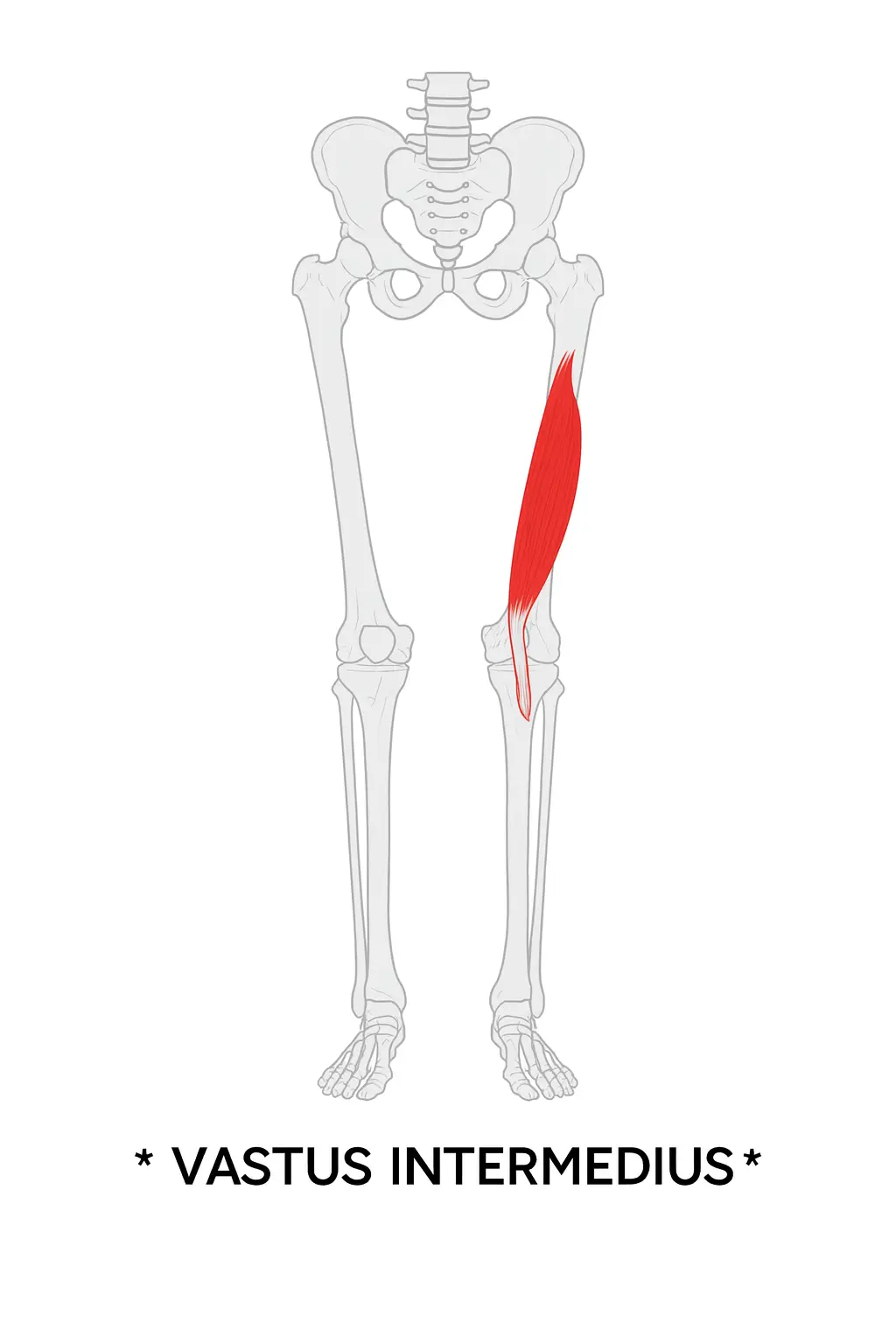
Vastus intermedius

Vastus intermedius anatomy showing the deep quadriceps muscle responsible for knee extension

*The vastus intermedius is a deep muscle, not visible on the surface. Its illustration deliberately differs from the “X-ray” views used for the other heads of the quadriceps.

Vastus intermedius

Deep muscle at the front of the thigh, located under the rectus femoris, between the vastus medialis and vastus lateralis.

Knee extension and anterior stabilization of the femur during pushing movements.

  • Running (acceleration, deceleration)
  • Cycling
  • Jump-based sports (athletics, team sports)
  • Change-of-direction sports (football, basketball, handball)
  • Anterior and lateral surface of the femoral shaft (middle to distal part).
  • Quadriceps tendon, then patellar ligament, inserting on the tibial tuberosity.
  • Femoral nerve (roots L2–L4)
    • Main nerve responsible for knee extension and anterior thigh control.
  • Mono-articular muscle (acts only on the knee).
  • Not visible superficially, but essential for overall quadriceps strength.
  • Highly involved during eccentric phases (braking, landing).
  • Knee extension (straightening the leg).
  • Rectus femoris
  • Vastus medialis
  • Vastus lateralis
  • Hamstrings (biceps femoris, semitendinosus, semimembranosus)
  • Contributes to anterior knee stability.
  • Helps control patellar tracking through the quadriceps tendon.
  • Under load, the vastus intermedius acts as a deep force generator, ensuring smooth and centered knee extension.
  • Strongly involved during braking phases (stairs descent, landing).
  • Weak → compensation by rectus femoris or increased patellar tendon stress.
  • Too tight → discomfort at the front of the knee, compression feeling under the kneecap.
  • Modified range of motion → altered recruitment, with medial or lateral vastus dominance.
  • Goal: check vastus intermedius activation without hip compensation.
  • Setup:
    • Seated position, upright torso.
    • Knee flexed around 90°.
    • Slow knee extension against a light resistance band.
  • What to observe:
    • Tension felt deep in the center of the front thigh.
    • Smooth movement, no hip lift.
  • Interpretation:
    • Front-of-hip sensation → rectus femoris dominance.
    • Early shaking → poor activation.
  • Goal: detect loss of control during knee extension.
  • Setup:
    • Single-leg wall sit, knee angle ~90°.
    • Hold for 20–30 seconds.
  • What to observe:
    • Knee stays aligned throughout the hold.
  • Interpretation:
    • Knee drifting inward or outward → vastus intermedius weakness.
  • Goal: identify dominance of other quadriceps heads.
  • Setup:
    • Single-leg leg extension, very light load.
    • Slow tempo (3–1–3).
  • What to observe:
    • Even sensation across the thigh.
  • Interpretation:
    • Mostly lateral sensation → vastus lateralis dominance.
    • Mostly medial sensation → vastus medialis dominance.
  • Simple correction:
    • Reduce load.
    • Slow down the tempo.
    • Emphasize controlled unilateral work.
  • Slow-tempo leg extension
  • Band-resisted knee extension
  • Controlled squat
  • Slow forward lunge
  • Step-down (controlled descent)
  • Squat with isometric pause at the bottom to reinforce eccentric control
  • Under-recruitment compared to other quadriceps heads.
  • Rectus femoris dominance during explosive tasks.
  • Anterior knee discomfort.
  • Feeling of weakness during braking or downhill movements.
  • Diffuse pain under or around the kneecap.
  • Early fatigue during prolonged efforts (running, cycling).
  • Early overload on leg extension machines.
  • Forced end-range extension under load.
  • Fast tempo, eliminating eccentric control.
  • Hip or lower-back compensation in seated positions.
  • Controlled knee flexion–extension in seated position, progressive range.
  • Gentle hip mobility (slow circles) to reduce proximal compensation.
  • Slow mindful walking, focusing on full knee extension at push-off.