
Vastus Medialis (VMO)
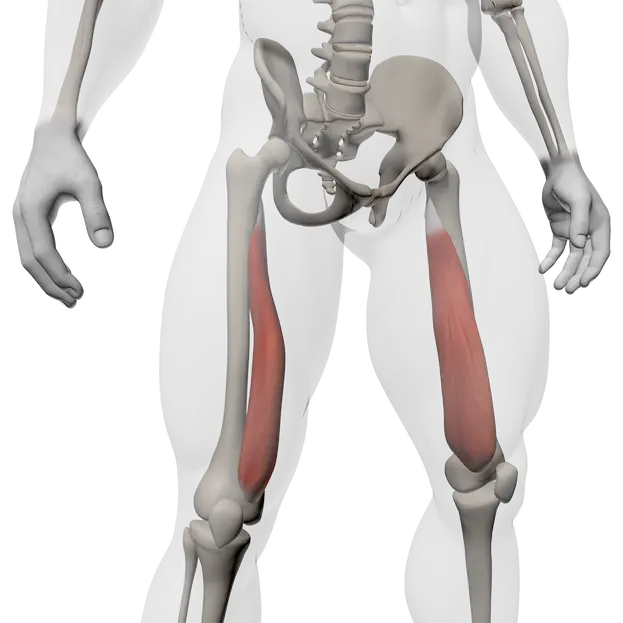
Scientific name:
Vastus medialis
Location:
Muscle located on the inner side of the front thigh, just above and inside the knee.
Overall role:
Provides medial patellar control and knee stability in the final phase of extension.
Sports where this muscle is a key :
- Sports with frequent direction changes (football, handball)
- Running
- Jumping sports
- Combat sports
- Sports requiring controlled landings
Origin
- Intertrochanteric line of the femur
- Linea aspera of the femur (medial portion)
Insertion
- Medial border of the patella via the quadriceps tendon
- Tibial tuberosity through the patellar ligament
Innervation
- Femoral nerve (roots L2–L4)
(nerve involved in knee extension and anterior thigh control)
Key points to remember
- Mono-articular muscle (acts only on the knee)
- Distal fibers often oriented obliquely (VMO portion)
- Plays a key role in patellar centering
- Low emphasis on maximal force, high emphasis on motor control
Main actions
- Knee extension, especially in the final degrees of extension
Synergists (muscles working with it)
- Vastus lateralis
- Vastus intermedius
- Rectus femoris
- Gluteal muscles (lower-limb stability)
Antagonists (muscles with opposite action)
- Hamstrings (knee flexion)
Postural / stabilizing role
- Medial stabilization of the patella
- Major contributor to fine knee stability during weight-bearing tasks
The vastus medialis is a precision and control muscle, not a power muscle.
It mainly acts to align, decelerate, and lock the knee safely.
Practical coaching interpretations:
- Weak → medial instability / altered patellar tracking
- Inhibited → dominance of the vastus lateralis
- Poorly controlled range → loss of stability near full extension
Activation test (bodyweight / light load)
- Goal: verify vastus medialis activation without compensation.
- Setup:
- Partial squat, feet hip-width apart.
- Focus on strict knee alignment.
- What to observe:
- Localized sensation above and inside the knee.
- Knee remains stable, no lateral drift.
- Interpretation:
- ➡️ No local sensation → insufficient activation.
- ➡️ Knee drifting outward → poor medial control.
Weakness test (light load)
- Goal: detect lack of control near full extension.
- Setup:
- Slow step-down from a low platform.
- Controlled tempo.
- What to observe:
- Knee stability during descent and landing.
- Interpretation:
- ➡️ Shaking or deviation → weak vastus medialis.
- ➡️ Hip compensation → local control deficit.
Dominance / compensation test
- Goal: identify excessive vastus lateralis dominance.
- Setup:
- Single-leg squat with reduced range of motion.
- What to observe:
- Patellar tracking during movement.
- Interpretation:
- ➡️ Visible lateral pull → vastus medialis under-recruited.
- Simple correction:
- Reduce range of motion.
- Slow down the tempo.
- Maintain strict knee–foot alignment.
Activation / isolation
- Low squat isometric holds with control
- Partial-range knee extensions with light resistance
Functional / multi-joint
- Controlled step-down
- Slow squats with strict alignment
Useful variations
- Slow unilateral work
- Isometric holds near full extension
Typical imbalances
- Vastus lateralis dominance
- Inhibition of the vastus medialis
Related risks / pain
- Anterior knee pain
- Patellar discomfort during effort
Warning signs
- Inner knee instability sensation
- Pain when descending stairs
- Discomfort near full knee extension
- Heavy loading without knee-axis control
- Seeking volume or maximal load
- Fast, uncontrolled ranges of motion
- Compensation through the hip or ankle
- Slow knee flexion–extension with controlled range
- Ankle mobility work to improve knee alignment
- Mindful walking, focusing on knee positioning
*VMO = Vastus Medialis Obliquus