
Seated Overhead Dumbbell Triceps Extension
Category: 🟧 Push – Chest / Shoulders / Triceps
Difficulty: ★★☆☆☆ (Intermediate)
Equipment: Short dumbbell (single or pair) + bench with back support
Goal
- Target the long head of the triceps by placing the arms overhead, where the muscle is in a deep stretch.
- Build pressing strength and scapular stability through a guided, controlled range of motion.
- Stimulate triceps hypertrophy while limiting stress on wrists and shoulders if the back stays firmly supported.
- Ideal exercise at the end of a strength block after presses or dips to fully finish the triceps.
Muscles Worked
- Primary: Triceps brachii (long head dominant, medial and lateral heads).
- Synergists: Anterior deltoid, scapular stabilizers.
- Stabilizers: Lower trapezius, deep core, lumbar stabilizers (when the torso stays neutral).
Variations
- Classic two-hand version: one dumbbell held with both hands, ideal when learning the movement.
- Unilateral: one dumbbell per arm to correct strength imbalances and improve mind–muscle connection.
- Bottom-range isometric: 1–2 s pause in the stretched position to emphasize long-head recruitment.
- Slow tempo: 3–4 s controlled descent to increase time under tension without relying on heavy loads.
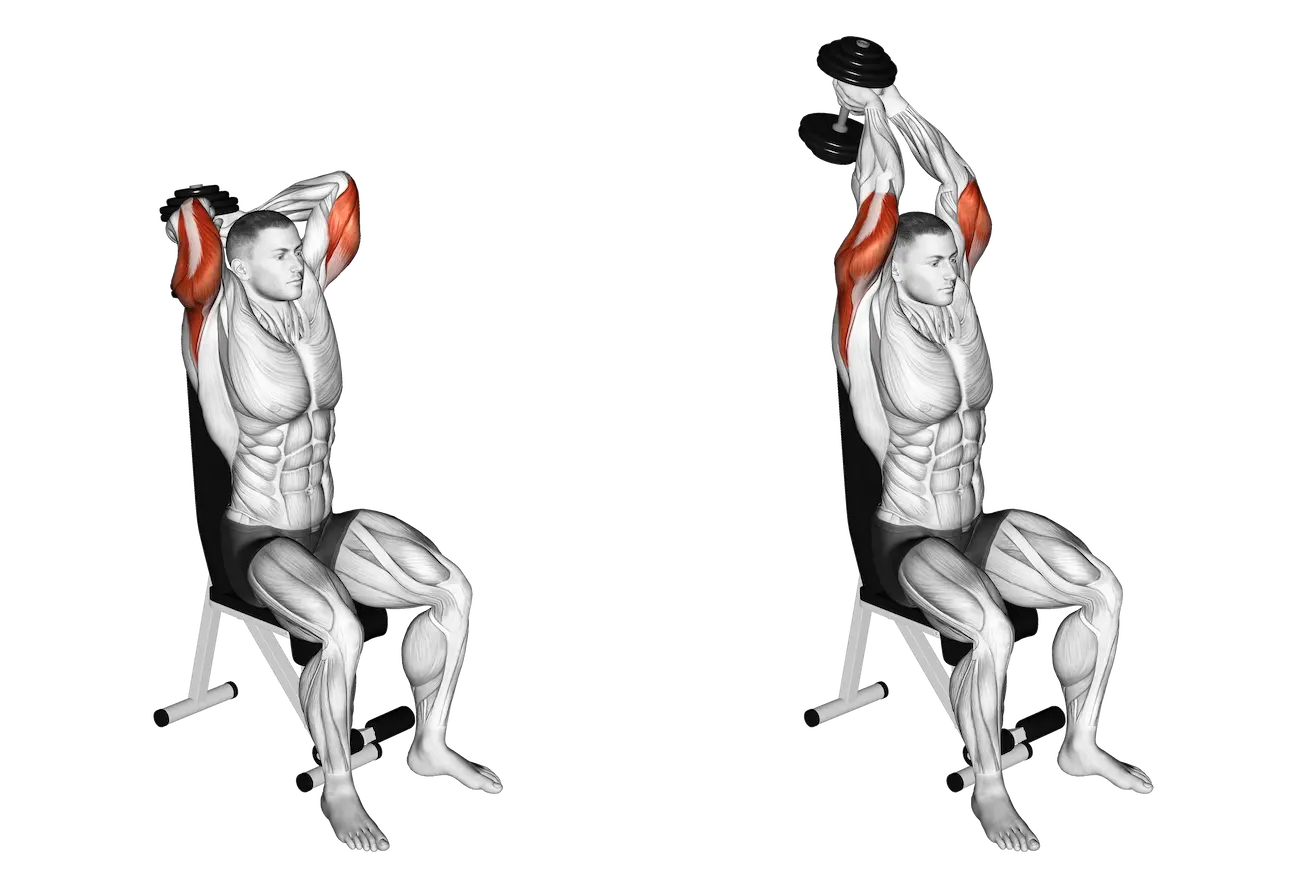
Strong triceps are often built overhead: controlled stretch, tight elbows, back firmly supported.
Technique — Step by Step
- Starting position:
Sit on a bench with back support, upper back firmly against the pad, feet hip-width apart. Hold a dumbbell with both hands (or one dumbbell per arm in the unilateral version) and bring it overhead, elbows pointing up. Keep the chest lifted, core lightly braced, eyes facing forward. - Eccentric phase (lowering):
As you inhale, bend your elbows and let the dumbbell travel behind your head while keeping the elbows tight and fixed. Aim for a comfortable stretch in the triceps without arching the lower back or letting the elbows flare to the sides. - Concentric phase (lifting):
As you exhale, extend your arms, driving the dumbbell back up until you return close to vertical. Avoid snapping the elbows; keep a slight bend to maintain muscular tension. - Target range / tempo:
Use a full, controlled range of motion without torso momentum. Reference tempo: 2 – 1 – 2 (controlled descent – brief pause at the bottom – smooth, controlled lift). The triceps stay under tension from start to finish. - Quick cues:
“Elbows tight and pointing up”, “Back glued to the pad”, “Lower behind the head, not to the sides”, “Chest tall, no exaggerated arch”.
| ❌ Common Mistakes | ✅ Best Practices |
|---|---|
|
|
Standard Workout Formats
| Hypertrophy (TUT 30–50 s) | Definition / Finisher (TUT 40–60 s) | Strength / Control (TUT 20–35 s) | |
|---|---|---|---|
| Sets | 3 – 4 | 3 – 4 | 3 – 4 |
| Reps | 8 – 12 | 12 – 15 | 6 – 8 |
| Tempo | 2 – 1 – 2 | 2 – 1 – 3 | 2 – 0 – 2 |
| Rest | 60–90 s | 45–60 s | 90–120 s |
1% Method
| PLC Power – Length – Contraction | 100-Rep Set Density / pump finisher | |
|---|---|---|
| Goal | Densify the key set with a calibrated load and strict tempo. | Boost local endurance and triceps pump at the end of the session. |
| Structure | 1 “key” set based on the PLC widget (validated tempo and range of motion). | 100 total reps (e.g. 10×10 or 5×20) with clean technique. |
| Load | Load selected from the widget, targeting RPE 8–9 without cheating with the back. | Light to moderate, focused on burn and quality of execution. |
| Intra-set rest | Continuous tempo (no rest) or very short micro-pause at the top. | 10–20 s between mini-blocks to maintain form and tension. |
| Frequency | 1–2×/week on the main triceps exercise of the block. | ≤ 1×/week as an arm or upper-body finisher. |
| Key cue | Elbows tight, back glued to the pad, controlled range from start to finish. | Break the set into chunks early, keep the elbows stable and breathe regularly. |
1% Method Integration
Phase 4 – Muscle Block (7 to 10 min)
Integration Rationale
- Recommended placement: after a compound push (press, dips) to finish the triceps specifically.
- Optional superset with a light back or biceps movement to maintain blood flow without overloading the elbows.
- 100-Rep Set: reserve for phases where the athlete tolerates deep stretches well, and keep technique extremely strict.
- PLC: ideal for learning to manage load through full range of motion without cheating with the back or letting the elbows flare.
Recommended Frequency
- 1 to 2 times per week depending on overall upper-body volume and elbow recovery.
- Alternate with other triceps variations (cable, dips, kickbacks) to distribute joint stress.
Back supported, elbows tight, controlled range: the recipe for a strong long head that carries all your presses.