
Standing Calf Raise (Machine)
Category : 🟨 Lower body – Calves/Lower posterior chain
Difficulty : ★★☆☆☆ (intermediate)
Equipment : Standing calf raise machine (or Smith machine + step)
Goal
- Strengthen the gastrocnemius and lower posterior chain for more powerful push-off.
- Improve stability and balance in walking, running and jumping.
- Develop calf hypertrophy and local endurance for athletic performance and posture.
Target Muscles
- Main: Gastrocnemius (medial and lateral heads).
- Synergists: Soleus, plantar flexors.
- Stabilizers: Intrinsic foot stabilizers, ankle stabilizers, core bracing.
Variations
- Bodyweight standing calf raise on a step (no external load).
- Unilateral standing calf raise (one leg at a time for symmetry work).
- Smith machine standing calf raise on a sturdy step.
- 2–3 s isometric hold at the top to accentuate peak contraction.
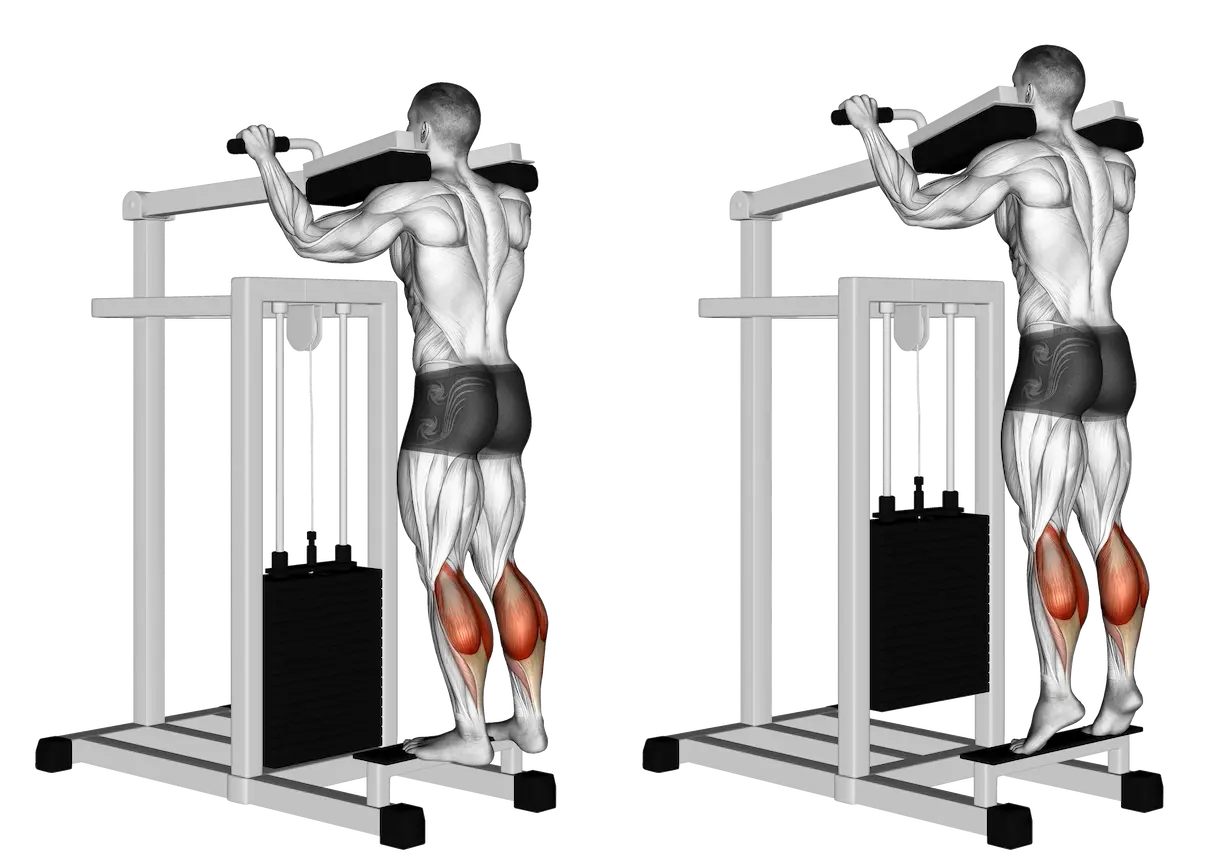
Slow stretch down, strong squeeze up — every rep counts from heel drop to lockout.
Technique — Step by Step
- Starting position:
Step onto the machine with the balls of your feet on the platform and your heels hanging off. Shoulders under the pads (or bar on the traps), knees slightly unlocked, core braced and torso upright. Feet hip-width apart, pointing straight ahead. - Concentric (up):
Push through the mid-foot/forefoot and rise onto your toes, driving the heels as high as possible without using torso momentum. Exhale and actively squeeze the calves for 1–2 seconds at the top. - Eccentric (down):
Inhale and lower the heels slowly until you feel a comfortable stretch in the calves, without dropping or bouncing at the bottom. Keep the knees softly extended and the weight distributed across the whole forefoot. - Tempo / Range target:
2 – 1 – 2 (up – hold – down) as a reference. Work through a full, controlled range without locking the knees or collapsing the ankles in/out.
| ❌ Common Mistakes | ✅ Best Practices |
|---|---|
|
|
Training Formats
| Strength / Control (TUT 30–45 s) | Hypertrophy (TUT 40–60 s) | Endurance (TUT 40–60 s) | |
|---|---|---|---|
| Sets | 4 | 4 | 3 |
| Reps | 8 – 10 | 12 – 15 | 20 – 25 |
| Tempo | 2 – 1 – 2 | 2 – 1 – 2 | 1 – 0 – 1 |
| Rest | 60 – 90 s | 45 – 60 s | 30 – 45 s |
1% Method
| PLC Power – Length – Contraction | Set of 100 Density/Pump Finisher | |
|---|---|---|
| Goal | Reinforce calves with a calibrated load and controlled stretch–squeeze cycle. | Build local endurance and pump at the end of the leg session. |
| Structure | 1 “key” set from the widget parameters. | 100 reps split into mini-blocks (e.g., 10×10 / 5×20). |
| Load | From the widget (tempo/range) – aim for RPE 8–9 with perfect form. | Light to moderate load, focus on smooth heel drop and full extension. |
| Intra-set rest | Continuous tempo or short targeted micro-pauses if needed. | 10–20 s between mini-blocks, keep the calves under tension. |
| Frequency | 1–2×/week on your main standing calf raise. | ≤ 1×/week as a finisher on lower-body day. |
| Key cue | Soft knees, stacked ankles, controlled stretch at the bottom. | Breathe, shake out between mini-blocks, never sacrifice range. |
1% Method Integration
Phase 4 – Muscle Block
Integration Logic
- Place the standing calf raise at the end of the lower-body block to finish the posterior chain.
- Superset option: alternate with seated calf raises or light partial squats to keep blood flow.
- Use PLC on heavy days for precise loading, and the Set of 100 as a high-tension finisher on lighter days.
Recommended Frequency
- Integrate standing calf raises 1–2×/week depending on overall leg volume and recovery.
- Alternate focus: one session more strength/control, one session more hypertrophy/endurance.
From deep stretch to full extension — controlled calf work pays off in every stride.