
Rotational Dumbbell Concentration Curl
Category : 🟥 Pull – Upper Body (Biceps)
Difficulty : ★☆☆☆☆ (beginner to intermediate)
Equipment : Dumbbell + bench (elbow braced against the inside of the thigh)
Purpose
- Develop the biceps brachii with progressive supination to maximize contraction at the end range.
- Specific emphasis on the short head of the biceps and the quality of the mind-muscle connection.
Muscles involved
- Primary : Biceps brachii, with a short-head bias through supination.
- Synergists : Brachialis, brachioradialis.
- Stabilizers : Finger and wrist flexors, anterior deltoid (minor involvement), lumbar bracing / seated lumbar stabilizers.
Variations
- Pure rotational version : neutral grip at the bottom → clear supination at the top, with the little finger moving toward the shoulder.
- Hammer grip (fixed neutral grip, no rotation) — a gentler variation for sensitive elbows and wrists; emphasis on the brachialis and brachioradialis.
- 1–2 s isometric pause at peak contraction, with the elbow anchored.
- Standing, torso inclined, with the elbow against the thigh, for a slightly different range of motion.
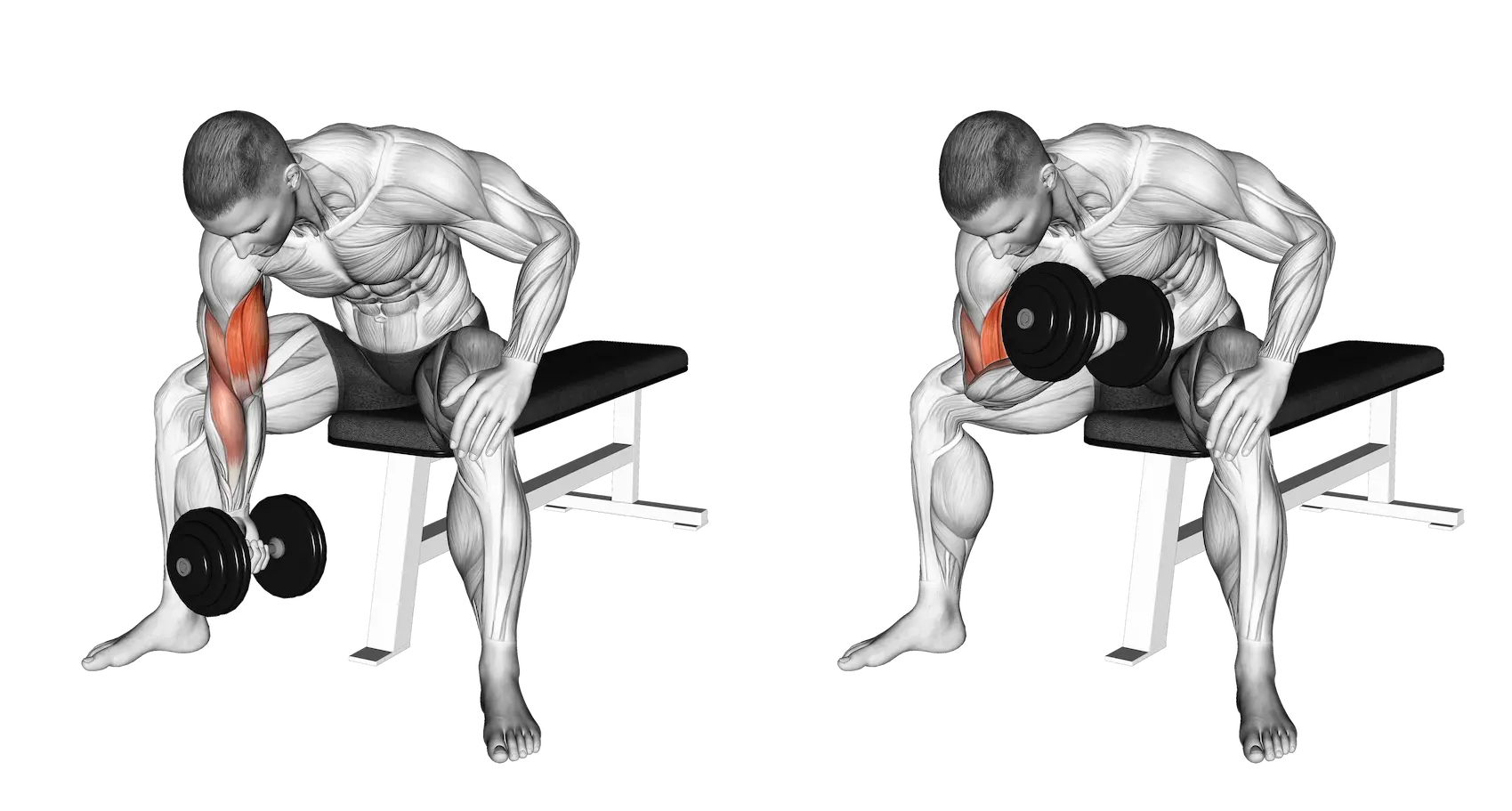
Rotational version: gradually turn the hand upward as you curl, creating a clearly stronger peak contraction than a strict concentration curl.
Technique — step by step
- Starting position :
Sit down and place your feet slightly apart. Brace the elbow against the inside of the thigh on the working-arm side. Hold the dumbbell with a neutral grip, palm facing you, shoulder down, torso stable. - Concentric phase (rotational curl) :
Exhale and flex the elbow while progressively supinating, turning the palm upward. Aim for the cue “little finger toward the shoulder” at the top. Avoid letting the shoulder move forward : only the elbow joint should drive the movement. - Peak contraction :
Hold a 1 s pause at the top, wrist aligned, not bent, with the biceps fully squeezed. - Eccentric phase (controlled lowering) :
Inhale and lower the dumbbell over 3 s, gradually returning toward a neutral grip without losing elbow anchoring. - Rhythm / Target range of motion :
Tempo 3–1–3 : 3 s up – 1 s squeeze – 3 s down. Avoid full extension : keep about 10–15° of elbow flexion to maintain tension.
| ❌ Common faults | ✅ Best practices |
|---|---|
|
|
Traditional programming
| Hypertrophy (TUT 30–50 s) | Definition / finisher (TUT 40–60 s) | Strength / density (TUT 15–30 s) | |
|---|---|---|---|
| Sets | 3 – 4 | 3 – 4 | 4 – 5 |
| Reps | 8 – 12 | 10 – 15 | 4 – 6 |
| Tempo | 3 – 1 – 3 | 3 – 0 – 3 | 2 – 0 – 2 |
| Rest | 60 – 90 s | 45 – 60 s | 90 – 150 s |
Integration within the “1% Method”
| PLC Power – Length – Contraction | 100-Rep Set Muscle density & local endurance | |
|---|---|---|
| Purpose | Increase the density of the “key” set with calibrated tempo and supination. | Local endurance & targeted biceps pump. |
| Structure | 1 set according to the widget, with controlled range of motion. | 100 reps in mini-blocks, for example 10×10 or 5×20. |
| Load | Based on the widget, RPE 8–9, strict execution. | Light → moderate load, flawless form. |
| Intra-set rest | Continuous execution or targeted micro-pause. | 10–20 s between mini-blocks. |
| Frequency | 1–2×/week | ≤ 1×/week, at the end of the session. |
| Key coaching cue | Progressive supination, elbow anchored, constant tempo. | Break the reps early, breathe, keep the elbow fixed. |
Phase
Phase 4 – Muscle Workout
Integration logic
- Complementary superset : pair with a triceps movement or a light back pull to balance mechanical stress.
- 100-Rep Set finisher for density and pump, using the rotational version.
- PLC : reinforce the 3–1–3 tempo and progressive supination on the key set.
Recommended frequency
- 1–2 exposures/week; alternate #7, rotational with peak contraction, and #6, fixed strict version, to stimulate different angles and constraints.
- Moderate volume, strict form as the priority.
For agonist/antagonist balance, combine the rotational concentration curl with a triceps exercise and a light back-pulling movement.