Jumping Jack
Category : 🟧 Warm-up / HIIT / Tabata – Jumping Jack
Difficulty : ★☆☆☆☆ (beginner to intermediate)
Equipment : Bodyweight – no equipment
Goal
- Boost your cardio and quickly raise your heart rate.
- Support fat loss by using it inside a HIIT or Tabata block.
- Improve arm–leg coordination with a simple, repetitive movement.
- Build overall endurance with an intensity and duration that are easy to adjust.
Muscles worked
- Main: quads, hamstrings, calves, glute max and med, anterior and middle delts.
- Synergists: abs, obliques, adductors, shoulder-girdle muscles.
- Stabilisers: lower back, foot and ankle muscles (landing stability).
Variations
- Easier: step jack (step one leg out at a time with no jump), arms to mid-height, moderate pace and zero impact.
- Harder: power jack (more explosive jump), band around the ankles, used inside a HIIT or Tabata block.
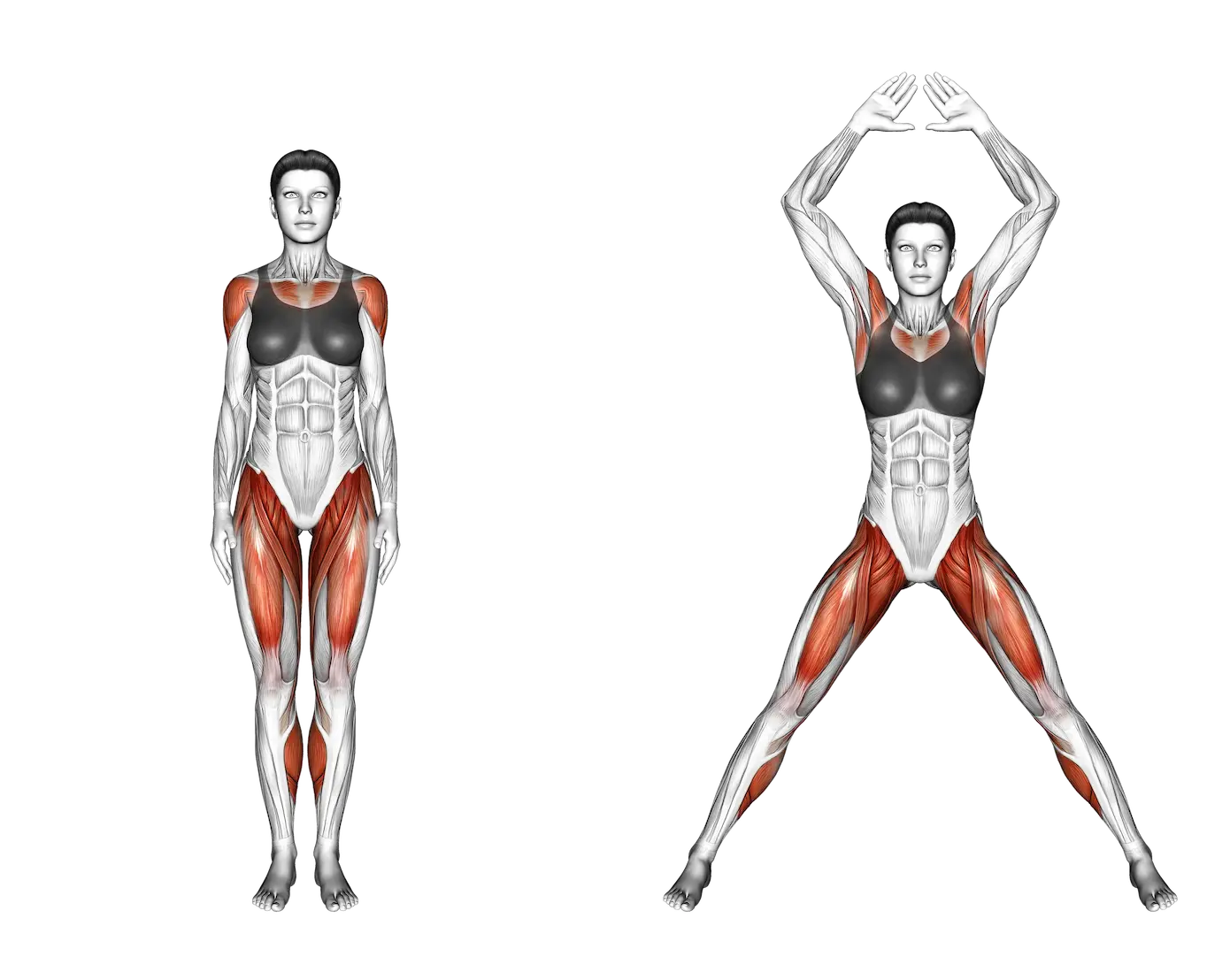
Jumping jacks are a classic cardio move: simple, effective, and perfect for warm-ups or for a well-structured HIIT or Tabata block.
Technique — Step by step
- Starting position:
Stand tall with your feet together and arms by your sides.
Keep your knees soft at all times, brace your core, chest up and eyes looking straight ahead.
Lightly brace your abs to avoid overarching your lower back. - Opening phase (lateral jump):
Jump out by spreading your feet wider than shoulder-width while bringing your arms overhead (without jamming your shoulders).
Land on the balls of your feet with “light feet”, knees bent to absorb the impact. - Closing phase:
Return to the starting position by bringing your feet back together and lowering your arms to your sides at the same time.
Control the arm descent, keep your torso stable and avoid “dropping” your weight onto your heels. - Target rhythm / range:
Warm-up: moderate pace, smooth breathing, quiet impact.
HIIT / Tabata: higher pace (1–2 jumping jacks per second) while keeping knees soft and landings light.
| ❌ Common mistakes | ✅ Best practices |
|---|---|
|
|
Standard formats
| Warm-up Progressive activation | HIIT Controlled cardio peak | Cardio endurance Continuous work | |
|---|---|---|---|
| Sets | 1 – 3 | 4 – 8 | 3 – 6 |
| Duration | 20 – 40 s | 20 – 40 s per interval | 30 – 60 s per set |
| Tempo | Moderate pace, light impact | High cadence, soft knees, “light feet” | Medium cadence, controlled breathing |
| Rest | 0 – 20 s | 10 – 30 s between intervals | 15 – 45 s or built into a circuit |
1% Method
| HIIT – Cardio Peak 1 20–40 s intervals | Tabata – Cardio Peak 2 20 s / 10 s – 8 rounds | |
|---|---|---|
| Goal | Create a short, controlled cardio peak. | Strongly boost endorphins at the end of the session. |
| Structure | 4–8 intervals of 20–40 s / 10–30 s recovery. | 8 × (20 s of jumping jacks / 10 s recovery). |
| Intensity | RPE 7–8/10, high speed but controlled form. | RPE 8–9/10, impact still light, knees soft. |
| Rest | Active rest (march in place) between sets. | Very short rest, focus on breathing. |
| Frequency | 1–2×/week depending on level and recovery. | ≤ 1×/week with jumping jacks, alternate with other exercises. |
| Key cue | “Soft knees, light feet”: quiet impact, stable torso. | Keep technique clean even when tired; reduce range before you sacrifice posture. |
1% Method integration
Phase 1 – Warm-up
Phase 3 – Cardio Peak 1
Phase 6 – Cardio Peak 2
Integration logic
- Phase 1 – Warm-up: use jumping jacks (or step jacks) to gradually raise body temperature, starting low impact then adding the jump.
- Phase 3 – Cardio Peak 1 (HIIT): add jumping jack intervals to create a first cardio peak, with a tempo inspired by simple cardio blocks like BodyAttack-style tracks.
- Phase 6 – Cardio Peak 2 (Tabata): choose jumping jacks or power jacks as the single exercise for the final Tabata to maximise endorphins without complicating technique.
Recommended frequency
- Include jumping jacks 1–3×/week depending on level, alternating between low-impact and high-intensity versions.
- Monitor joint feedback (knees, ankles, lower back) and adjust range of motion or switch back to step jacks if needed.
This exercise pairs perfectly with lower-body strength moves like squats and lunges for full-body balance.