
Air Bike – Assault / Echo / Cross Trainer
Category: 🔴 Cardio – HIIT / Tabata / Full-Body
Difficulty: ★★★★☆ (intermediate to advanced)
Equipment: Air Bike (Assault Bike, Echo Bike, Air Cross Trainer)
Goal
- Stimulate the cardiorespiratory and neuromuscular system at high intensity.
- Engage the entire body (push/pull arms + pedalling) with a resistance that auto-adapts to power output.
- Elevate VO₂max, lactate tolerance and overall coordination.
- Act as a central tool for HIIT and Tabata blocks in the 1% Method.
Muscles worked
- Main lower body: quadriceps, hamstrings, glutes, calves.
- Main upper body: chest, deltoids, lats, biceps, triceps.
- Stabilisers: abdominals, lower back, scapular stabilisers (postural core work).
Variations
- Arms only: targeted work for shoulders, back and core.
- Legs only: emphasis on quads and glutes.
- 15/15/15 Progressive Sprint: increase power slightly every 15 seconds.
- 10–20–30 Pyramid: advanced HIIT format with increasingly longer intervals.
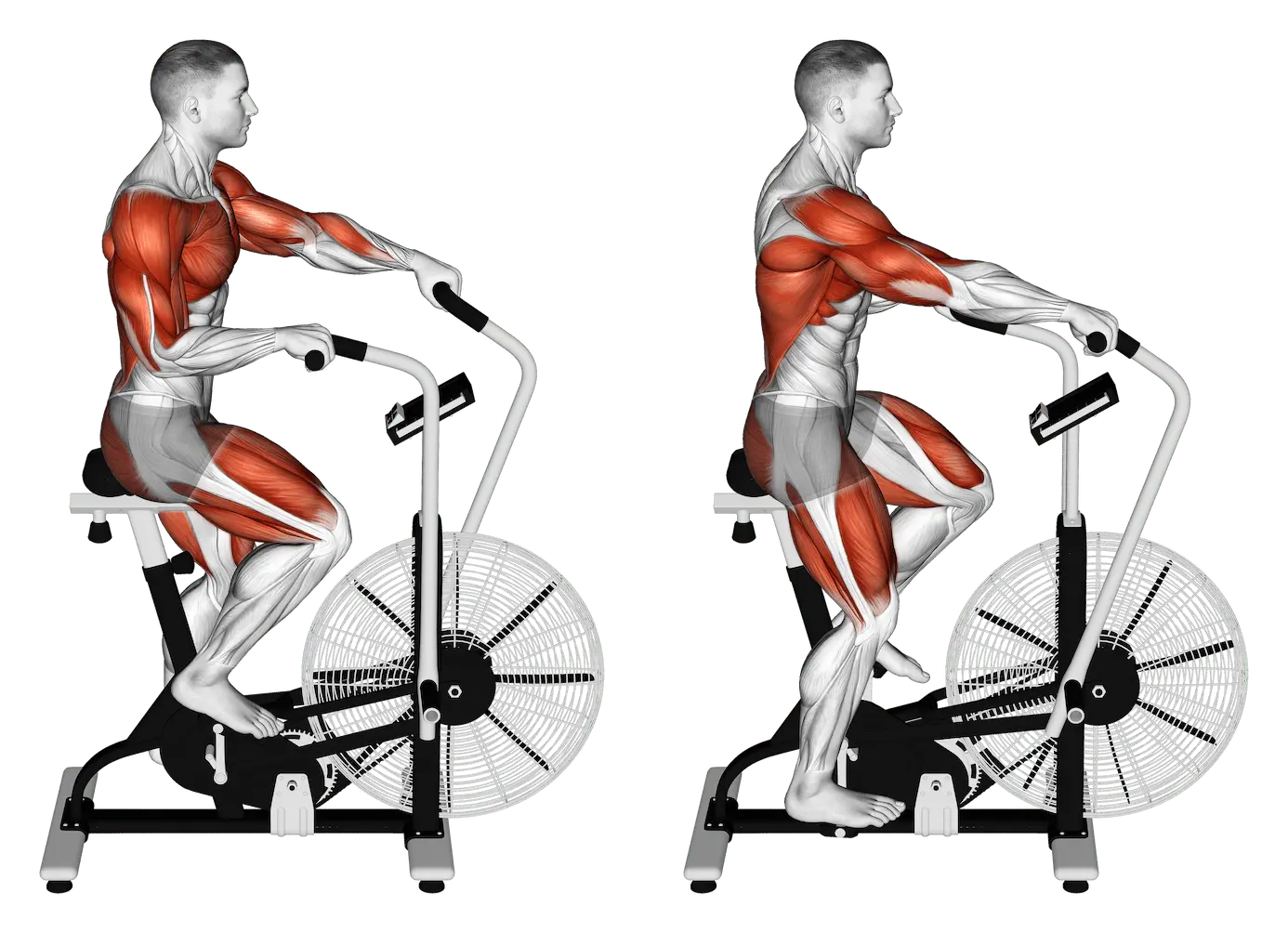
The Air Bike is a full-body cardio weapon — a few minutes are enough to push the system to its limit, as long as you handle it with respect.
Technique — Step by Step
Starting Position
Adjust the saddle so your leg is slightly bent at the bottom of the cycle, without locking the knee. Place the feet centred on the pedals. Handles at shoulder height, torso slightly leaned forward, core engaged, eyes looking straight ahead.
Start-Up
Begin with moderate resistance. Aim for a smooth pattern: the arms push and pull while the legs keep pedalling continuously. Keep the shoulders down, the grip firm but not tense, and avoid jerky movements.
Intensity Management
- Neuro Block (pre-HIIT): 5 min at 60–70% effort, stable cadence, focus on arm–leg coordination and controlled breathing.
- Short HIIT Block: 6 × (30 s work / 30 s recovery) at ~85–90% effort, high power with clean technique.
- Tabata Block: 8 × (20 s work / 10 s recovery) at 95–100% effort, maximum cadence on each 20 s, active recovery during the 10 s.
Breathing / Posture
Keep a neutral spine, torso slightly inclined but never collapsed. Breathe rhythmically: exhale during the push phase, inhale on the way back. The higher the intensity, the more you must focus on pelvic stability and abdominal bracing.
End of Block
At the end of a HIIT or Tabata block, first reduce the power, then the cadence. Stay on very light pedalling for 2–3 minutes to let the heart rate come down before stepping off the bike.
| ❌ Common Mistakes | ✅ Best Practices |
|---|---|
|
|
Typical Formats
| Neuro Block (pre-HIIT) | Short HIIT Block (Power) | Tabata Block (Explosive) | Active Recovery Block (Cool Down) | |
|---|---|---|---|---|
| Duration | 5 min | 6 × 30/30 | 4 min (8 × 20/10) | 3–6 min |
| Intensity | 60–70% effort | ~85–90% effort | 95–100% effort | 40–50% effort |
| Main Goal | Full upper/lower-body activation | Power endurance | Total metabolic shock | Gradual return to calm |
| Best For | All coached levels | Intermediates | Experienced athletes | All levels |
| Feelings | Controlled breathing, body waking up | High cardio, technique maintained | Legs on fire, very short breathing at the end | Heart rate dropping, tension decreasing |
1% Method
⚠️ Do not combine a long HIIT block and a full Tabata on the same Air Bike in a single session — choose the block that best matches your goal.
Phase 2 – Neuro-Connection: 5 min at 60–70% HR max
- Level 1: smooth pedalling, light resistance, easy breathing.
- Level 2: more dynamic arm–leg coordination, moderate resistance, stable cadence.
- Level 3: slight increase in power, focus on movement symmetry without excessive burning.
Goal: wake up the cross-chains (upper and lower body) and the nervous system without draining the main block.
Cardio Peak: controlled HIIT or, for advanced athletes, final Tabata
HIIT (Phase 3 – Cardio Peak 1)
- Format: 6–10 × (30 s work / 30 s recovery).
- Effort: 70–85% effort, RPE 7–8/10, high power with clean technique.
- Posture: core braced, hips stable, shoulders relaxed.
- Active rest: very light pedalling, never a complete stop.
Goal: create a controlled cardio peak without sacrificing technique.
Tabata (Phase 6 – Cardio Peak 2)
- Format: 8 × (20 s work / 10 s rest) on the Air Bike.
- Effort: 95–100% effort, RPE 9–10/10.
- Resistance: high but still compatible with smooth pedalling, no jerks.
- Recovery: 10 s of very light active pedalling, then 3–6 min of cool down after the full block.
The Air Bike turns a simple session into a true resilience test — physically and mentally — while still being joint-friendly.