
Butt Kicks (Running Butt Kicks)
Category : 🟧 Cardio / Coordination – Warm-up / HIIT
Difficulty : ★☆☆☆☆ (beginner)
Equipment : No equipment; running shoes and a flat, non-slippery surface recommended
Goal
- Improve knee mobility, leg turnover and hamstring activation with a simple running-style drill.
- Develop light cardio conditioning that is easy to scale from warm-up to HIIT intervals.
- Use as active recovery between explosive exercises such as sprints or jumps.
Muscles worked
- Main movers: Hamstrings, calves (gastrocnemius and soleus).
- Synergists: Glutes, quadriceps (stabilisation), hip flexors.
- Stabilisers: Core (abdominals, obliques), lumbar muscles, shoulders and deltoids through natural arm swing.
Variations
- Easier – slow butt kicks : low tempo, no rebound; use as a gentle warm-up for 30–60 seconds.
- Easier – marching butt kicks : alternate heel-to-glute while marching on the spot or walking forward.
- Easier – short bouts : 15–20 seconds of work followed by 20–30 seconds of easy walk.
- Harder – fast running butt kicks : increase leg frequency to simulate sprint mechanics while staying on the spot.
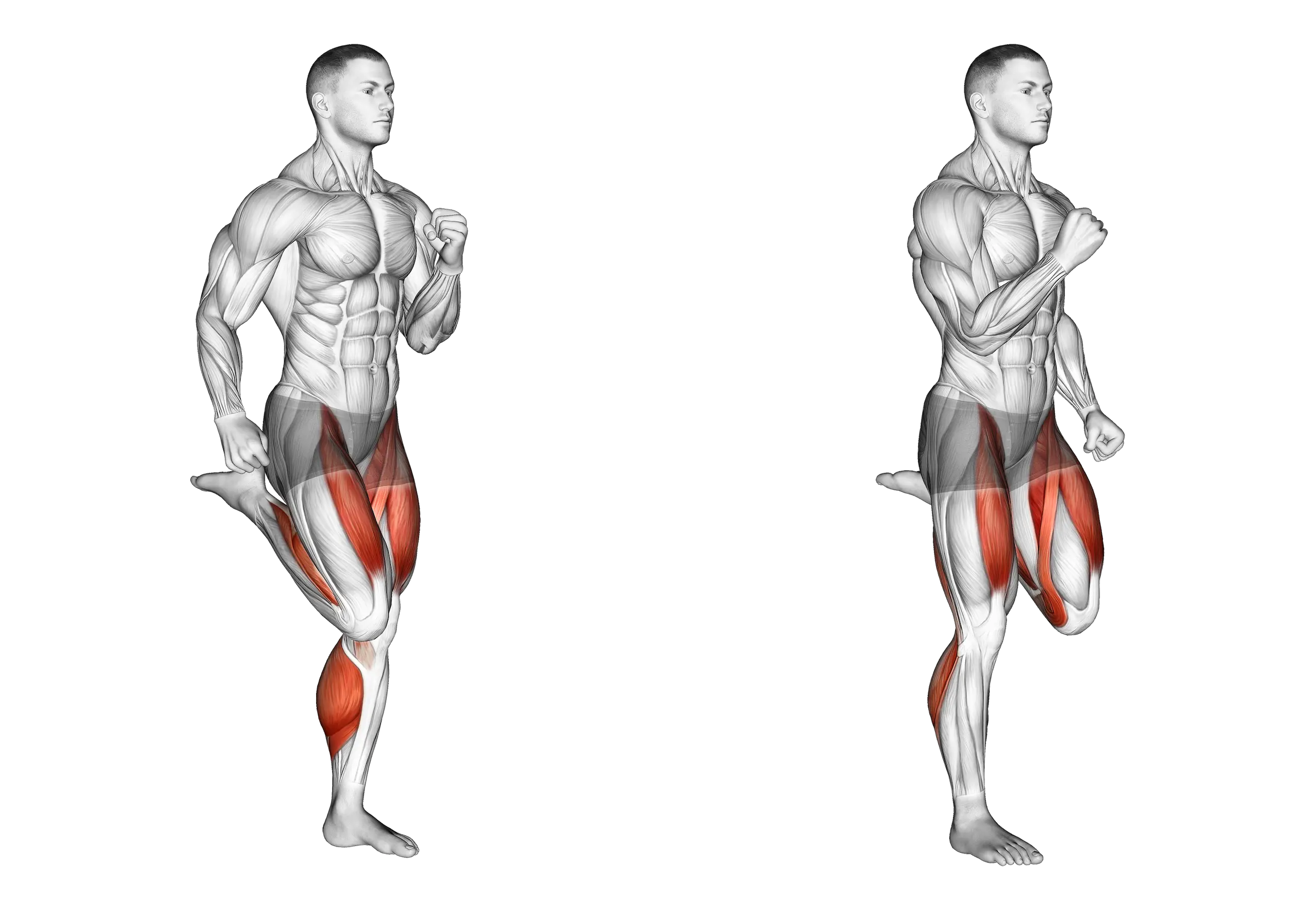
Butt kicks are a simple cardio drill to wake up the legs, activate the hamstrings and prepare the body for faster running work.
Technique — Step by step
- Start position
Stand tall with your feet hip-width apart on a stable, non-slippery surface. Keep the chest open, shoulders relaxed and eyes looking forward. Brace the core gently as if preparing for a light impact. - Leg drive
Start to jog on the spot, bringing one heel up towards the glute at a time. The knee bends under the body rather than kicking backwards. Land softly on the balls of the feet under your centre of mass. - Arms and posture
Let the arms swing naturally like an easy run, elbows close to the body. Keep a long spine with only a slight forward lean from the ankles, not from the lower back. Avoid letting the head drop or the shoulders tense up. - Rhythm and breathing
Find a comfortable rhythm of 1–2 heel kicks per second depending on fitness level. Breathe regularly (exhale on effort, inhale as you reset). Maintain smooth, quiet contacts with the floor and stop the set if posture or coordination break down.
| ❌ Common mistakes | ✅ Good practice |
|---|---|
|
|
Typical formats
| Warm-up block (Easy cardio) | Tabata / HIIT (Fast turnover) | |
|---|---|---|
| Work duration | 30 – 60 s | 20 s |
| Rest | 0 – 20 s active rest (march or walk) | 10 s |
| Number of cycles | 2 – 4 rounds at comfortable pace | 8 cycles |
| Target intensity | RPE 4 – 6, light sweat, conversation still possible | RPE 7 – 9, fast leg turnover while keeping clean posture |
1% Method
| HIIT format Cardio Peak 1 | Final Tabata Cardio Peak 2 | |
|---|---|---|
| Goal | Create a progressive cardio peak with fast but controlled butt kicks on the spot. | Short, intense finisher to push leg speed and hamstring activation at the end of the workout. |
| Structure | 30–40 s work / 20–30 s rest, repeated. | Fixed 20 s work / 10 s rest × 8 rounds. |
| Placement | Phase 3 – Cardio Peak 1, after warm-up and pre-activation. | Phase 6 – Cardio Peak 2, as a final finisher. |
| Load | Body weight, flat surface with good grip; adjust tempo to skill level. | Body weight, option to slightly reduce cadence if landing quality drops. |
| Frequency | 1–2×/week in full-body or cardio-focused sessions. | Up to 1×/week as a high-intensity finisher. |
| Key coaching cue | Posture tall, cadence first, then increase intensity. | Keep the same technique and rep quality from round 1 to 8. |
1% Method integration
HIIT – Cardio Peak 1 (5 min)
Tabata – Cardio Peak 2 (4 min)
Phase 2 – Neuro-connection (3–4 min)
Goal: prepare the neuromuscular system for fast butt kicks by breaking the running pattern into simple drills.
Level 1 – Marching butt kicks (no impact)
- “March on the spot and bring one heel towards the glute at a time, staying tall.”
- “Keep the step small and under your hips, with soft contacts and relaxed shoulders.”
Level 2 – Traveling butt kicks (forward / backward)
- “Walk forward or backward while performing controlled heel-to-glute kicks.”
- “Keep the pelvis level and avoid over-striding or leaning from the lower back.”
Level 3 – Light jogging butt kicks
- “Start to jog on the spot, gently increasing leg turnover while keeping landings quiet.”
- “Focus on rhythm and coordination between arms and legs rather than maximum speed.”
Level 4 – Short accelerations
- “Alternate 10–15 seconds of faster butt kicks with 10–15 seconds of easy march or jog.”
- “This block is still neural preparation: technique and posture stay perfect before you enter HIIT work.”
Goal: start the HIIT block with an automatic, efficient butt kicks pattern, with no tension or fear of losing posture.
Phase 3 – Cardio Peak 1 – HIIT (5 min)
Goal: create a controlled cardio peak with repeated butt kicks at a moderate to high cadence.
Coaching cues to push further
- “Stay tall and light: quick feet under the body, heels brushing towards the glutes.”
- “Hold a steady tempo for the full interval instead of starting too fast and fading.”
- “Think ‘strong core’ during every step: no side-to-side wobble, chest open.”
- “If technique drops, reduce cadence or switch back to marching butt kicks, but keep clean form.”
- “Aim for an RPE of 7–8 depending on the athlete: breathless but always in control of posture and impact.”
Phase 6 – Final Tabata (4 min – 20/10 × 8)
Goal: short, dense and explosive finisher to close the session with a fast running-style effort on the spot.
Advanced coaching cues
- “Give your best effort on each 20-second block while keeping the same landing quality from start to finish.”
- “As fatigue builds up, first shrink the step length before letting posture collapse.”
- “Use a benchmark: aim for a similar number of heel kicks from round 1 to round 8.”
- “Keep a rhythmic breathing pattern: one or two breaths per second depending on the athlete.”
Recommended frequency
- Use butt kicks 1–3 times per week as part of warm-ups, cardio blocks or HIIT intervals.
- Avoid stacking them with other high-impact running or sprint work on the same day for less conditioned athletes.
- Combine this drill with more controlled strength or core work (squats, lunges, planks) to balance the session.
Used correctly, butt kicks are a low-complexity tool to work on leg turnover, cardio and running mechanics without needing extra equipment.