
Reverse Pec Deck (Seated Rear Delt Fly)
Category : 🟥 Pull – Rear delts / Upper back
Difficulty : ★★☆☆☆ (intermediate)
Equipment : Reverse pec deck machine (seated)
Goal
- Strengthen the rear deltoids and upper-back muscles to improve posture.
- Isolate the scapular retractors to balance pressing work and protect the shoulders.
- Improve scapular control and left–right symmetry with a stable chest support.
Target Muscles
- Main: Posterior deltoids, middle and lower trapezius, rhomboids.
- Synergists: External rotators of the shoulder, short head of triceps.
- Stabilizers: Spinal erectors, deep neck flexors, core bracing muscles.
Variations
- Regression: Light resistance with cables or bands in a reverse fly pattern.
- Dumbbell version: Rear delt fly on an incline bench.
- Isometric hold: 1–2 s pause in peak contraction for more scapular control.
- Unilateral work: One arm at a time for postural control and symmetry.
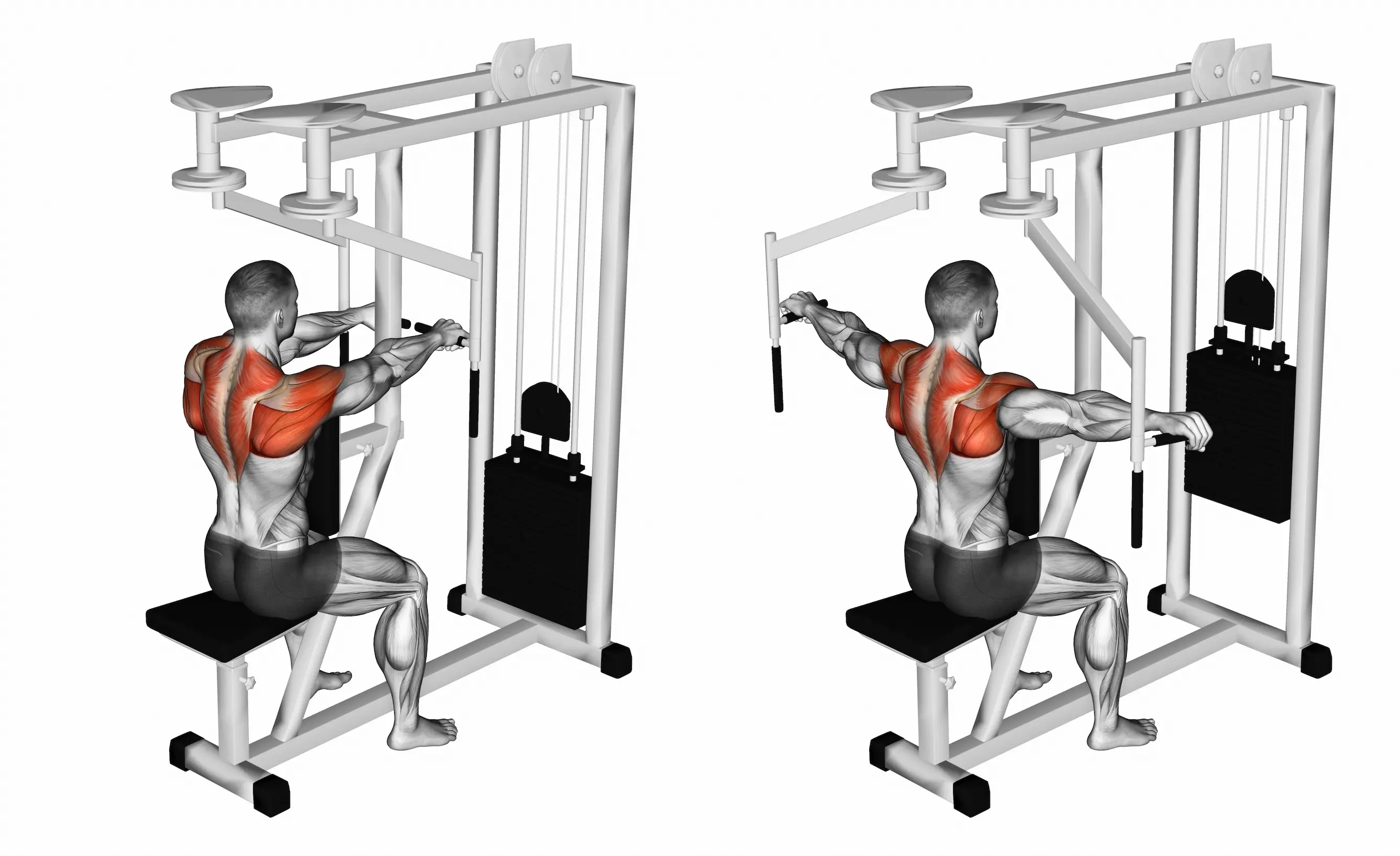
Chest glued to the pad, shoulders low, squeeze between the shoulder blades — not with the arms.
Technique — Step by Step
- Starting position:
Set the seat so that the handles are at shoulder height. Sit facing the machine, chest firmly against the pad, feet flat and core braced. Take the handles with a neutral or slightly pronated grip, elbows slightly bent, shoulders depressed and away from the ears. Inhale. - Concentric (pull back):
Open the arms in a wide arc, pulling the handles back until they are roughly in line with the shoulders. Focus on squeezing the shoulder blades together, not on yanking with the hands. Exhale and hold the contraction for about 1 second. - Eccentric (return):
Lower the arms slowly and under control to the start position while maintaining a small bend in the elbows. Keep the chest glued to the pad and avoid bouncing on the weight stack. Inhale during the return. - Tempo / Range target:
Aim for a controlled 2 – 1 – 2 tempo (up – hold – down). Use a full but pain-free range, without losing scapular control or rounding the upper back.
| ❌ Common Mistakes | ✅ Best Practices |
|---|---|
|
|
Training Formats
| Controlled Strength (2–0–2, 6–8 reps) | Hypertrophy (2–1–2, 10–12 reps) | Endurance (1–0–1, 15–20 reps) | |
|---|---|---|---|
| Sets | 3 | 4 | 3 |
| Reps | 6 – 8 | 10 – 12 | 15 – 20 |
| Tempo | 2 – 0 – 2 | 2 – 1 – 2 | 1 – 0 – 1 |
| Rest | 90 s | 60 s | 45 s |
1% Method
| PLC Power – Length – Contraction | Tempo Cadence & Control | |
|---|---|---|
| Goal | Densify the end of the block with one calibrated “key” set. | Teach athletes to feel rear delts through precise rhythm. |
| Structure | 1 key set using the widget (load, range, tempo fixed). | All sets follow the same tempo cue (e.g. 2–1–2) from start to finish. |
| Load | Load selected from the widget aiming for RPE 8–9. | Moderate load that allows strict control and full range. |
| Intra-set rest | Continuous work or short targeted micro-pauses if form drops. | No intra-set rest; adjust load instead of breaking the tempo. |
| Frequency | 1–2×/week on the key rear delt exercise. | Can be used almost every session while technique is being learned. |
| Key cue | Fixed chest, low shoulders, constant tension on rear delts. | Count the seconds out loud: “2 up – 1 hold – 2 down”. |
1% Method Integration
Phase 4 – Muscle Block (7 to 10 min)
Integration Logic
- Place the Reverse Pec Deck after a main horizontal or vertical pull to target rear delts and mid-back.
- Use it as an isolation balance for pressing sessions (bench press, shoulder press) to protect the shoulders.
- Apply PLC on the last working set to densify the block without increasing volume excessively.
- Use tempo-focused sets early in a cycle when athletes need more control than load.
Recommended Frequency
- Include the Reverse Pec Deck 1–2×/week depending on total upper-back volume and recovery.
- Rotate the focus: block with controlled strength → block with hypertrophy → block with PLC emphasis.
Low shoulders, chest on the pad, slow return — let the rear delts do the work, not the traps.