Middle Deltoid (Lateral Deltoid)

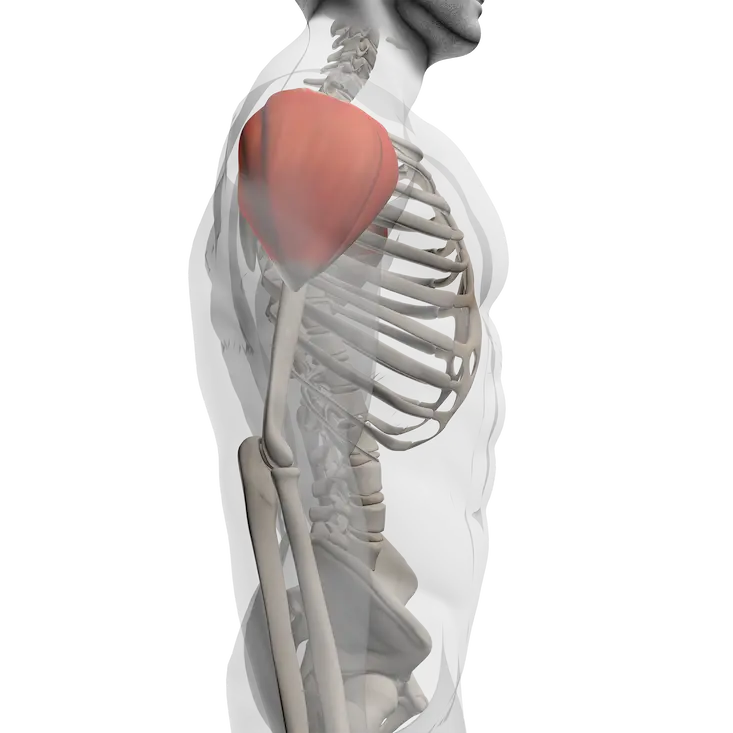
Middle deltoid shown in a transparent anatomical view, highlighting the lateral shoulder muscle responsible for arm abduction

Deltoideus – acromial (lateral) head

Muscle located on the outer side of the shoulder, forming the rounded contour of the shoulder.

Main muscle responsible for lifting the arm out to the side and contributing to shoulder stability.

  • Strength training / fitness
  • Weightlifting
  • Combat sports (boxing, Muay Thai, MMA)
  • Swimming
  • Throwing sports
  • Lateral border of the acromion (upper part of the shoulder blade)
  • Deltoid tuberosity of the humerus (outer side of the upper arm bone)
  • Axillary nerve (C5–C6)
    • Controls shoulder elevation and joint stability
  • Works closely with the rotator cuff for safe shoulder movement
  • Rarely works alone during real movements
  • Very sensitive to poor scapular control and compensations
  • Arm abduction (lifting the arm sideways), mainly between ~30° and 90°
  • Supraspinatus (movement initiation)
  • Anterior and posterior deltoid (stability)
  • Upper and lower trapezius (scapular positioning)
  • Latissimus dorsi
  • Pectoralis major
  • Teres major
  • Helps keep the humeral head centered in the shoulder socket
  • Supports shoulder control during loaded and overhead movements
  • Produces arm elevation but also compresses the shoulder joint, requiring good rotator cuff balance
  • Weak → upper trapezius compensation (early shoulder shrug)
  • Overactive or tight → reduced shoulder fluidity
  • Poor range control → anterior deltoid dominance

Goal: check if the lateral deltoid activates without neck compensation

Setup:

  • Standing position
  • Slow lateral raise up to ~60°
  • Very light dumbbell or no load

What to observe:

  • Tension felt on the outer shoulder
  • Neck stays relaxed

Interpretation:

  • Neck tension → trapezius dominance
  • Weak shoulder sensation → poor lateral deltoid activation

Goal: assess mechanical control

Setup:

  • Dumbbell lateral raises
  • Slow tempo (≈ 2–1–3)

What to observe:

  • Smooth path
  • No body swing

Interpretation:

  • Body momentum → lack of true strength
  • Uncontrolled lowering → eccentric weakness

Goal: identify trap or anterior deltoid dominance

Setup:

  • Slightly bent arms
  • Neutral grip lateral raise

What to observe:

  • Primary sensation on the side of the shoulder

Interpretation:

  • Immediate shoulder shrug → upper trap dominance

Simple correction:

  • Reduce load
  • Limit range to ~60–70°
  • Emphasize slow lowering phase
  • Dumbbell lateral raises
  • Cable lateral raises
  • Partial-range controlled lateral raises
  • Overhead press (secondary role)
  • Unilateral landmine press
  • Unilateral cable lateral raise (constant tension)
  • Upper trapezius dominance
  • Anterior deltoid overuse
  • Shoulder discomfort during arm elevation
  • Chronic shoulder fatigue
  • Pain during lateral raises
  • Loss of control above ~60–70°
  • Excessive load
  • Body swinging or momentum
  • Shoulder shrugging
  • Excessive range without scapular control
  • Training in fatigue without stability work
  • Controlled shoulder circles
  • Thoracic opening with relaxed arms
  • Slow unloaded arm raises with controlled breathing
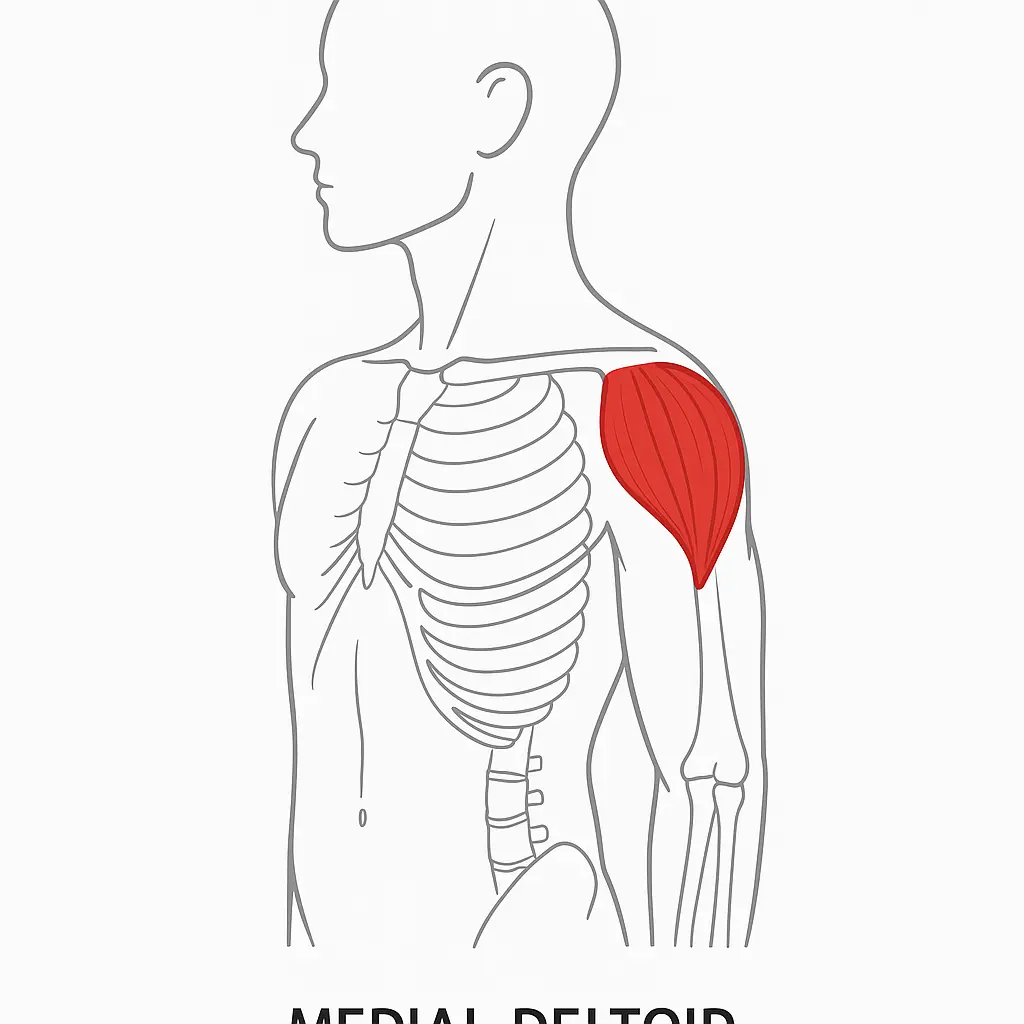
Simplified diagram of the middle deltoid showing its lateral position on the shoulder and its role in lifting the arm sideways

The middle deltoid (lateral deltoid) is a key shoulder muscle, heavily involved in both daily movements and sports training.

Located on the outer side of the shoulder, it originates from the acromion and plays a primary role in lifting the arm out to the side, while contributing to shoulder joint stability during arm-elevation tasks.

On some three-dimensional anatomical models, the middle deltoid can be visually confused with the other deltoid heads, especially the anterior deltoid.
This simplified anatomical diagram clearly highlights its lateral position, making its specific biomechanical role easier to understand.

An under-recruited or poorly coordinated middle deltoid may alter shoulder mechanics, promote upper trapezius dominance, and reduce movement quality during lateral raises and overhead activities.
A clear understanding of its function is therefore essential to optimize training and prevent shoulder imbalances.