
Serratus anterior
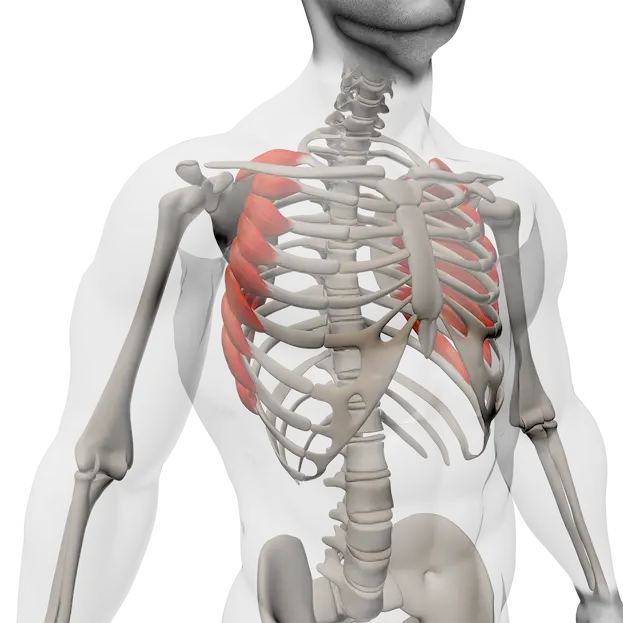
Scientific name:
Serratus anterior
Location:
Muscle located on the side of the rib cage, between the ribs and the shoulder blade (scapula), visible under the armpit when developed.
Overall role:
Provide scapular stability and allow smooth and strong arm elevation.
Sports where this muscle is a key :
- Boxing & combat sports (shoulder stability, punching, guard)
- Swimming (scapular control during pull and push phases)
- CrossFit / Weightlifting (overhead stability: jerk, snatch, wall balls)
- Climbing (scapula control against the rib cage)
- Gymnastics / Calisthenics (push-ups, handstands, planche)
- Throwing sports (efficient force transfer from trunk to arm)
Origin
Outer surfaces of ribs 1 to 8/9 (individual variations exist).
Insertion
Medial border of the scapula, mainly on its anterior (rib-facing) surface.
Innervation
Long thoracic nerve (C5–C7).
(C5–C7 = cervical spine levels sending nerve signals to this muscle.)
Key points to remember
- Key scapular control muscle.
- Essential for upward rotation of the scapula during overhead movements.
- Frequently under-recruited in people with unstable or “floating” shoulder blades.
Main actions
- Scapular protraction (bringing the shoulder blade forward)
- Upward rotation of the scapula
- Scapular fixation against the rib cage
Synergists (muscles working with it)
- Upper and lower trapezius (upward rotation and stability)
- Middle trapezius (positional control)
- Deltoid and rotator cuff (arm movement and joint centering)
Antagonists (muscles with opposite action)
- Rhomboids (scapular retraction)
- Middle trapezius (opposes excessive protraction depending on angle)
Postural / stabilizing role
- Stabilizes the shoulder during push patterns and overhead positions.
- Prevents scapular drifting or winging under fatigue.
- Weak or inhibited → reduced scapular stability, inefficient pushing mechanics, fragile overhead control. Compensation often appears in the neck, upper back, or lower back.
- Overactive or dominant → shoulder blades stuck forward, difficulty restoring an open shoulder posture in some profiles.
- Restricted thoracic mobility → altered scapular mechanics, leading to compensations at the lumbar spine or neck.
- Under load → the heavier or faster the push, the earlier the serratus must stabilize; delayed activation disrupts movement quality.
Important note
- The serratus anterior cannot be voluntarily isolated.
- The tests below do not assess the muscle in isolation.
- They evaluate its functional involvement in scapular control, and the ability of the scapular system to remain stable and coordinated without compensations.
- A poor result does not automatically indicate weakness, but often reflects a motor control or coordination deficit, or dominance of other muscles (neck, upper trapezius, chest).
Activation test
- Goal: assess early serratus activation during controlled pushing.
- Setup:
- Wall push-up (easy) or incline push-up on a bench.
- Arms straight, body aligned.
- Perform scapular push-ups: push away without bending elbows, then return.
- Optional: light resistance band around wrists.
- What to observe:
- Smooth scapular glide without medial border lifting.
- Shoulders staying away from the ears.
- Interpretation:
- ➡️ Scapula lifting off the rib cage → poor serratus activation.
- ➡️ Neck tension dominating → upper trapezius compensation.
Weakness test
- Goal: evaluate scapular endurance and stability.
- Setup:
- High plank or push-up position, hold 20–40 seconds.
- Light active push into the floor throughout.
- What to observe:
- Scapulae staying flat and controlled.
- Calm neck and steady breathing.
- Interpretation:
- ➡️ Scapula collapsing or winging under fatigue → insufficient endurance.
- ➡️ Shoulders rising toward ears → loss of scapular control.
Dominance / compensation test
- Goal: identify dominance of upper trapezius or chest over serratus control.
- Setup:
- Wall slides: back against wall, forearms on wall, slow upward and downward movement.
- Rib cage controlled, no excessive arching.
- What to observe:
- Smooth upward rotation without shrugging.
- Interpretation:
- ➡️ Shoulder shrugging → upper trapezius dominance.
- ➡️ Lumbar arching → trunk compensation.
- Simple correction:
- Reduce range of motion.
- Slow the tempo.
- Use long exhalation during upward phase.
Activation / isolation
- Scapular push-ups (wall → bench → floor)
- Resistance band serratus punches
- Controlled wall slides with breathing focus
Functional / multi-joint
- Push-up variations with scapular control
- Light overhead carries (slow, controlled)
- Landmine press (diagonal push, shoulder-friendly)
Useful variations
- Push-ups with isometric hold at full arm extension
- Push-ups on handles or dumbbells if wrist mobility limits control
Typical imbalances
- Scapular instability, especially under fatigue
- Neck dominance during pushing patterns
- Thoracic stiffness limiting scapular rotation
Related risks / pain
- Anterior or superior shoulder discomfort during repetitive pushing
- Cervical tension during overhead tasks
- Feeling of a “weak” or unstable shoulder despite good general strength
Warning signs
- Visible scapular winging during push-ups or planks
- Systematic shoulder shrugging under effort
- Poor overhead control even with light loads
- Chasing performance without scapular control.
- Letting shoulders rise toward the ears.
- Excessive lumbar arching to compensate overhead.
- Moving too fast: serratus performance is often limited by control and endurance, not raw strength.
- Controlled scapular circles (protraction/retraction, 6–10 reps)
- Thoracic rotation on all fours (slow, controlled, 6 reps per side)
- Wall slides with breathing (slow tempo, long exhale, 6–8 reps)