Quadriceps: global function and knee control
No, the quadriceps is not a single muscle.
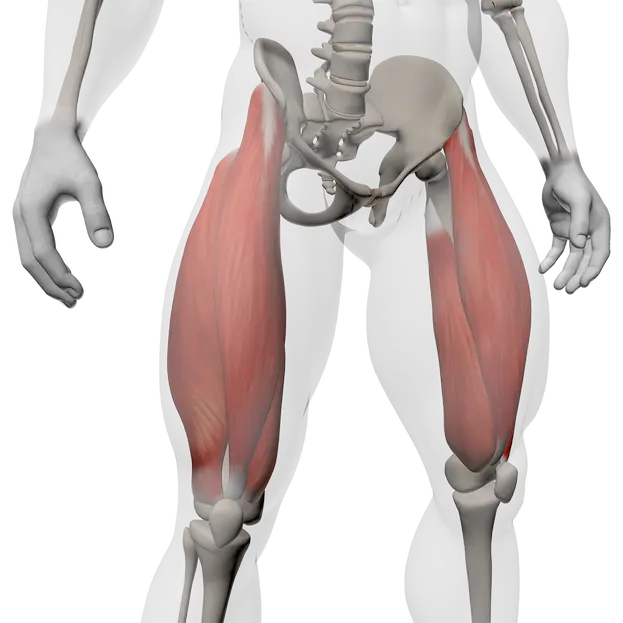
The quadriceps is often seen as one powerful muscle at the front of the thigh.
In reality, it is a muscle system made up of four distinct heads, each with a specific role in strength, stability, knee control, and patellar tracking.
Strengthening the quadriceps “as a whole” is an incomplete approach.
Pain, instability, or performance loss are most often linked to imbalances between its heads, not to a lack of overall strength.
👉 You don’t just strengthen the quadriceps — you balance its heads.
The 4 heads of the quadriceps — distinct and complementary roles
Rectus femoris
- Bi-articular muscle (hip + knee)
- Key role in force transmission
- Highly involved in explosive movements
- Directly influences the hip ↔ knee relationship
👉 See detailed sheet: Rectus femoris
Vastus lateralis
- Mono-articular muscle
- Primary driver of knee extension
- Strongly involved in load and impact management
- Contributes to lateral knee stability
👉 See detailed sheet: Vastus lateralis
Vastus medialis (VMO)
- Fine control muscle
- Essential for patellar centering
- Particularly active at end-range extension
- Plays a major role in medial knee stability
👉 See detailed sheet: Vastus medialis
Vastus intermedius
- Deep muscle
- Ensures smooth and continuous knee extension
- Important for postural support and local endurance
- Less noticeable, but essential to system coherence
👉 See detailed sheet: Vastus intermedius
The quadriceps as a knee control system
The knee is not a simple mechanical hinge.
It is a guided joint, whose stability depends largely on the quadriceps.
This muscle system:
- produces knee extension,
- guides patellar tracking,
- distributes stress during movement,
- stabilizes the knee under dynamic load.
When balance between the heads is disrupted, joint mechanics change, leading to increased:
- local stress,
- premature fatigue,
- risk of irritation or pain.
Common quadriceps imbalances (field observation)
Dominant vastus lateralis
- Excessive lateral pull on the patella
- Sensation of instability or anterior/lateral knee pain
- Squat or lunge with the knee drifting outward
👉 Often associated with an inhibited VMO
Insufficient VMO recruitment
- Poor control during descent (stairs, squat)
- Pain at end-range extension
- Difficulty stabilizing the knee in unilateral work
👉 Common in sedentary individuals or post-injury
Hyperactive rectus femoris
- Rapid fatigue during effort
- Anterior pelvic tilt
- Lumbar compensation during leg movements
👉 Often linked to poor hip / knee dissociation
Quadriceps and key movements in sport and daily training
Squat
- Engages the entire quadriceps
- Imbalances appear mostly at end range
- An unstable knee often reveals poor medial control
Lunges
- Highlight left / right asymmetries
- High demand on VMO stabilization
- Rectus femoris influences overall posture
Running and impacts
- Repeated eccentric loading of the quadriceps
- Poor load distribution = local overload
- Pain can appear even without heavy external load
Stair ascent / descent
- Natural test of knee control
- Descent is often more revealing than ascent
Common mistakes in quadriceps training
- Loading without controlling the knee–ankle axis
- Confusing muscle burn with effectiveness
- Training “the quadriceps” without distinguishing its heads
- Neglecting the role of the hip and ankle
- Ignoring instability signals in favor of load
When to adapt or seek professional advice
Certain signs should prompt training adjustments or professional assessment:
- persistent pain despite moderate loading,
- joint swelling,
- feeling of knee instability,
- night pain or pain at rest.
👉 The goal is prevention, not self-diagnosis.
Access detailed muscle sheets
To go deeper into each quadriceps component:
👉 Rectus femoris — full sheet
👉 Vastus lateralis — full sheet
👉 Vastus medialis (VMO) — full sheet
👉 Vastus intermedius — full sheet
Conclusion
The quadriceps is a system, not an isolated muscle. Strengthening it without understanding it creates imbalances.
Balance between its heads is the foundation of a stable, durable, and high-performing knee.