
Extensor Digiti Minimi
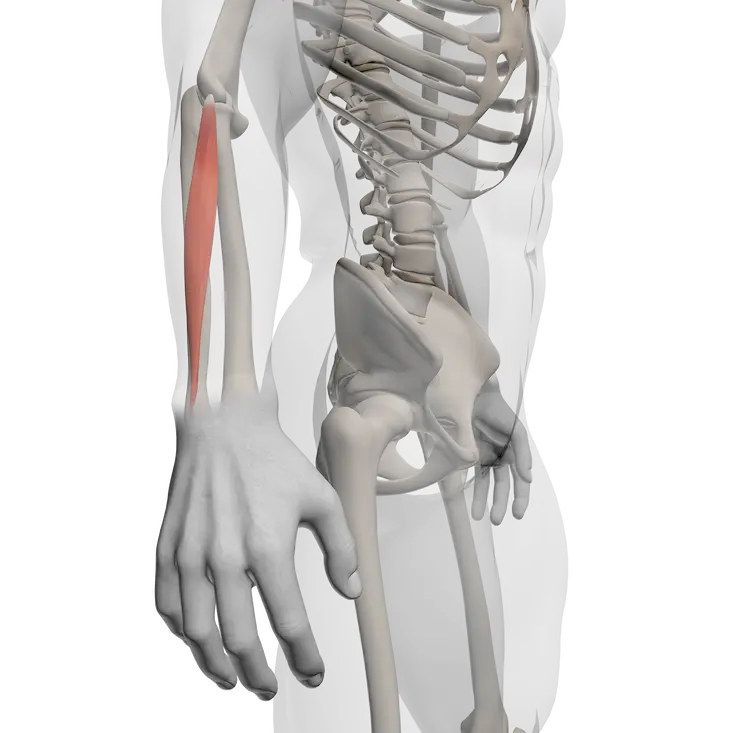
Scientific name:
Extensor Digiti Minimi
Location:
Muscle located on the posterior side of the forearm, on the little finger side
Overall role:
Allows specific extension of the little finger and contributes to precision and stability of the grip
Sports where this muscle is a key :
- Climbing and grip-dominant sports
- Combat sports (closed fist stability)
- Strength training with prolonged grip demands
- Sports requiring fine hand control
Origin
- Lateral epicondyle of the humerus
- (shared origin with finger extensors)
Insertion
- Dorsal expansion of the 5th finger (little finger)
Innervation
- Radial nerve (C7–C8)
(nerve responsible for finger and wrist extension)
Key points to remember
- Small, specific muscle, often overshadowed by extensor digitorum
- Can work partially independently for the little finger
- Plays a role in lateral stability of the hand
Main actions
- Extension of the little finger
- Secondary assistance in wrist extension
Synergists (muscles working with it)
- Extensor digitorum
- Extensor carpi ulnaris
- Intrinsic hand muscles (fine motor control)
Antagonists (muscles with opposite action)
- Flexor digitorum profundus (little finger)
- Flexor digitorum superficialis (little finger)
Postural / stabilizing role
- Contributes to fist stability during strong gripping
- Helps maintain finger balance during prolonged loading
- Acts mainly as a stabilizer and fine-tuning muscle
- Important for subtle adjustments of hand position
Coaching-oriented observations:
- Weak → loss of little finger control, unstable grip
- Overactive / tight → localized tension on the outer forearm
- Restricted range → increased compensation by extensor digitorum
Activation test
Goal: check specific activation of the little finger
Setup:
- Forearm supported, hand relaxed
- Light elastic band around the little finger
What to observe:
- Clear little finger extension without movement of other fingers
Interpretation:
- ➡️ Difficulty isolating → insufficient activation
Weakness test (light, sustained resistance)
Goal: assess local endurance
Setup:
- Maintain little finger extension against light resistance
- Duration: ~20–30 seconds
What to observe:
- Trembling or gradual loss of tension
Interpretation:
- ➡️ Early release → low local endurance
Dominance / compensation test
Goal: detect dominance of global finger extensors
Setup:
- Full hand opening against an elastic band
What to observe:
- Little finger remains passive or lags behind
Interpretation:
- ➡️ Passive little finger → extensor digitorum dominance
Simple correction:
- Isolated little finger extension with slow tempo
Activation / isolation
- Isolated little finger extension with elastic band
- Hand opening with conscious focus on the little finger
Functional / multi-joint
- Farmer carries with attention to little finger engagement
- Light deadlifts with controlled fist closure
Useful variations
- Unilateral hand training (dominant vs non-dominant side)
Typical imbalances
- Passive little finger during grip
- Dominance of global finger extensors
Related risks / pain
- Localized fatigue on the outer forearm
- Uneven load distribution across the hand
Warning signs
- Little finger “letting go” during prolonged grip
- Feeling of instability in the hand
- Treating this muscle as a prime strength muscle
- Skipping isolation work
- Fast, uncontrolled finger movements
- Excessive compensation by other fingers
- Slow hand opening and closing with emphasis on the little finger
- Gentle wrist mobility with lateral control
- Controlled finger circles synchronized with breathing