
Standing Dumbbell Calf Raise
Category : 🟨 Lower body – Calves/Lower posterior chain
Difficulty : ★☆☆☆☆ (beginner)
Equipment : Dumbbells + step or raised plate
Goal
- Strengthen the calves and improve stance stability without a machine.
- Build functional lower-leg strength and left–right symmetry between both legs.
- Teach full-range plantar flexion under control, useful for walking, running and jumping.
Target Muscles
- Main: Gastrocnemius (medial and lateral heads).
- Synergists: Soleus.
- Stabilizers: Intrinsic foot muscles, ankle stabilizers, core bracing.
Variations
- Bodyweight standing calf raise on a step (no dumbbells).
- Unilateral standing calf raise (one leg at a time for symmetry work).
- 2 s isometric hold at the top to emphasise peak contraction.
- Standing calf raise on a slightly unstable surface (BOSU, balance pad) for proprioception.
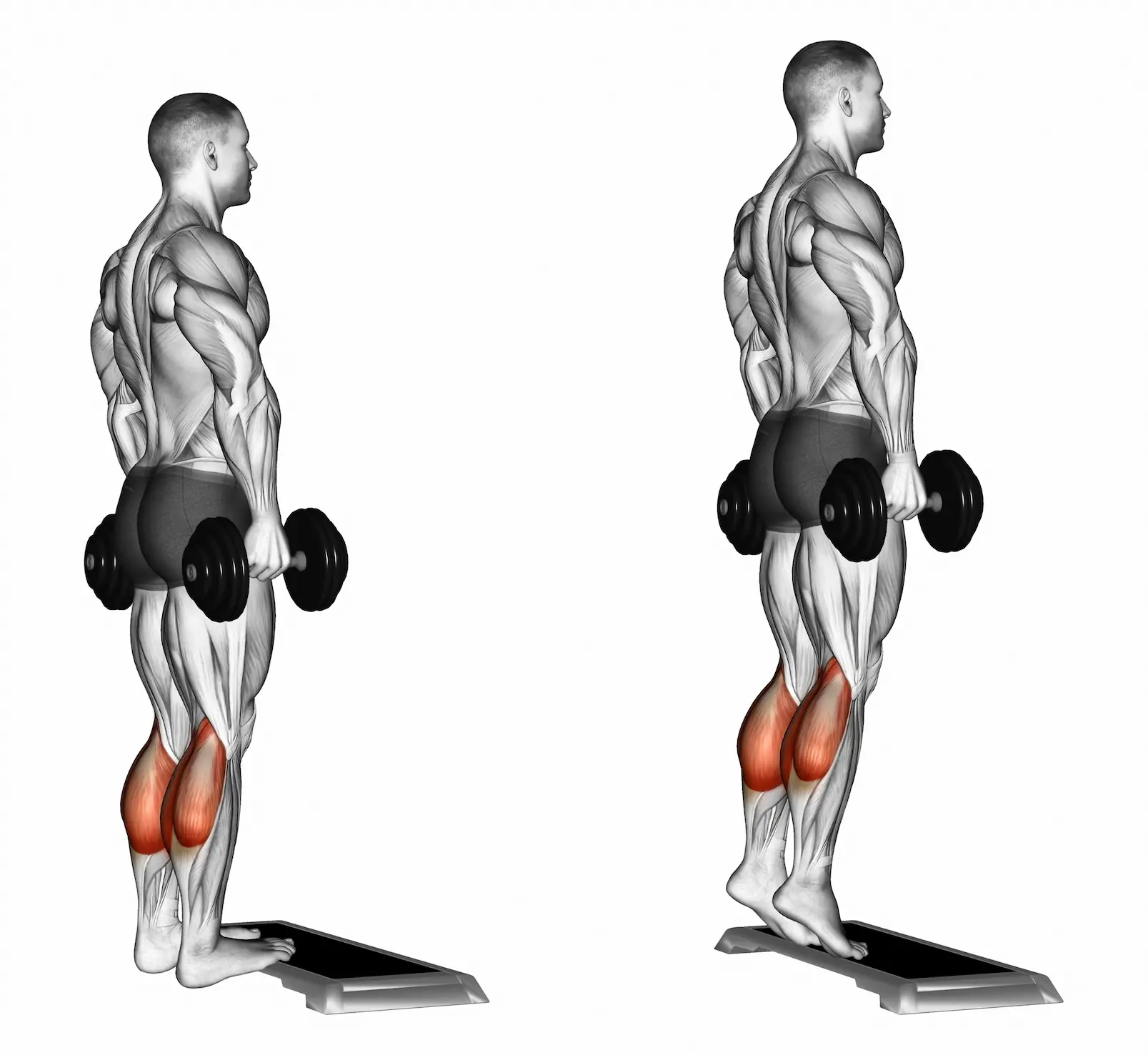
Heels down, core tight, controlled rise — let the calves do the work, not the momentum.
Technique — Step by Step
- Starting position:
Hold a dumbbell in each hand, arms hanging by your sides. Place the balls of your feet on a step or plate with the heels hanging off into space. Stand tall, look straight ahead and brace the abs. Take a breath in before you start the first rep. - Concentric (up):
Push through the forefoot and rise slowly onto your toes, actively squeezing the calves. Keep the legs almost straight (knees unlocked but not bending). Exhale as you reach the top and hold the peak for a brief squeeze. - Eccentric (down):
Lower the heels slowly below the level of the step until you feel a gentle stretch in the calves. Control the descent, without dropping or bouncing at the bottom. Inhale during the lowering phase. - Tempo / Range target:
Aim for a smooth 1–2 s rise and a 2–3 s controlled descent through a full, pain-free range of motion. - Quick cues:
Eyes forward, abs tight, torso still. Push through the mid-foot, mark a voluntary squeeze at the top and keep a steady breathing pattern throughout the set.
| ❌ Common Mistakes | ✅ Best Practices |
|---|---|
|
|
Training Formats
| Strength control (TUT 30–45 s) | Hypertrophy (TUT 40–60 s) | Endurance (TUT 40–60 s) | |
|---|---|---|---|
| Sets | 3 | 4 | 3 |
| Reps | 10–12 | 15–20 | 25–30 |
| Tempo | 2 – 1 – 2 | 2 – 1 – 2 | 1 – 0 – 1 |
| Rest | 60 s | 45 s | 30 s |
1% Method
| PLC Power – Length – Contraction | Set of 100 Density / Pump Finisher | |
|---|---|---|
| Goal | Reinforce the calves with a calibrated load and controlled stretch–squeeze pattern. | Maximise local endurance and pump at the end of the lower-body block. |
| Structure | 1 key set defined by the widget (tempo / range). | 100 reps split into mini-blocks (e.g., 10×10 or 5×20). |
| Load | Load from the widget, targeting RPE 8–9 with strict technique. | Light to moderate dumbbells, keep range and rhythm clean. |
| Intra-set rest | Continuous tempo or short micro-pauses if technique starts to degrade. | 10–20 s between mini-blocks, heels never crashing on the floor. |
| Frequency | 1–2×/week on your main standing calf raise. | ≤ 1×/week as a finisher on leg or full-body day. |
| Key cue | Soft knees, stacked ankles, deliberate stretch at the bottom. | Breathe, shake out between mini-blocks, never sacrifice range or control. |
1% Method Integration
Phase 4 – Muscle Block
Integration Logic
- Place the standing dumbbell calf raise in the finishing part of the lower-body block to polish calf work and stance control.
- Superset idea: alternate with seated calf raises to hit the soleus or light ankle-mobility drills between sets.
- Use PLC on days where you want a precise, heavy stimulus and keep the Set of 100 as a high-tension finisher on easier weeks.
Recommended Frequency
- Integrate standing dumbbell calf raises 1–2×/week, depending on total leg volume and tendon tolerance.
- Alternate one session with a more strength/control focus and another with higher-rep endurance to cover both capacities.
Control the heel drop, own the top squeeze — that’s how calf work stops being “just a burn” and starts building real support.