Standing Elbow-to-Knee Twists
Category : 🟧 Cardio / Core – Coordination – Mobility
Difficulty : ★★☆☆☆ (beginner to intermediate)
Equipment : Bodyweight only, sports shoes, stable surface
Goal
- Improve arm–leg coordination in a standing position.
- Activate and strengthen the oblique muscles and deep core.
- Gently raise the heart rate for warm-ups, light HIIT blocks or active recovery.
Muscles worked
- Main: Rectus abdominis, external and internal obliques.
- Synergists: Hip flexors, quadriceps, deltoids, upper trapezius.
- Stabilizers: Lumbar region, deep core muscles, hip stabilizers.
Variations
- Easy version: slow rhythm, no full contact between elbow and knee, focus on range and control.
- Chair version: seated on a chair, alternate elbow-to-knee for a gentle warm-up.
- Intervals for beginners: 30 seconds of work / 30 seconds of rest, 3–4 rounds.
- HIIT version: fast execution with clear form, 20 s ON / 10 s OFF (Tabata style).
- With small jump: add a light hop when switching sides to increase cardio demand.
- Loaded version: light weighted vest or mini-bands around the thighs for extra core and hip work.
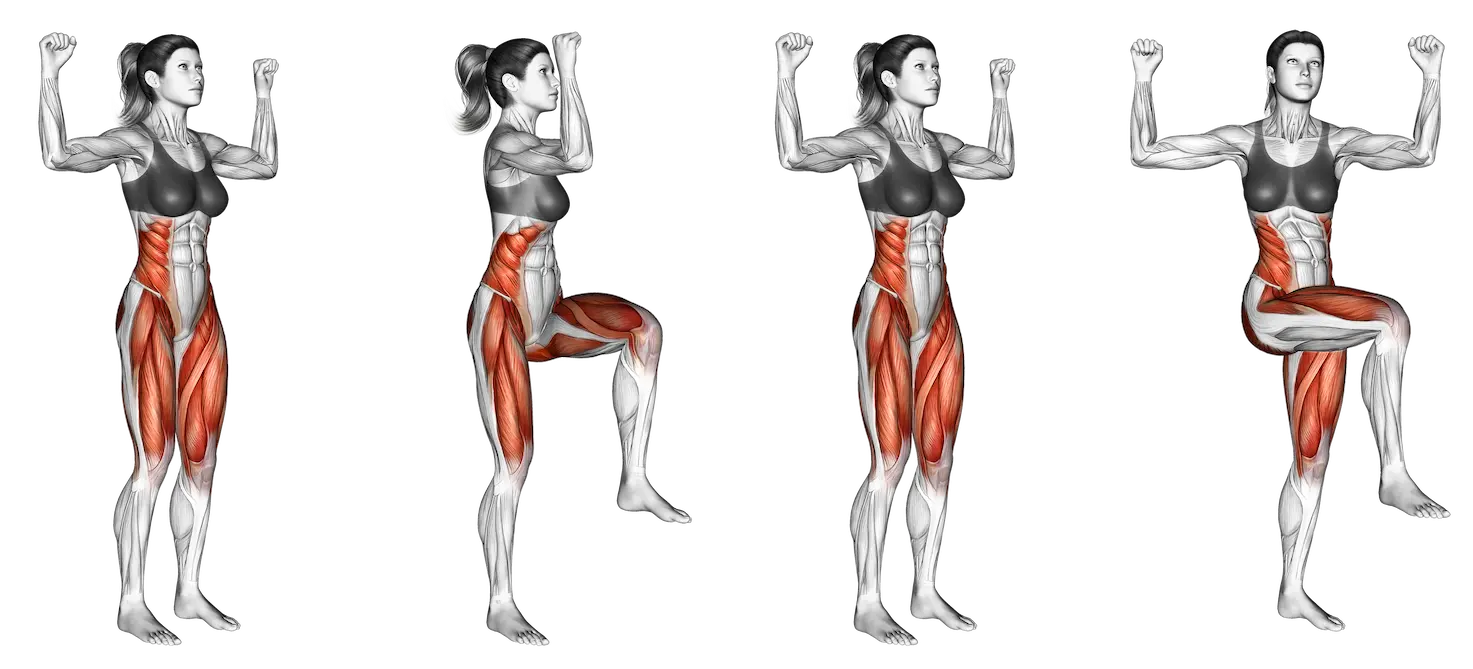
Standing elbow-to-knee twists are a simple, low-impact way to wake up your core, coordination and cardio without going down to the floor.
Technique — Step by step
- Start position:
Stand tall with your feet hip-width apart, toes slightly turned out. Bend your elbows to about 90°, hands close to the sides of your head without pulling on the neck. Engage your abdominals and keep the chest lifted. - First elbow-to-knee crunch:
Lift your right knee towards your chest while bringing your left elbow down and across the body, aiming to bring them together in front of your torso. Think about crunching through the obliques, not rounding the upper back. - Return and alternate:
Return to the start position with control: lower the leg, open the chest, reset the posture. Immediately repeat on the other side: left knee towards right elbow, same range and same control. - Rhythm and breathing:
Keep a smooth, rhythmic tempo, like a standing march with rotation. Avoid swinging the torso excessively or losing posture. Breathe out on each elbow-to-knee contact and breathe in as you return to the center. Maintain the pattern for the planned duration.
| ❌ Common mistakes | ✅ Good practice |
|---|---|
|
|
Standard formats
| Warm-up / Coordination (Low impact) | HIIT / Tabata (Cardio block) | |
|---|---|---|
| Work time | 30 – 45 s | 20 s |
| Rest | 15 – 30 s | 10 s |
| Number of rounds | 2 – 4 rounds | 8 rounds (classic Tabata) |
| Target intensity | RPE 4 – 6, focus on technique and range of motion. | RPE 7 – 8, breathing elevated but form and posture stay clean. |
1% Method
| Neuro-connection Phase 2 | Cardio block Phase 3 or 6 | |
|---|---|---|
| Goal | Connect upper and lower body, groove the cross-pattern and switch on the obliques. | Use a simple, low-impact move to keep the heart rate up while protecting the joints. |
| Structure | Short blocks of 20–30 s, clean range of motion, focus on posture and timing. | Longer sets of 30–40 s with consistent tempo, optionally in 20/10 Tabata format. |
| Placement | Phase 2 – directly after the basic warm-up, before more explosive drills. | Phase 3 or 6 – as a moderate option inside a HIIT circuit or as an easier Tabata finisher. |
| Load | Bodyweight only, controlled height of the knee and relaxed shoulders. | Bodyweight or light external load (vest/mini-bands) if posture and rhythm are solid. |
| Frequency | 1–3× per week as a core activation drill in full-body or cardio sessions. | 1–2× per week as a low-impact alternative to jumps and high-impact burpees. |
| Key cue | “Tall posture, precision first, then add speed.” | “Keep the pattern clean from first to last rep, even when you’re out of breath.” |
1% Method integration
Phase 2 – Neuro-connection (3–4 min)
Phase 3 or 6 – Cardio Peak (4–5 min)
Phase 2 – Neuro-connection (3–4 min)
Goal: prepare the neuromuscular system with a simple standing pattern before more complex or explosive work.
Level 1 – Slow cross-pattern without impact
- “Lift the knee and bring the opposite elbow towards it with a tall spine and relaxed shoulders.”
- “Focus on finding the same range right and left, without rushing the movement.”
- “Use this as your moment to dial in posture, breathing and coordination.”
Level 2 – Add rhythm and rotation
- “Keep the pelvis stable and let the rib cage rotate slightly towards the knee.”
- “Increase the tempo gradually while keeping every crunch clear and controlled.”
Level 3 – Light cardio flow
- “Link the repetitions like a continuous march, elbows and knees meeting in a steady rhythm.”
- “Land each foot softly and keep your breathing smooth: exhale on the crunch, inhale back in center.”
Goal: arrive at the cardio block with a movement that feels automatic, coordinated and pain-free.
Phase 3 – Cardio Peak 1 – HIIT (4–5 min)
Goal: build a moderate cardio peak with a simple, joint-friendly standing exercise.
Coaching cues to progress:
- “Same range, same speed from first to last second of the interval.”
- “If you lose posture, slow down before you stop so the pattern stays clean.”
- “Keep the chest proud and the gaze forward, not down at the floor.”
- “Aim for an effort around RPE 6–8: you should be out of breath, but still in control of every rep.”
Phase 6 – Tabata finisher (4 min – 20/10 × 8)
Goal: use a low-impact finisher to end the workout on a cardio high without overloading the joints.
Advanced coaching cues:
- “Treat each 20-second block as a focused push, not a sprint with sloppy form.”
- “If fatigue kicks in, shorten the range of the knee lift before you change the pattern.”
- “Try to keep almost the same rep count on the 1st and on the 8th round.”
- “Use a steady breathing rhythm: one breath every one or two reps, without holding tension in the shoulders.”
Suggested frequency
- 1 to 3 times per week in warm-ups or neuromuscular prep blocks.
- 1 to 2 times per week as a low-impact HIIT or Tabata option, especially for clients who need to limit jumping.
- Combine with more strength-focused blocks (squats, deadlifts, planks) to balance cardio and stability work.
Used in the right place, standing elbow-to-knee twists give you a clean cardio boost while keeping the joints happy and the core fully engaged.