
Skater Jump
Category: 🟧 Cardio / Plyometrics – Stability – Coordination
Level: ★★★☆☆ (intermediate)
Equipment: Bodyweight only, stable surface, training shoes
Goal
- Create an effective cardio peak in HIIT or as a Tabata finisher with a dynamic movement.
- Develop lateral power and explosiveness on a single-leg base.
- Improve hip and knee stability, plus overall coordination.
Muscles worked
- Main: Quadriceps, glute max, glute med.
- Synergists: Hamstrings, calves (soleus, gastrocnemius).
- Stabilizers: Abs, obliques, spinal erectors, shoulder girdle.
Variations
- Basic version: Lateral steps (step-touch style) without jumps, with a controlled weight shift.
- Low-impact version: Small lateral jump with a light tap of the rear foot on the floor to help with balance.
- “Fluid cardio” version: Moderate range of motion, focus on a smooth, steady rhythm.
- Advanced version: Skater Jump with light dumbbells or a weighted vest while keeping soft, controlled landings.
- Explosive version: Skater Jump with quick changes of direction and maximum range, keeping the knee aligned.
- Tabata version: High intensity while keeping clean technique all the way through.
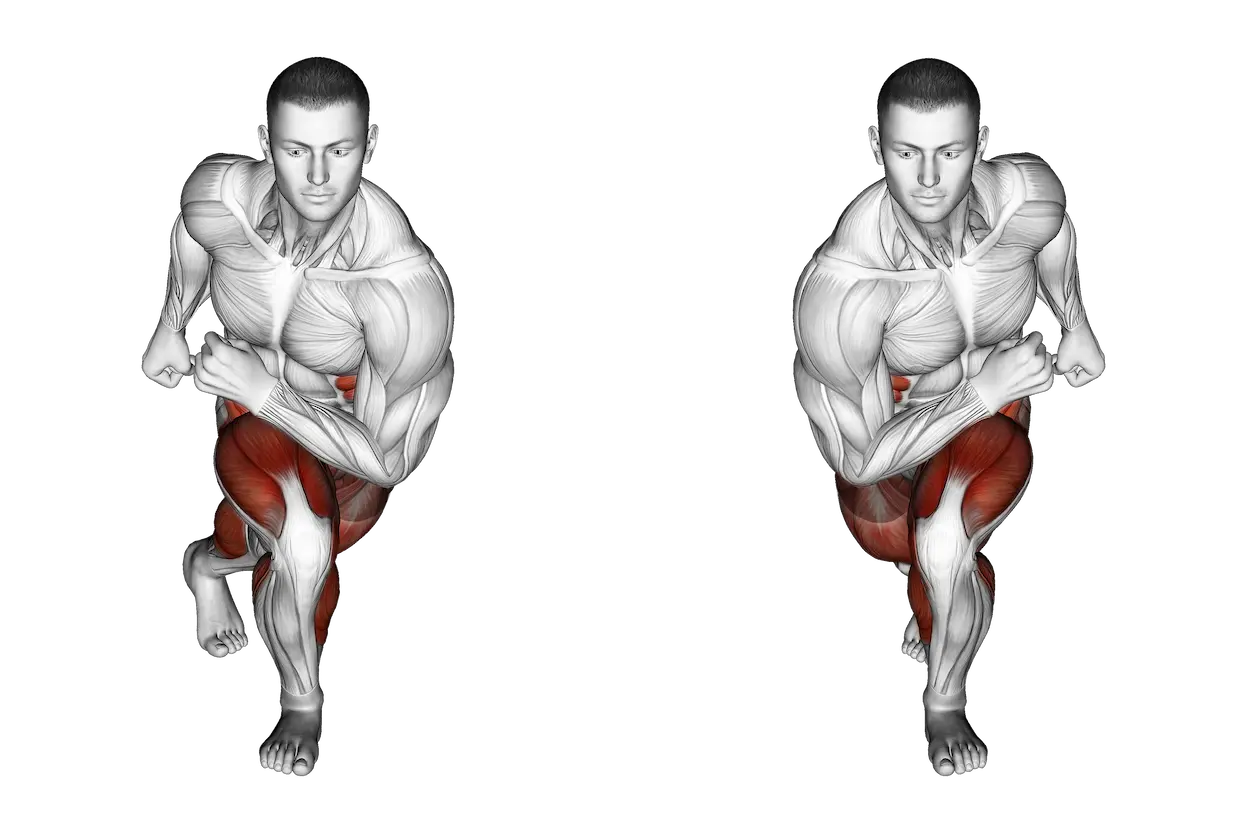
The Skater Jump is a great tool to train cardio and lateral explosiveness while building hip and knee stability.
Technique — Step by step
- Starting position:
Stand tall with your feet hip-width apart, knees soft. Lean your torso slightly forward, hips low, core braced. Arms are ready to swing dynamically. - Lateral jump and landing:
Push the floor away with the working leg to drive your body laterally. Land on the opposite leg with a slight knee bend, the other foot passing behind for balance. Land on the ball of the foot, then let the heel lightly touch down. - Stability and posture:
On landing, stabilize first: knee tracking over the toes, hips facing forward, torso stable. Let the arms move like a speed skater to help balance, without over-rotating the trunk. - Rhythm, range and breathing:
Once the support leg is stable, immediately jump to the other side. Aim for a smooth rhythm: start with a medium range, then go wider as control improves. Inhale as you prepare, exhale on each lateral push.
| ❌ Common mistakes | ✅ Best practices |
|---|---|
|
|
Typical formats
| HIIT (Cardio Peak block) | Tabata (Explosive finisher) | |
|---|---|---|
| Work time | 20 – 40 s | 20 s |
| Rest | 20 – 40 s | 10 s |
| Number of cycles | 6 – 10 cycles depending on level | 8 cycles |
| Target intensity | RPE 7 – 9, landing and lateral stability controlled on every jump | RPE 8 – 9, same quality of single-leg support right up to the last cycle |
1% Method
| HIIT Cardio Peak 1 | Final Tabata Cardio Peak 2 | |
|---|---|---|
| Goal | Boost cardio and lateral power with controlled single-leg work | Very short but dense finisher to boost endorphins and tolerance to effort |
| Structure | Block of 20–40 s work / 20–40 s rest | Fixed format 20 s work / 10 s rest × 8 cycles |
| Placement | Phase 3 – Cardio Peak 1, after warm-up and pre-activation | Phase 6 – Cardio Peak 2, at the end of the workout |
| Load | Bodyweight, optionally light load if stability is under control | Bodyweight, range of motion adjusted if technique breaks down |
| Frequency | 1–2×/week in full-body or high-intensity cardio sessions | 1×/week maximum at the end of a full-body or cardio block |
| Key cue | Stability on the working leg first, then speed and range | Stay explosive but clean: no sloppy landings just to get a few extra jumps |
1% Method integration
HIIT – Cardio Peak 1 (5 min)
Tabata – Cardio Peak 2 (4 min)
Phase 2 – Neuro-connection (3–4 min)
Goal: prepare the neuromuscular system for lateral jumps by breaking the movement down and securing single-leg stability.
Level 1 – Lateral weight transfers without jumping
- “Perform controlled lateral steps, shifting your bodyweight from one leg to the other without lifting both feet at the same time.”
- “Keep hips low, torso slightly leaned forward and knees soft.”
Level 2 – Small lateral jump with rear-foot contact
- “Add a small lateral jump and let the rear foot tap the floor lightly to help you stabilize.”
- “Aim for silent landings on the ball of the foot, knee tracking over the toes.”
Level 3 – Controlled Skater Jump, medium range
- “Move to true single-leg support: keep the rear foot off the floor and stabilize before you jump again.”
- “Use your arms like a speed skater to balance the upper body without turning the shoulders.”
Level 4 – Explosive Skater Jump, larger range
- “Gradually increase jump distance while keeping the same control on the landing.”
- “Stay in an athletic stance: hips low, knee soft, trunk stable on every landing.”
Goal: hit the HIIT block with a lateral movement that feels automatic, stable and safe for your joints.
Phase 3 – Cardio Peak 1 – HIIT (5 min)
Goal: create a controlled cardio peak by combining lateral range, power and solid single-leg support.
Cues to progress further:
- “Drive hard, land soft: power comes from the working leg, landing stays controlled.”
- “Keep a steady tempo for the whole interval: same quality of landing from start to finish.”
- “On every landing, lock the hip–knee–ankle alignment before you push off again.”
- “If you lose stability, reduce the range or go back to a light rear-foot tap, but keep the technique clean.”
- “Aim for RPE 7–9 based on your level: breathless, but still in control of each jump.”
Phase 6 – Final Tabata (4 min – 20/10 × 8)
Goal: short, explosive and mentally demanding finisher while maintaining single-leg support quality despite fatigue.
Advanced cues:
- “Give your best effort during each 20-second bout, but never at the expense of knee stability.”
- “As fatigue builds, first reduce jump distance before changing the rhythm.”
- “Keep a reference: roughly the same number of jumps per interval from the 1st to the last cycle.”
- “Breathe with rhythm: one breath per jump or every two reps depending on your comfort.”
Recommended frequency
- Use 1 to 2 times per week max in high-intensity cardio blocks (HIIT or Tabata) to limit plyometric load on the lower body.
- Avoid programming Skater Jumps in Tabata the day before or the day after other very explosive workouts (jumps, sprints, heavy plyometrics).
- Skater Jumps pair well with lower-body strength blocks (squats, lunges) and core bracing exercises to balance the session.
Placed wisely in your workout, the Skater Jump becomes a powerful test of lateral control, cardio and mindset — with zero equipment.