
Dynamic High Knees
Category: 🟧 Cardio / Plyometrics – Coordination – Explosiveness
Difficulty: ★★★☆☆ (intermediate to advanced)
Equipment: Bodyweight only, training shoes, stable surface
Goal
- Improve leg turnover and coordination in a running posture.
- Boost cardio-respiratory capacity in a HIIT block or Tabata finisher.
- Strengthen the hip flexors, dynamic core bracing, and overall running posture.
Muscles worked
- Main: Hip flexors (psoas, iliopsoas), quads, calves.
- Synergists: Hamstrings, glute med and max, deltoids, biceps and triceps (arm drive).
- Stabilizers: Abs, deep core, lower back, shoulder girdle.
Variations
- Basic version: Slow high knees without bouncing, focusing on knee height and posture.
- Supported version: High knees while holding on to a wall or stable support to secure balance.
- “Controlled pace” version: 30 s work / 30 s recovery, steady cadence, ideal as part of the warm-up.
- On-the-spot sprint version: Very fast high knees with higher knee lift, only for experienced exercisers.
- Band-resisted version: High knees with a resistance band around the thighs to increase tension.
- Tabata version: 20 s “ON” / 10 s “OFF” × 8 rounds, maximum cadence with clean technique.
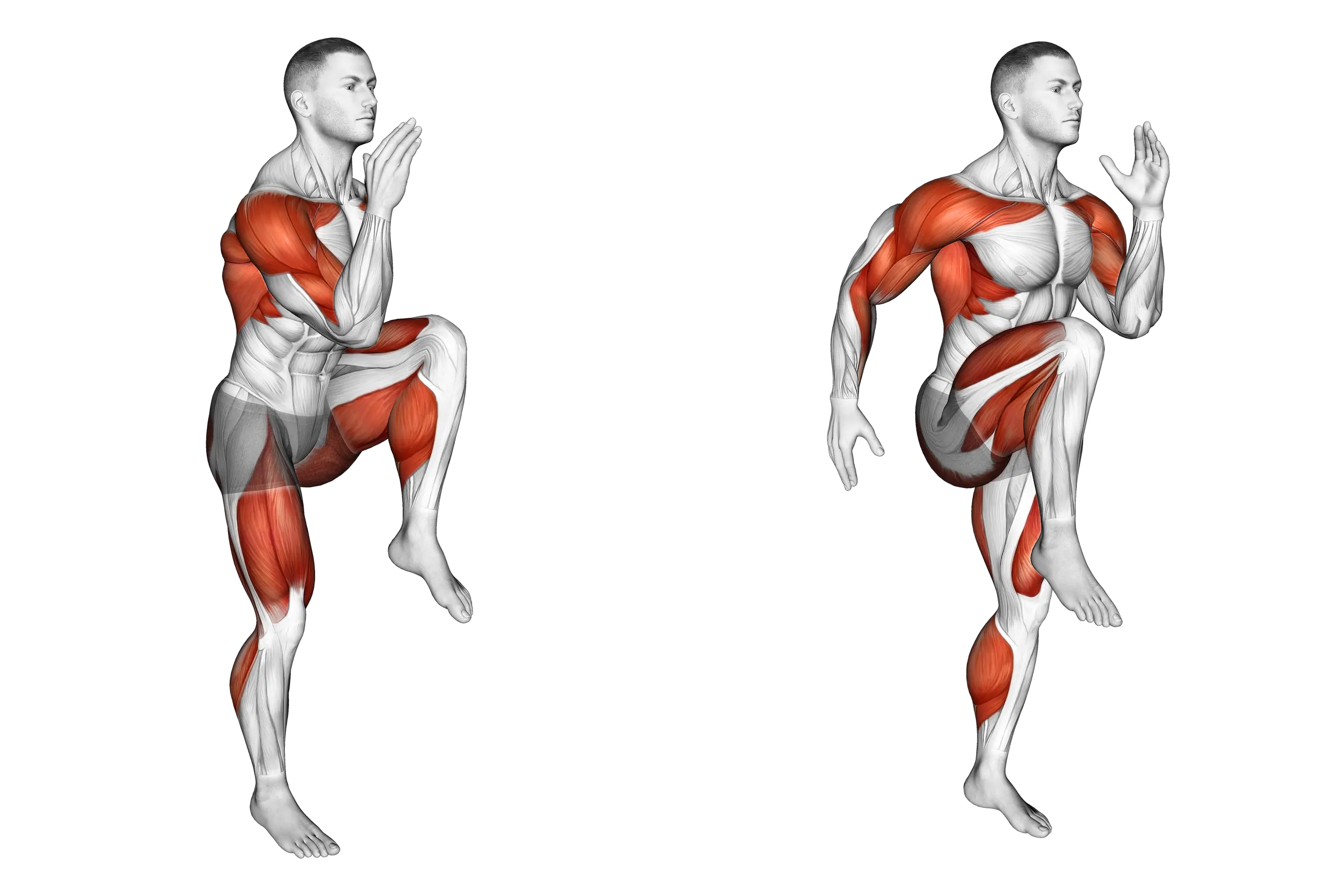
High knees are a staple in cardio blocks: a movement that looks simple, but once the cadence goes up, it becomes brutal for your heart rate.
Technique — Step by step
- Start position:
Stand tall with your feet hip-width apart, chest up, eyes looking straight ahead. Arms are bent around 90°, close to the body, ready to drive like in running. - Knee drive and bounce:
Drive one knee up toward your chest until it reaches hip height while keeping your core braced. The foot on the floor pushes lightly into the ground to create a soft bounce on the ball of the foot, without slamming the heel. - Alternating and arm/leg coordination:
Switch legs quickly as if you were running on the spot. Let the arms follow naturally: right knee / left arm forward, then alternate. Keep the torso stable and avoid leaning forward or backward. - Rhythm and breathing:
Gradually increase cadence while maintaining knee height and posture. Breathe with the rhythm (2 steps to inhale, 2 steps to exhale) and aim for light, quick, controlled contacts with the floor.
| ❌ Common mistakes | ✅ Best practices |
|---|---|
|
|
Standard formats
| HIIT (Cardio Peak block) | Tabata (Explosive finisher) | |
|---|---|---|
| Work duration | 20–40 s | 20 s |
| Rest | 20–40 s | 10 s |
| Number of rounds | 4–8 rounds depending on level | 8 rounds |
| Target intensity | RPE 7–9, high cadence but running posture always under control. | RPE 8–9, high knees and stable core all the way to the last round. |
1% Method
| HIIT Cardio Peak 1 | Final Tabata Cardio Peak 2 | |
|---|---|---|
| Goal | Create a controlled cardio peak around a running-on-the-spot movement. | Short but very intense finisher to spike endorphins. |
| Structure | Block of 20–40 s work / 20–40 s rest. | Fixed format 20 s work / 10 s rest × 8 rounds. |
| Placement | Phase 3 – Cardio Peak 1, after warm-up and pre-activation. | Phase 6 – Cardio Peak 2, at the end of the workout. |
| Load | Bodyweight, working on cadence and knee height. | Bodyweight, adjust cadence if technique breaks down. |
| Frequency | 1–2×/week in full-body / high-intensity cardio sessions. | 1×/week max at the end of a full-body or cardio block. |
| Key cue | Running posture first, leg speed second. | Stay explosive but clean all the way to the last round. |
1% Method integration
HIIT – Cardio Peak 1 (5 min)
Tabata – Cardio Peak 2 (4 min)
Phase 2 – Neuro-Connection (3–4 min)
Goal: prime the neuromuscular system by breaking down running posture and knee height.
Level 1 – High-knee marching (no bounce)
- “Drive one knee up after the other to hip height, without jumping, keeping your chest tall.”
- “Take time to feel the hip flexors and core bracing working.”
Level 2 – Slow high knees with light bounce
- “Add a small bounce on the balls of your feet while keeping the same knee height.”
- “Keep the torso stable, no tipping forward.”
Level 3 – Arm/leg coordination
- “Add a strong arm drive, like when you run: right knee / left arm forward.”
- “Keep elbows around 90° and a smooth forward/backward rhythm.”
Level 4 – Progressive cadence build
- “Slightly increase frequency while keeping the same knee height and the same quality posture.”
- “This block stays a neural prep: smooth, controlled, not an all-out sprint for speed.”
Goal: hit the HIIT block with a running posture that feels automatic, clean, and coordinated.
Phase 3 – Cardio Peak 1 – HIIT (5 min)
Goal: create a cardio peak with high leg cadence and a solid running posture.
Cues to go further:
- “Knee height before speed: keep knees at hip level even if you need to slow down a bit.”
- “Hold a steady rhythm for the whole interval instead of an uncontrolled sprint at the start.”
- “Keep contacts light and quiet on the balls of your feet, heels barely touching the floor.”
- “If form breaks down, drop cadence rather than knee height.”
- “Aim for an RPE of 7–9: out of breath but still clean on every rep.”
Phase 6 – Final Tabata (4 min – 20/10 × 8)
Goal: explosive finisher to end the workout with a strong endorphin peak and real speed sensation.
Advanced cues:
- “On every 20-second block, give your best while keeping the same quality posture.”
- “If fatigue hits, slightly lower the cadence but keep the knees high.”
- “Use a reference: try to keep roughly the same number of steps from the first to the last round.”
- “Keep breathing with the movement, don’t hold your breath: let breathing follow your leg drive.”
Recommended frequency
- Use 1–2 times per week in high-intensity cardio blocks (HIIT or Tabata), depending on total weekly volume.
- Avoid scheduling very fast high knees the day before or after other highly explosive sessions (sprints, heavy plyometrics).
- High knees pair well with more controlled lower-body strength blocks (squats, lunges) and core work.
Placed at the right time in the workout, dynamic high knees turn a simple cardio block into real leg-speed and running-posture training.